
The Beginning: The Humble Origins of a Revolution 🌱
It all began in the 1960s, not in an attempt to explain gravity, but in an effort to understand the strong nuclear force that holds protons and neutrons together in the nucleus. Experiments were revealing a growing number of mesons (particles that carry the strong interaction) that behaved in a very specific way.
When the square of the mass of the mesons (J ~ α’ m² + …) was plotted on a graph, they aligned along straight lines. This interesting linear dependence – the Regge trajectory – suggested that these particles did not behave like point-like particles, but rather as if they were rotating objects.
The Genius Shift: “Imagine it’s a String!” 💡
Instead of viewing particles as structureless points, physicists began to hypothesize that they were actually tiny vibrating strings. Different modes of vibration = different particles. The fundamental vibration mode would be the lightest particle (lowest mass), while higher vibration modes would correspond to heavier, excited particles.
When such a relativistic string is described quantum-mechanically, Regge trajectories naturally emerge! A rotating string indeed gives a linear relationship between spin and the square of the mass.
Mathematical Consequence: The Realm of Compulsion ⚙️
For the equation of a vibrating string’s energy to be mathematically consistent, the theory imposes enormous constraints:
- Number of Dimensions: The equations require a specific number of spatial dimensions – 26 in the original bosonic theory, later 10 with supersymmetry.
- Tachyons Disappear: In the proper, consistent string theory, the problematic particles are eliminated.
This mathematical compulsion would become a central point of divergence between the two main actors.
Focus on Supersymmetry (SUSY): The Point of Divergence 🚧
String theory is inextricably linked to supersymmetry. Without it, it loses most of its “magic” – the cancellation of divergences, elegance, and the ability to include fermions.
The LHC probed the energy scales where the lightest supersymmetric particles were expected to appear. So far – nothing.
This becomes a key point of divergence:
- Susskind, as a practical physicist, acknowledges the facts: “If SUSY exists, it is much more ‘hidden’ than hoped.”
- Witten remains faithful to mathematical elegance.
Susskind’s Shift: A Strategic Retreat 🏃♂️
Ironically, Susskind himself helped transform string theory through his work on the Anthropic Principle and the “Landscape” (the field of possibilities). His current stance could be described as follows:
“String theory is probably a mathematically correct description of some consistent realities. However, instead of predicting one unique universe, it allows for a huge number of solutions (10⁵⁰⁰ or more). We live in one of these mathematically possible universes…”
This is, in fact, a strategic retreat. For many critics, this is an abandonment of the essence of science – falsifiability.
The Curious Case of Edward Witten 🧠
The Fields Medal that Witten received for work deeply rooted in physics is perhaps the best example of his genius: he uses physics to inspire purely mathematical theorems.
In contrast, the absence of a Nobel Prize in Physics is a direct consequence of the lack of experimental verification. This division of awards perfectly illustrates the divide between mathematical consistency and physical verifiability.
Immeasurable Intellect and the Danger of Resistance to Truth ⚠️
A paradox exists: the very thing that makes Witten so powerful – his incredible power of abstraction – can simultaneously isolate him from standard methods of criticism. As with Hegel, whose dialectic was so all-encompassing that it could absorb any contradictory fact, Witten can respond to any objection on an even deeper level.
Two Sides of the Same Coin ⚖️
Susskind’s critical stance is a sign of mature science. It shows that:
- Experiment has the final say.
- Scientists can evolve.
- Physics may be at a turning point.
Witten remains the “Architect of Mathematical Worlds” – a visionary who believes in the power of mathematical beauty to lead to truth.
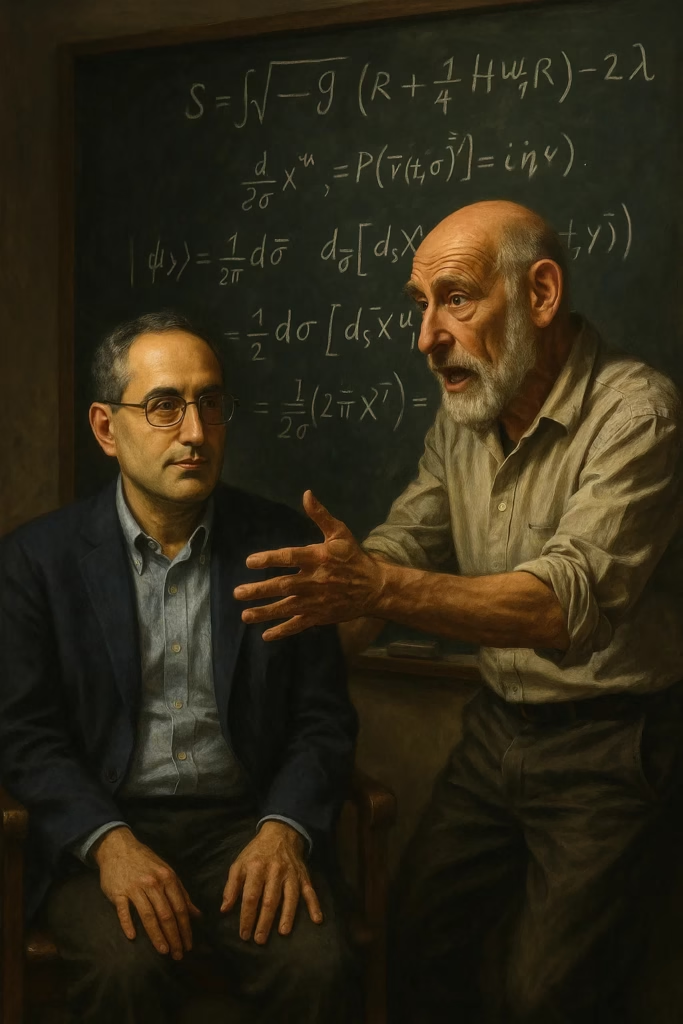
Their dialogue represents the essential drama of modern physics: Is reality, in the end, just elegant mathematics, or is mathematics merely the most precise language we have to describe an inelegant, complex reality?
String theory, in the end, is more than a theory. It is a cultural and intellectual phenomenon that teaches us about the limits of our knowledge, the power of our imagination, and the persistent human striving for ultimate understanding.
Leave a Reply