
Introduction: A Little Friend Whose Feathers Carried the Sky 🌌
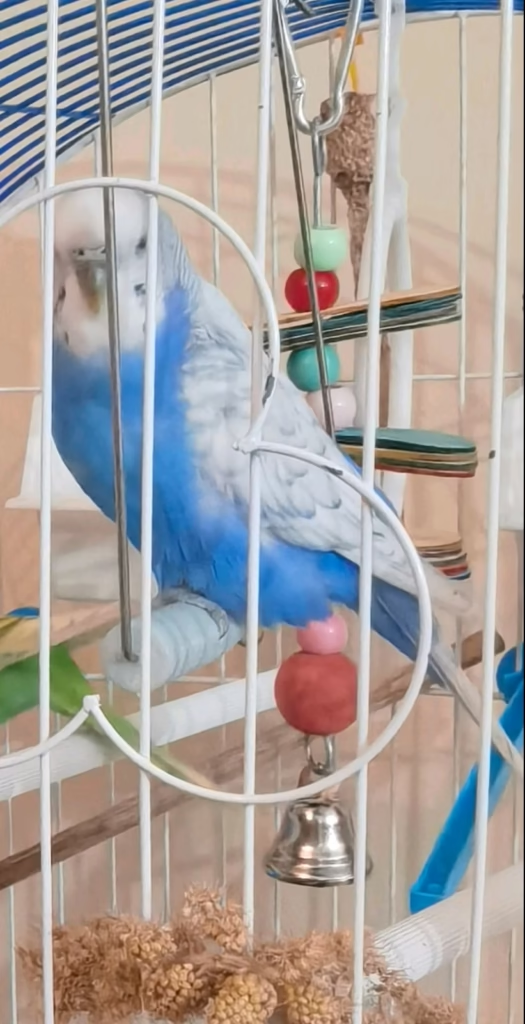
Tonight, my cage is too quiet. In the spot where my little budgie Mici would usually chirp to greet the evening, there is now only emptiness. He passed away on November 28th, leaving behind not just silence, but questions much deeper than expected for such a tiny being weighing only 30 grams. His companion Cici has been searching for him around the cage for several days now – behavior that is not just habit, but a ritual of mourning.
Budgerigars (Melopsittacus undulatus) are beings whose dreams, emotional lives, and cognitive abilities astonish even the most cynical researchers. And while Cici slowly fills the void in her life left by Mici’s absence, let’s explore the world he shared with us – a world that forces us to reconsider what it truly means to be conscious, emotional, intelligent.
How Dreams Budgie? Science Reveals Incredible Similarities 🧠💤
A study from November 2020 conducted by Sofia V. Canavan and Daniel Margoliash brought a revolution in understanding bird sleep. They proved that adult budgerigars spend a staggering 26.5% of their sleep in the REM phase – proportionally almost the same as humans. This is far more than earlier estimates (2-7%) and indicates deep neurophysiological similarity.
What does this actually mean?
- REM phase in humans is associated with dreaming, memory consolidation, and emotional processing.
- Similar pattern in budgies: The slow-wave sleep (SWS) phase decreases during the night, while REM increases – identical to human patterns.
- Light sensitivity: Just like us, lighting significantly affects their sleep cycles.
When I observed Mici and Cici at night, I noticed twitches, quiet “chirping in sleep,” and occasional bouts of restlessness that looked like nightmares. Cici would sometimes wake up frightened, seeking comfort. Were these remnants of daytime experiences? Were they dreaming of flying through the room, or perhaps fleeing from threats? Science cannot yet answer what exactly they dream, but we now reliably know that they dream.
A 1.32 Gram Brain: Intelligence That Surprises 🧠⚡
The average brain mass of a budgerigar is just 1.32 grams. Yet, within that tiny space, cognitive activity comparable to that of a 2-3 year old human child takes place. What does this entail?
- Social intelligence: Budgies live in complex social structures, recognize individuals, form strong pair bonds, and show empathy.
- Problem-solving: In laboratory conditions, budgies can solve complex tasks requiring sequential thinking.
- Communication: Their calls are not just instinctive – they are learned, modified, and adapted to context.
Personally, I noticed how Mici had his own rituals: calls for food, for play, for attention when Cici was sad. It wasn’t just noise – it was intentional communication.
Auditory Cortex: A Tiny Keyboard in the Head 🎹🧠
Perhaps the most fascinating discovery concerns how budgies process sound. Studies have shown that individual neurons in their auditory cortex activate to specific components of chirps – as if each neuron represents one key on a keyboard. Complex vocal patterns are built from these basic “notes,” which is strikingly similar to human speech and song production.
Imagine: when you utter a word, specific neurons in your brain activate for each phoneme. Mici did exactly the same when composing his chirps. This is not mere mimicry – it is complex neurology underlying creative communication.
Emotions: Not Just Instinct, But Deep Feeling 💔😢
Mici’s loss didn’t only affect me. Cici showed clear signs of grief:
- Searching for her lost companion
- Reduced activity and appetite
- Change in vocalization – quieter, “sadder” calls
This is not anthropomorphism. This is observed behavior that aligns with what ethologists call a “reaction to loss” in animals with high social intelligence. Budgies don’t just feel – they experience and process emotions at a level that transcends basic survival instinct.
Why Are Budgies More Than Just “Pretty Little Birds”? 🐦🌟
If you asked the average person what they know about budgerigars, you’d likely hear: “pretty little birds, inexpensive, easy to keep.” But after living with Mici and Cici, and after deeply immersing myself in the science that studies them, I see something entirely different:
Budgies are beings with:
- Complex inner lives that include dreaming
- Emotional intelligence enabling empathy and grief
- Cognitive abilities surpassing many “smarter” mammals
- Neurological sophistication in communication
Little Mici wasn’t just a pet. He was an individual – with his own habits, preferences, fears, and joys. He was proof that consciousness and intelligence aren’t measured by brain size, but by the complexity of connections and capacity for relationship.
Conclusion: Lessons from a Little Beak 📚💭
As Cici slowly fills the void in her life, I remain with a mixture of grief and gratitude. Grief for the loss, gratitude for having had the opportunity to share life with such an exceptional being.
Mici taught me that:
- Intelligence has many forms – sometimes hidden in 1.32 grams of brain
- Emotions are universal – we recognize them because we share them
- Dreams may not be just human – perhaps budgies too fly through their nightly worlds
In the end, perhaps the most important lesson is this: Let us not overestimate human uniqueness, nor underestimate animal complexity. In the chirp of a budgie, in its sleep, in its grief for a lost companion – there lies an entire universe of experience waiting to be understood.
For Mici, whose chirp has forever fallen silent, but whose presence remains forever etched in the memory of those who loved him.
Leave a Reply