
What happens in the crypt below sea level where a clear fluid flows, and relics remain untouched for 17 centuries? 🔍🕊️
A Fact That Baffles Science: “Manna di San Nicola” ⚗️
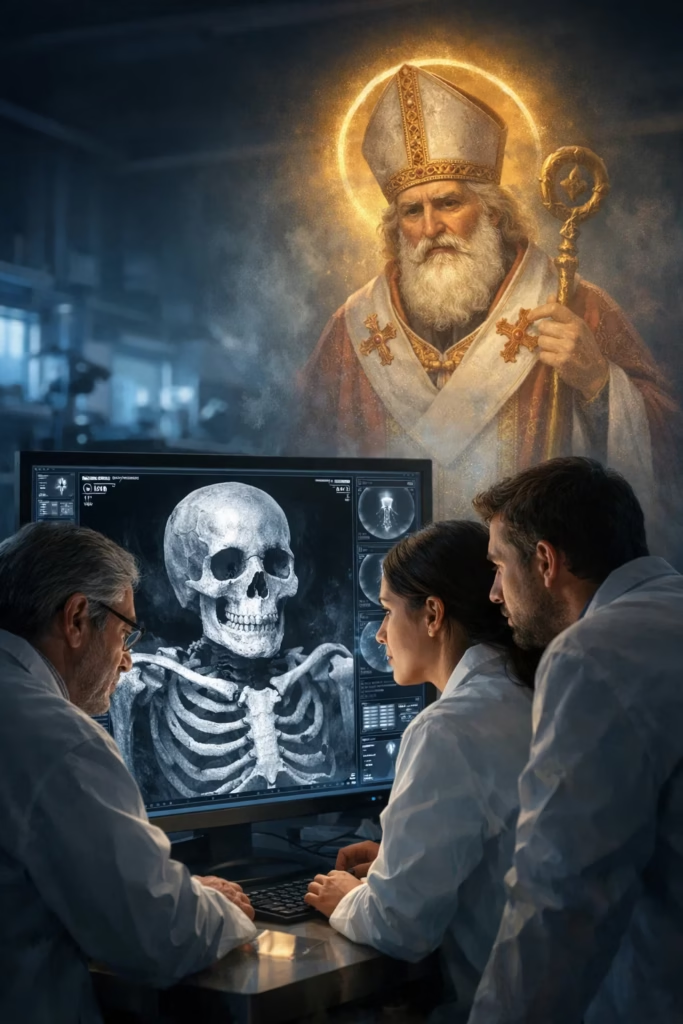
In 1953, 1600 years after the death of Saint Nicholas, a scientific examination of his relics was conducted in Bari. The bones were dry.
However, decades later, something changed. The crypt below sea level – a place where organic remains should have decomposed in less than a century – once again filled with a clear fluid.
Italians call it “Manna di San Nicola”. Chemical analyses show: it is essentially pure, distilled water. A sterile environment. No signs of decay.
According to all natural laws, bones in a damp underground space should have turned to dust more than 16 centuries ago. But here, the opposite occurs: the bones remain preserved, dense, white, and “radiate” moisture. The laws of chemistry seem suspended in this case.
Scientists can observe, but cannot explain why the natural laws of decay do not apply here. 🏛️➡️❓
The Real Man Behind the Legend: Traces of Suffering and Perseverance ✝️
These are not the bones of a mythical figure, but the mortal remains of a historical person, a witness of his time. The examination revealed:
- A broken nose – likely from a Roman jailer’s blow to the face.
- Damage to joints and vertebrae – a consequence of long imprisonment in Diocletian’s dungeons.
- Traces of deformities and arthritis – resulting from prolonged stays in damp and cold places, both during persecution and later in church service.
Saint Nicholas is not the Santa Claus of children’s fairy tales. He is a real archbishop who endured torture, imprisonment, and asceticism without renouncing his faith.
Victory Over Power: Where is Diocletian Now? ⚔️➡️🏛️➡️🧩
Let us recall the context:
The Roman Empire was all-powerful. It had legions, laws, courts, wealth.
Emperor Diocletian considered himself a god. He could crush anyone who opposed him.
But where is Diocletian now?
His palaces are in ruins. His empire has collapsed. The names of his prefects are forgotten.
Yet the name of Saint Nicholas is known to billions of people across the planet.
His tormented bones – 1700 years later – do not decay, but “give water”.
What Does This Tell Us Today? 🌊✨
This mystery is not only for the faithful. It is a parable about permanence:
- The force that breaks bones and closes churches is transient.
- What seems weak and vulnerable (faith, love, justice) – survives the centuries.
Saint Nicholas’ victory is not in golden domes.
It lies in the loyalty that neither dungeon nor blow to the face could break.
It lies in the fact that, after 17 centuries, science still asks: “How?”
And the crypt quietly, ceaselessly, answers with a clear fluid.
Is this a miracle? Science or spirit? Or something else?
The relics of Saint Nicholas stand as a bridge between historical fact and spiritual mystery.
They tell us: He who defied an empire is still here.
And as the “Manna di San Nicola” flows, so does the hope that truth and goodness have the final word – even when all logic says they should not.
Share your perspective: Is the inexplicable preservation of the relics a challenge to science, a confirmation of faith, or both?
👇 Discuss in the comments – with respect for differing beliefs.
Leave a Reply