
Why do we remember the genius who died on Christmas, and how do his visions of free energy and communication echo the message of peace from Bethlehem? ⚡🌟
Christmas is more than a holiday – it is an archetypal moment of hope. A moment when, under the humblest circumstances, a light is born that promises the transformation of the world. In the Orthodox calendar, January 7 carries another, bittersweet dimension: on this day in 1943, in room 3327 of the New Yorker Hotel, Nikola Tesla died.
It is no coincidence that the death of the man who wanted to illuminate the planet coincides with the day we celebrate the birth of the Light of the World.
Tesla’s Christmas: A Pigeon, Solitude, and a Vision of a Wireless World
Tesla spent his last Christmas in complete solitude, feeding pigeons on his windowsill. One white pigeon he considered a personality, a spiritual companion. In it, he saw more than a bird – he saw a symbol of pure, wireless communication and inexhaustible energy.
His life was a story of bitter twists:
- The man who invented alternating current – the foundation of modern civilization – died poor and forgotten.
- The genius who dreamed of free, global energy (the Wardenclyffe Tower) and free communication decades before mobile phones, ended his life in the shadow of more powerful and practical interests.
- The visionary who believed technology would unite humanity lived through two world wars.
The “Dead Machine” and Soul-less Technology: Is Tesla’s Warning Authentic?
Tesla literature often cites his alleged fear of creating a “dead machine” – technically perfect, but without a soul or higher purpose. While a direct quote may be hard to verify from primary sources, the theme is profoundly Tesla-esque. Throughout his life, he emphasized the moral responsibility of science and warned that technology without a human purpose could become dangerous.
Could this be today’s algorithmic intelligence performing tasks without understanding? A drone carrying a lethal payload instead of medicine?
Tesla was not a techno-pessimist – he was a techno-moralist. He believed a machine must have a soul, a purpose, a human goal.
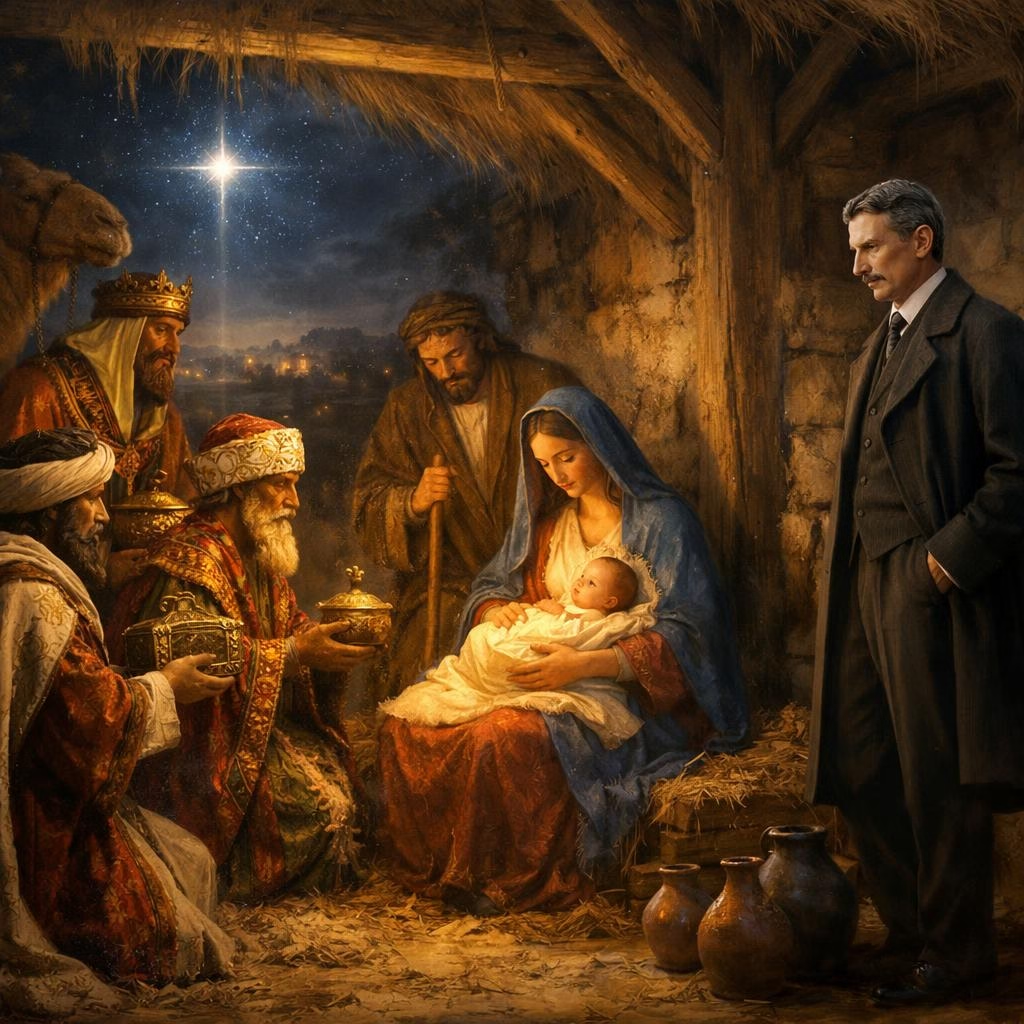
Tesla’s Tower and the Star of Bethlehem: Two Lights, One Message
Consider for a moment the parallel:
- The Star of Bethlehem – a celestial sign guiding the Magi from the East to the child, a symbol of guiding light, hope, and revelation.
- Tesla’s Wardenclyffe Tower – an earthly tower meant to freely distribute electrical energy and information across the planet, a symbol of shared light, unity, and progress.
Both were visible signs of something revolutionary. Both evoked hope and distrust. And both reminded us that true light comes to serve, not to rule.
Christmas 2026: Between Tesla’s Dreams and Our Reality
Today we live in a world whose present reality has betrayed Tesla’s visions:
- We have wireless communication, but it is full of noise, disinformation, and division.
- We have a global network, but it lacks true community.
- We possess unseen technological power, yet we ask: does this power serve humanity or replace it?
This is precisely why the Christmas story and Tesla’s story are important to us. They remind us that true light is born in humility, not in palaces. They remind us that the true gift is one that is shared – just as Tesla wanted to share energy, and Christmas offers hope for all. They remind us that the future is not predetermined – we shape it by choosing between technology with a soul and “dead machines.”
Conclusion: Christ is Born, and Tesla’s Ideas Await Fulfillment
Tesla did not just die on Christmas. He died with a vision of a world not yet realized. But his ideas are not dead – they live on in every wireless connection, in every striving for clean energy. The problem is not a lack of vision; the problem is that the world is still ruled by the interests of the powerful, not by the idea of community and sharing.
Perhaps the message for us today lies precisely in this unfulfilled connection:
That technology without spirit, without a moral compass, without love – becomes merely a sophisticated tool.
And faith without deeds, without the striving to improve human life – remains an empty ritual.
Merry Christmas.
May the light from Bethlehem and the light from Tesla’s mind remind you: we are the ones who choose whether machines will come alive with love, or whether humans will become their maintenance crew.
Food for thought: Was Tesla the last great romantic of technology or the first critic of its soulless development? Today, in the age of AI, would he still want to share energy freely – or would he warn us of the danger of “dead machines”?
Leave a Reply