
🌊 Navier-Stokes Equations: The “Holy Grail” of Fluid Mechanics
The Navier-Stokes (NS) equations represent a set of empirically derived equations based on Newton’s laws and the assumption of fluid continuity. Their status is paradoxical:
- They work incredibly well for a wide range of practical problems – from aerodynamics and hydrodynamics to weather forecasting.
- But: There is no general proof of the existence and smoothness of solutions in 3D for arbitrary initial conditions – which is precisely one of the Clay Millennium Problems.
In other words, no one knows if these equations always have a solution. This is not a philosophical question – it is a question of numerical stability, computational power, and the fundamental understanding of nature. It is particularly noticeable in the case of turbulence, which represents one of the most complex phenomena in nature.
🧠 Terence Tao: The Mathematician Playing with “Energy Cascades”
Terence Tao is not a physicist, but a theoretical mathematician with a broad spectrum – a recipient of the Fields Medal (equivalent to the Nobel Prize in Mathematics). His approach is fundamentally theoretical.
Key contribution: Instead of trying to solve the general problem, Tao analyzes simplified models that retain the essential nonlinearity of the NS equations. He studies how energy can “leak” from large scales into smaller and smaller ones, which is the very essence of turbulence.
💡 In 2016, Tao published a paper showing that a certain simplified version of the 3D NS equations can explode in finite time (i.e., develop infinite values). This does not solve the Millennium Problem, but it shows the way – if it can be proven that this simplification reflects the behavior of the full NS equations, the problem would be solved with a negative answer.
💻 Why is This Relevant to IT/Computer Science?
🔥 Numerical Instability
If NS equations can develop singularities (infinite values), then our numerical simulations (CFD) are constantly on the brink of collapse. Engineers use “hacks” – turbulence modeling, adjusting numerical diffusion – to maintain stability.
🖥️ Computational Resource Consumption
For Direct Numerical Simulation (DNS), exaflops of computing power are needed for real-world problems. Understanding the fundamentals could lead to revolutionary algorithms that bypass these difficulties and enable more optimized models.
🤖 Artificial Intelligence
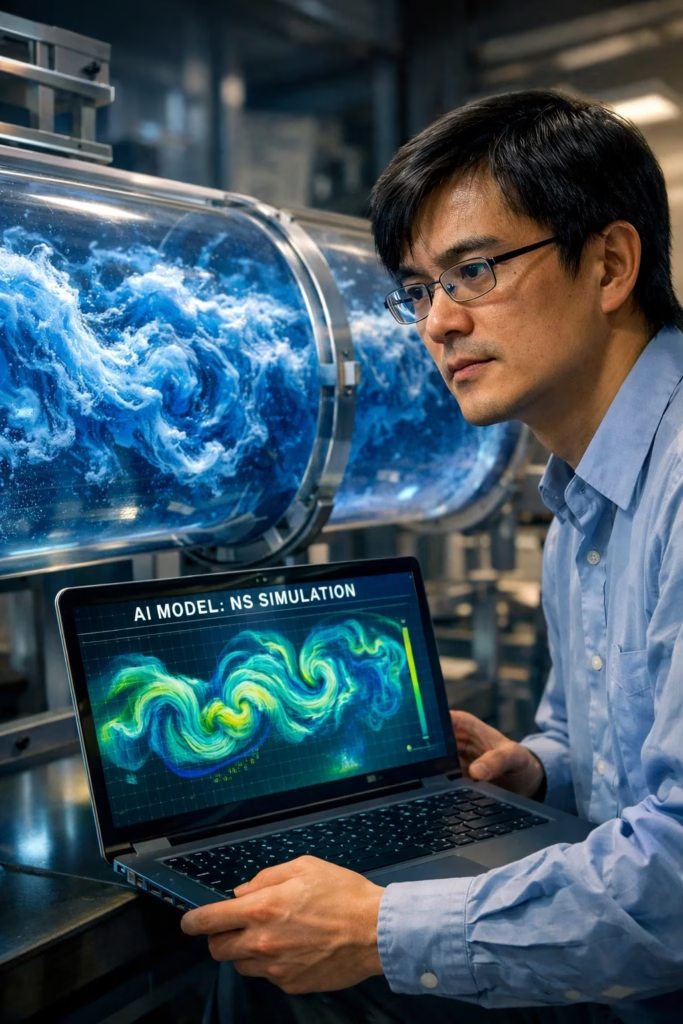
Today, Machine Learning (ML) is used to model turbulence closure. But to train reliable models, we need to know exactly what we are trying to approximate. Tao’s analysis helps define the mathematical constraints within which AI must operate.
🌀 Parallels with Chaos Theory and Quantum Computing
📈 Sensitive Dependence on Initial Conditions
The butterfly effect in turbulence is even stronger than in classical chaos – it occurs in an infinite-dimensional phase space, making prediction extremely sensitive to small changes.
⚛️ Quantum Computing
Some theorists are considering whether NS equations can be solved more efficiently on quantum computers using quantum analogs of Monte Carlo methods. But to do that, we need to know which properties of the equations are key for quantum implementation.
🔮 What if the Problem is Solved?
✅ Positive Solution (Proof of Existence and Smoothness)
It would unleash a huge amount of theoretical research. CFD would become more predictive with fewer assumptions, revolutionizing the design of aircraft, cars, and climate models.
❌ Negative Solution (Proof of Singularities)
This would be an earthquake in physics – it would mean that the NS equations are not a complete description of fluids. We would have to seek a deeper theory – perhaps one where quantum effects are considered even at the macro level. It would open the door to completely new models.
🎯 Conclusion
Fluid mechanics still moves through a dynamic balance between empirical laws and fundamental principles. The NS equations remain an irreplaceable pillar, but awareness of their limitations in turbulent regimes and the micro-world is growing.
New insights come from the synthesis of mathematics, computing, and experiments, with a strong influence from nonlinear dynamics and statistical physics. Great minds of today – like Terence Tao – rely not only on their intellect and intuition but also on powerful computers and AI models.
The Navier-Stokes problem is not just a mathematical curiosity. It is a metaphor for the limits of our prediction in everything – from weather phenomena to markets and information flow in networks. Solving this Millennium Problem will have a strong impact on our further scientific and technological development.
✨ Is fluid dynamics the greatest challenge of classical physics? Perhaps – but it is precisely such challenges that drive the greatest innovations.
Leave a Reply