
Why do Serbs celebrate New Year twice, how did spring become a symbol of resurrection, and what did the ancient Yarilo, and the Byzantine era say about us? 🌾📅🌌
Every civilization is born from the earth and the sky. The first step toward becoming a civilization was not a city, a tool, or writing – it was the calendar.
When the first farmers realized that the Sun returns, that the Moon changes, and that life could be predicted – they stopped living in an eternal now. They discovered the concept of time.
Celestial Rhythm and Earthly Labor: Why Orion and Sirius Were More Important Than Kings
Before physics existed, there were important questions. When to sow? When will the river flood? When to go to war?
Ancient peoples did not “invent” calendars – they read them from the sky.
- Ancient Egypt: The flooding of the Nile coincided with the heliacal rising of Sirius – “Sothis” was their celestial hydrometer.
- Stonehenge: The huge megaliths were a solar and lunar computer, marking solstices and equinoxes.
- Maya Civilization: Developed the haab (a 365-day solar calendar) and the tzolkin (a sacred 260-day calendar), combining them into a Calendar Round that lasted 52 years.
The calendar was not a tool. It was a sacred covenant between humanity and the cosmos.
Yarilo, Vesna, and the Slavic Year: When New Year Was the Awakening of Nature
For the ancient Slavs – and for the ancestors of the Serbs – the new year was not in January. It was in spring, most often around the March equinox or early April.
Why? Because they lived within the cycle of nature:
- Yarilo (god of spring, fertility, youth) symbolized the rebirth of the world.
- Vesna (goddess of spring) brought warmth and life.
- The New Year was a celebration of surviving winter and the start of a new sowing cycle.
This was not just tradition – it was deep ecological wisdom. Humans celebrated as an integral part of nature, not as its master.
Serbian New Year (Jan 1/14): Where Memory, Faith, and Resistance Intersect
Today, many Serbs celebrate two New Years:
- January 1 (Gregorian calendar) – a global, secular holiday.
- January 14 (“Serbian New Year” by the Julian calendar) – a day that is much more than a date.
What does this day carry?
- The Orthodox Julian calendar still used by the Serbian Orthodox Church today.
- Memory of a medieval empire – in the time of Saint Sava, this was the official calendar.
- Resistance to assimilation – maintaining one’s own rhythm during times of foreign rule.
- Cultural continuity – a link to Byzantium, but also to an ancient understanding of time.
By this calendar, it is now the year 7535 since the creation of the world (according to the Byzantine, or Alexandrian, era). Some authors even connect this number to the Vinča culture and its system of notation, claiming it is an even older, autochthonous heritage.
The Theology of Numbers: Why September Was the Start of the Year in Byzantium
In the Byzantine Empire, the new year (Indiction) began on September 1.
The reasons were multi-layered:
- Agricultural: September is harvest time, the end of one cycle and the beginning of another.
- Theological: According to Byzantine calculation, the world was created in September – hence the era “from the creation of the world”.
- Practical: It was a time for tax, administrative, and military cycles.
This practice was transferred to the Russian Empire, where it lasted until Peter the Great (1700).
The Calendar as a Map of Identity: What Does a Year Preserve?
Every calendar is more than a system for measuring days. It is:
- ✅ A cosmological map – showing how a people see the relationship between Earth and sky.
- ✅ An agricultural manual – a schedule for sowing and reaping.
- ✅ A religious timetable – determining holidays, fasts, and feast days.
- ✅ A political manifesto – the choice of a calendar was often a choice of side, faith, ideology.
- ✅ A psychological framework – defining what is a “beginning” and what is an “end”.
Conclusion: Does Time Flow, or Do We Swim Through It?
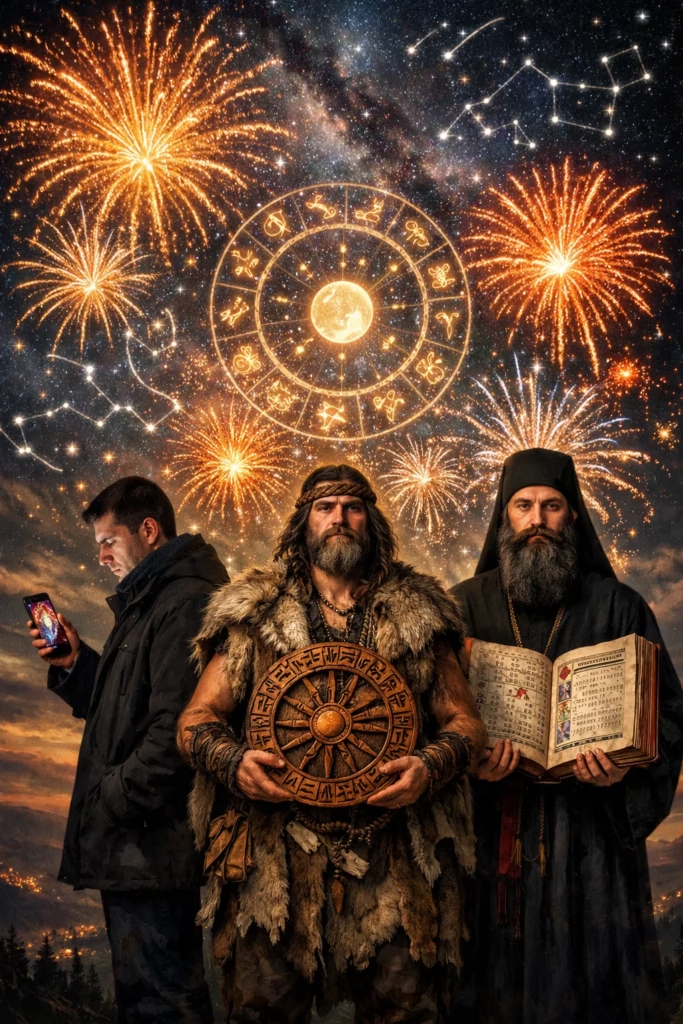
When we look at a calendar on the wall or in our phone today, we see a matrix of numbers, holidays, and reminders.
But historically, the calendar was a living, breathing reality – a text written by astronomers, priests, farmers, and rulers.
The Serbian New Year is not an anachronism.
It is a living imprint of our collective memory – a reminder that we once measured time by stars, the blossoming of cherry trees, and church bells, not just by clocks and servers on a global network.
Perhaps now, in the age of uniform, global time, it is important to ask:
Can we find our own rhythm in the chaos of the world? Can we be modern without forgetting how our ancestors read the years in the wheel of seasons and the movement of celestial bodies?
Question for you: Is preserving a tradition like “Serbian New Year” safeguarding cultural identity or closing oneself off in the past? Is a calendar a scientific instrument or a cultural symbol?
Leave a Reply