
Why is the most ordinary substance on Earth also the most extraordinary – and what can (and can’t) science explain about its “memory”? 💧🔬🌌
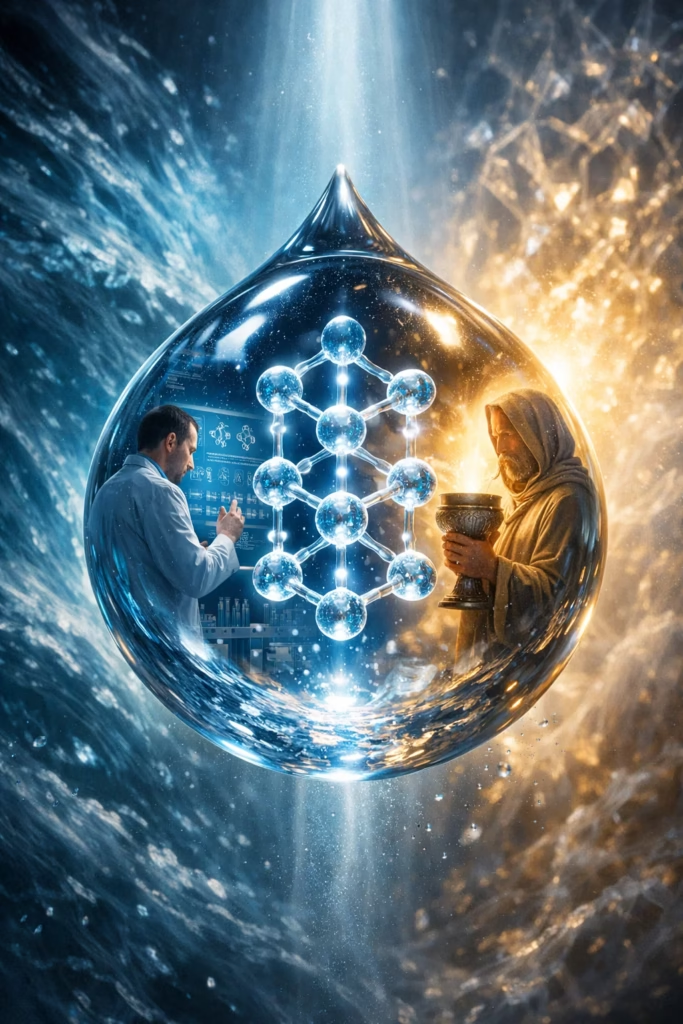
Without water, there is no life. That is a scientific axiom. But what if water is more than the chemical formula H₂O? What if it is not just a passive solvent or fluid, but a dynamic, structured system that carries information, perhaps even a “memory”?
On the day of Epiphany, when believers consecrate water believing it becomes a vessel of divine grace, this topic becomes especially vivid. But even without a religious context – water surprises us.
Scientific Facts: What We Know We Know 📚✅
Water is a unique substance with properties that make life possible:
- Anomalous expansion upon freezing – Ice is less dense than liquid water, allowing lakes to freeze from top to bottom, protecting life beneath. This is due to the tetrahedral arrangement of hydrogen bonds.
- Universal solvent – Thanks to the polarity of its molecules, water can dissolve ions and polar substances, making biochemical reactions within cells possible.
- Solubility of gases in water – Its ability to dissolve oxygen and carbon dioxide makes it a transport medium for respiration in aquatic organisms.
- High specific heat capacity – It heats and cools slowly, modelling the climate and maintaining stable body temperatures in living beings.
- Capillarity and surface tension – Thanks to cohesion, water climbs up plants and forms droplets, which is the basis of water circulation in nature and in living beings.
The water cycle is, in fact, the greatest energy machine on the planet: Solar energy drives evaporation, forms clouds, which travel and return water as rain – a perpetuum mobile that feeds the entire living world.
Mysteries on the Border: What We Know We Don’t Know ❓🌀
Here we enter an area where scientific fact, incomplete knowledge, and controversy mix:
1. “Structured” or “Coherent” Water – Does water have a “memory”? 💭
The hypothesis (whose most famous proponent was Jacques Benveniste, a respected immunologist whose work on allergies was foundational) claims that water can form long-lasting molecular patterns (clusters) under the influence of electromagnetic fields, substances, and even intention. According to this theory, water does not just “remember” chemical impurities, but also the informational “imprint” of substances that were in it – which would explain the mechanism of homeopathy.
Scientific status and controversy: Benveniste caused an uproar with his work on the “memory of water.” Instead of his claims being thoroughly and openly tested, most of the scientific community quickly and harshly rejected him, and he was practically “cancelled” from official scientific circles. A similar fate befell Nobel laureate Brian Josephson for his research on consciousness and transcendent phenomena. This kind of dogmatic, inquisitorial approach by the scientific establishment towards unorthodox ideas – no matter how radical they may be – represents a serious deviation from the very spirit of science, which should be open, skeptical, but not closed to new questions. The history of science is full of examples of geniuses who were ridiculed (like Ludwig Boltzmann regarding atomic theory), only to be confirmed later.
2. Properties of Consecrated Water – Epiphany and other feast days ✝️
Believers observe that water consecrated on the feast of Baptism does not spoil for years. There are also anecdotal reports of altered physical properties (e.g., increased refractive index of light).
Possible scientific explanations:
- Reduced microbiological activity – A silver cross or vessel (used in many Christian rituals) can have an oligodynamic effect (silver ions act antibacterial).
- Changes in temperature and gases – Water from cold springs or consecrated in a cold church has increased oxygen solubility, which can affect oxidation-reduction processes.
- Psychosomatic and symbolic effect – The belief that water is “holy” changes how it is stored and used (stored in clean bottles, without exposure to sunlight).
3. Healing properties of spa and mineral waters 🏞️💊
Waters from certain springs (Vrnjačka, Selters, Baden-Baden) show therapeutic effects that go beyond their basic chemical compositions (minerals).
What does science see here?
- Complex biophysical interactions – It’s not just calcium or magnesium; the ratio of ions, redox potential, presence of trace elements and colloidal particles is important.
- Gases and radon – Some waters contain natural radioactive radon in small doses, believed to stimulate cellular repair (hormesis effect).
- Structural properties at the nano-level – It is possible that a specific geological path through rocks gives the water a special structure or gas clusters that our body metabolizes differently.
Where Do the Boundaries Blur? Scientific Method vs. Open Questions ⚖️🔍
The scientific method requires measurability, repeatability, and falsifiability. Many claims about “intelligent water” cannot meet these criteria. But – that does not mean they are untrue. It means they have not yet been accepted into the scientific mainstream.
The key problem: How to measure “information” or “intention” in water? If water has a “memory”, where is the physical substrate of that information? Is it long-term hydrogen bonds, electromagnetic imprints, or quantum coherence?
Epiphany Water as a Symbol: What Does Water Teach Us About the Nature of Reality? 🌊✨
Perhaps the deepest message lies precisely in the duality of water: it is simpletely explainable and completely mysterious at the same time.
- For the scientist: Water is a system of 10²⁵ molecules per liter that obeys quantum chemistry and statistics.
- For the believer: Water is a material vessel of the spiritual, a means of divine grace.
- For the philosopher: Water is a metaphor for reality itself – it flows, changes, reflects, carries, but is never completely graspable.
Conclusion: Should We Believe in the Miracles of Water? 🤔➡️🚀
No, we should investigate them.
But the investigation must be open, not dogmatic. Not accepting “structured water” due to lack of evidence is scientific. But a priori rejection of all anomalies because they don’t fit current models, coupled with the scornful removal of researchers from the community, is scientific closed-mindedness and a betrayal of the very spirit of inquiry.
Water reminds us that nature always has another secret up its sleeve. Whether it’s “memory,” a spiritual imprint, or just another misunderstood physical phenomenon – remains to be seen. Science that fears this question is not science, but dogma.
Perhaps that is the lesson: To understand water, we must be willing to change not only our instruments, but also our minds – and the structure of our scientific community.
Question for you: Does water remain just H₂O for you, or is there room for mystery? Is Epiphany water a scientific anomaly, a religious symbol, or both? And what do you think about the fate of scientists like Benveniste and Josephson – are they victims of scientific heresy or cases of justified skepticism?
Leave a Reply