
When we think about the origins of life, our imagination often paints a linear story: simple cells, a slow rise toward complexity, billions of years of waiting, and then—an explosion. But nature, as always, loves to play outside our intuitive concepts.
In recent months, three independent discoveries—two from 2025 and one new interpretation of an old fossil—have sent shockwaves through paleontology. Together, they don’t just supplement the history of evolution; they rewrite it from the ground up. From intriguing events in the “Boring Billion,” through mysterious giants that ruled the land before trees, to a fossil that witnessed an epoch for over a billion years—it’s time to meet the real, complex story of the beginnings.
🌍 The “Boring Billion” Wasn’t Boring: A Breath from an Ancient Atmosphere
The Proterozoic Era, the period from 1.8 to 0.8 billion years ago, carries a perplexing nickname: the “Boring Billion.” It was believed to be a time of evolutionary stagnation, low oxygen levels, and waiting for life to find new complex patterns.
The first discovery comes from Canada. By analyzing ancient air bubbles trapped in salt crystals dated to 1.4 billion years ago, scientists arrived at a shocking figure: the atmospheric oxygen level at that time was 3.7% of modern levels (0.037 PAL).
This is dramatically higher than previous estimates. Although it seems low to us today, it was entirely sufficient to support complex, multicellular life. This raises a key question: if there was enough oxygen, why did animals wait another 800 million years to appear?
The answer lies in dynamics. This wasn’t a stable state, but an episodic oxygenation event, likely triggered by the rapid proliferation of red algae. These early eukaryotic photosynthetic organisms, like tiny factories, pumped oxygen into the atmosphere, creating short but powerful “pulses” of life amidst a billion-year-long, stable slumber.
This finding also solves a climatic paradox of that era: the Sun was fainter then, yet Earth was not a frozen wasteland. The reason? Carbon dioxide levels were ten times higher than today, creating a greenhouse effect that kept the planet warm and habitable.
Conclusion: The “Boring Billion” wasn’t dead. It was stable, but not static. It was a stage where life and planetary chemistry played a long-term game, waiting for the right moment for the next act.
🌱 Grypania: A Witness to Stabilocracy
In that same era, there was a fossil that witnessed it all. Grypania—an organism resembling a spiral ribbon, found in rocks as old as 2.1 billion years, but present all the way until the end of the Ediacaran (about 550 million years ago). Over one and a half billion years of existence!
For a long time, a debate raged: was Grypania a giant bacterium, a colony, or an alga? The latest research, including chemical analyses (elevated levels of zinc, crucial for eukaryotic metabolism), firmly places it among the photosynthetic eukaryotes – algae.
Grypania was not an evolutionary dead end. It was proof of “stabilocracy.” In a world without true predators and dramatic changes, this simple alga found a formula that worked—and stuck with it for billions of years. Its presence tells us that eukaryotes were capable of macroscopic life long ago. They were simply waiting for the right moment and the right pressure to explode in diversity.
🍄 Prototaxites: The Giant That Still Defies Classification
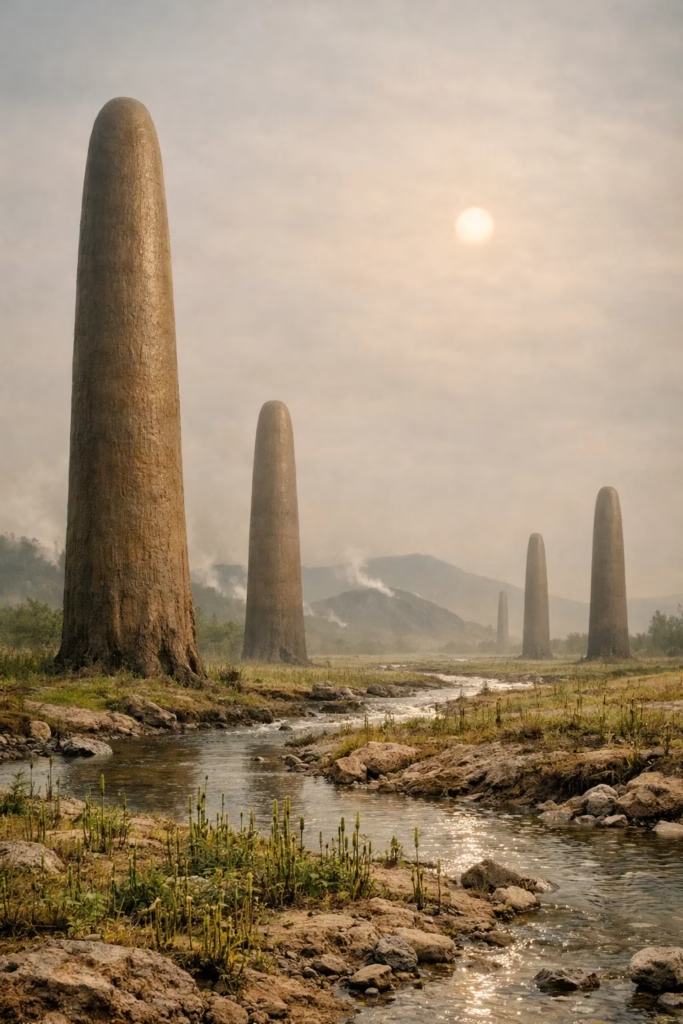
And now, we move to land. The Devonian, about 410 million years ago. A world of low, primitive vascular plants like the famous Rhynie. Amidst this low vegetation, monsters rose.
Prototaxites. These fossil beings resembled smooth, strange, branchless trunks, reaching up to 9 meters in height. They were Earth’s first land giants. But what were they really? A giant fungus? This debate lasted from the 19th century.
At the end of 2025, a study emerged that changes our view of these ancient beings. By analyzing exceptionally preserved fossils from the famous Rhynie Chert locality (Scotland), scientists compared Prototaxites with genuine fossil fungi found in the same layer.
The results are unambiguous:
- No chitin. The hallmark of fungi, the polymer chitin, is simply absent. Its chemical traces were not found.
- Tubular structures. Prototaxites is built from complex tubes that divide and rejoin in a way not characteristic of fungi, resembling a system for gas and nutrient exchange—a primitive but functional vascular system.
- The energy problem. For a fungus (a saprophytic organism) to reach 9 meters, it would need a colossal amount of organic matter to decompose. The plant mass required to feed such massive saprophytic organisms simply did not exist in the early Devonian.
Prototaxites is not a fungus.
So, what is it? Researchers are cautious, but clear: it represents a completely extinct, uncharacterized lineage of eukaryotes (“extinct eukaryotic lineage”). It was a multicellular experiment of evolution that left no living descendants. How did it feed? Most likely through photosynthesis, either directly (difficult to imagine for a 9-meter column) or, far more probably, through symbiosis with algae—like a giant, upright lichen.
Prototaxites tells us that evolution on land had at least two major experiments: one was led by the ancestors of our plants (Rhynie and its relatives), and the other, completely independent and equally successful, was led by these mysterious giants. They were not a “mistake” or a “dead end.” They were a dominant lineage for millions of years, until true vascular, seed-bearing plants outcompeted them in the struggle for light.
🔬 A New Narrative: Life Never Waited
Together, these three discoveries paint a new, exciting picture of the past:
- Eukaryotes didn’t wait. They became macroscopic 2 billion years ago (Grypania).
- Oxygen didn’t wait. It appeared in powerful pulses billions of years before animals capitalized on the advantage.
- The land didn’t wait for trees. Before true forests, it was ruled by giant, now-extinct eukaryotes (Prototaxites).
The old narrative of “waiting” has been replaced by a narrative of continuous experimentation. Life has always been pushing boundaries, creating strange forms, conquering new spaces. Most of these experiments went extinct, but not because they were unsuccessful—but because new, more adaptable forms took their place.
We, the complex life forms of today, are not the crown of a long, slow ascent. We are just one, still ongoing, experiment in a series. The one that has, so far, managed to outlive the Grypanias, the Prototaxites, and many others.
At MilovanInnovation, we follow the latest breakthroughs in science and technology, because understanding the past is the key to the innovations of the future. This story shows us that true innovation isn’t just in the human mind—it’s in the very DNA of life, which has been tirelessly seeking new paths for billions of years.
What do you think? Does this new picture of the past also change our view of the future? Leave a comment or join the discussion!
Leave a Reply