
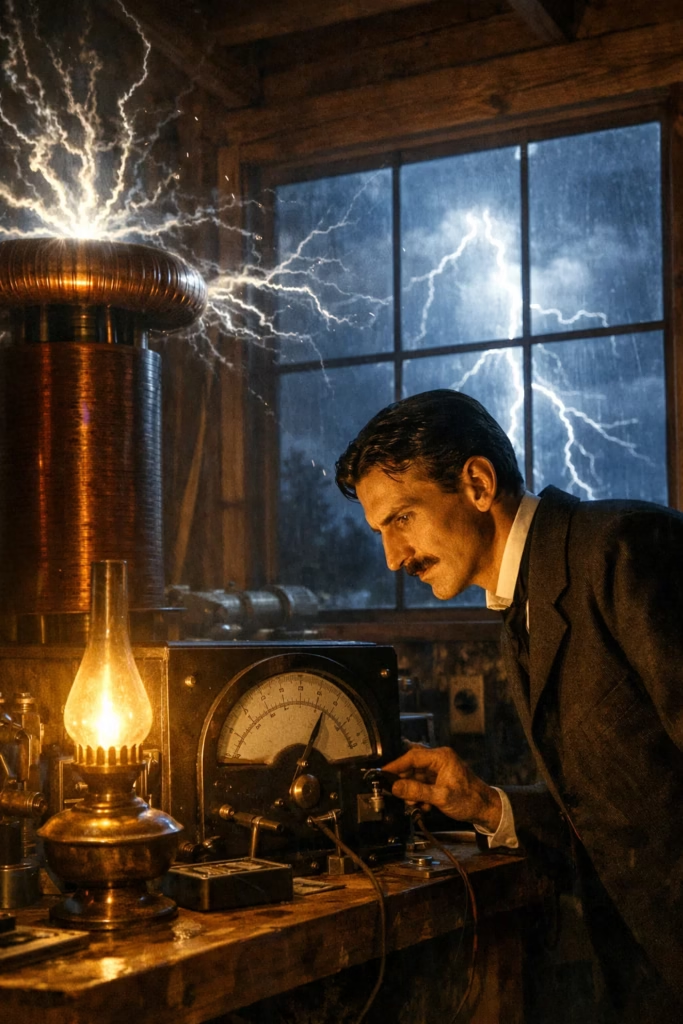
Nikola Tesla in Colorado Springs, 1899. His goal: a global system for the wireless transmission of energy. His starting point: Maxwell’s equations and Hertzian (transverse) waves. The problem: they attenuate with the square of the distance. Tesla knew that path wouldn’t lead to his dream. Then came the night of July 3rd.
🌩 The Night That Changed Everything
That evening, Tesla noticed his receiver was “excited” in a specific way during a thunderstorm. He concluded it was due to standing waves in the Earth’s crust and atmosphere. He estimated the frequency of the fundamental mode at around 8 Hz. The modern value for Schumann resonances? 7.83 Hz. Intuition in action.
Tesla thought: if the Earth could resonate with a high quality factor (Q) , energy transmission losses could be minimized. This led him to Long Island and the financial bankruptcy of Wardenclyffe.
Why did it fail? Modern measurements show that the Q factor of the Earth-ionosphere cavity for Schumann resonances is actually quite low (between 4 and 10). Energy dissipates quickly. As one expert noted in a discussion of Tesla’s work: “There appear to be no empirical evidences for any high-Q electrical resonance involving the earth or the earth-ionosphere cavity.” Tesla correctly observed the phenomenon, but he overestimated its practical efficiency.
💧 From Transverse to Longitudinal
Tesla didn’t give up. He turned to the idea of the ether and fluid mechanics. What if waves could be longitudinal, like sound waves? A pressure perturbation in the direction of propagation. In an ideal fluid, they wouldn’t attenuate by the inverse square law. That would be the Holy Grail of wireless transmission.
The problem: Maxwell’s equations in a vacuum do not allow propagating longitudinal solutions. Period. Or do they?
⚛ What Does QED Say? Higgs and Vacuum Energy
This is the key point. Classical electrodynamics is exclusive. But quantum field theory leaves room for concepts that Tesla intuitively felt.
- Spin-0 Photons: In the Standard Model, the photon is a spin-1 particle (transverse). However, in certain theoretical contexts (such as theories with extra dimensions or within some quantum gravity models), predictions arise for scalar particles similar to photons.
- The Higgs Field: This is a fundamental scalar field that permeates all of space and gives particles their mass. Its existence was experimentally confirmed at CERN. Nature does allow scalar fields.
- Vacuum Energy: The Casimir effect, the Lamb shift – experimentally confirmed phenomena that testify to the energy of space itself. This is the same energy Tesla might have been, perhaps unknowingly, referring to.
Therefore, theoretical physics has not closed the door. What Tesla called “longitudinal waves” or the “field of potential” could today be described as a macroscopic, coherent excitation of some fundamental (possibly scalar) field – a phenomenon not encompassed by the standard Maxwellian description.
🔬 The Limits of Experiment
Tesla worked with extreme voltages (millions of volts) and sharp pulses. In this regime, materials behave non-linearly. His “anomalies” – such as artificial ball lightning (plasmoids) – could be a consequence of these non-linearities, rather than a new fundamental field. Nevertheless, some researchers today are still attempting to replicate his experiments with two spheres, testing the hypothesis of “electro-scalar” waves. The results? So far, no irrefutable proof.
🎯 Conclusion: Where Does This Leave Tesla and Us?
Tesla’s work cannot be dismissed as mere pseudoscience, nor can it be accepted as a finished product. It stands at the boundary:
- Experimental Insight: Global resonances, work with extreme fields – visionary.
- Theoretical Interpretation: His insistence on the ether and rejection of relativity was a tactical error and isolated him from the scientific mainstream.
- Modern Echoes: Higgs, Casimir, vacuum energy – all suggest that “not everything has been said” about fields and energy in space.
Tesla was like a detector, sensitive to signals he couldn’t fully decipher. He sensed the existence of layers of reality that our current theory does not yet fully encompass. His genius was not in the mathematical formalization of those layers, but in engineering intuition. And it is precisely this intuition that deserves to be taken seriously. He ventured into an unexplored domain of physics before the detailed theoretical framework – which would arrive after his death with QED – was developed.
What do you think? Did Tesla see something we have yet to discover, or is this a fascinating but blind alley in the history of science?
Leave a Reply