
Introduction: Two Paths to the Same Truth 🛤️
There is something profoundly exciting when two completely different approaches — one based on geometric intuition, the other on the abstract mathematics of strings — begin to whisper the same message.
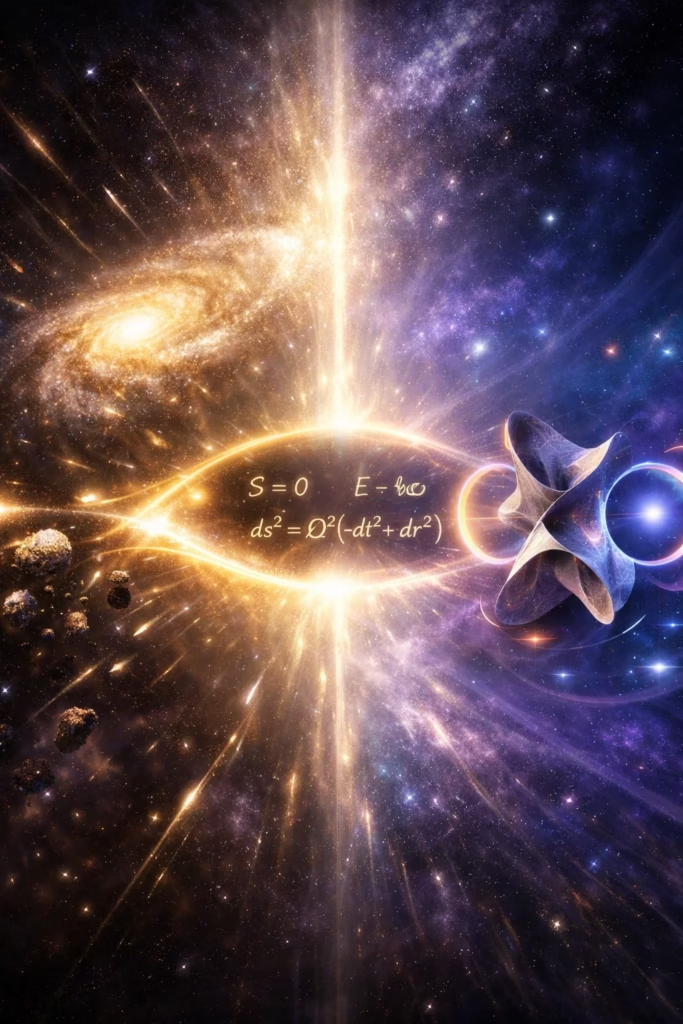
Penrose’s conformal cyclic cosmology (CCC) and the concept of T-duality from string theory, at first glance, have little in common. The former speaks of infinite eons of the universe, the latter of the symmetry between large and small dimensions.
But when you scratch beneath the surface, a fascinating correspondence emerges: both theories speak of the disappearance of space-time measures at the boundaries of existence.
Penrose’s Insight — When Only Photons Remain 📸
Let us recall the essence of the CCC model. At the end of each eon, all particles that have mass (electrons, protons…) disappear. Only photons and other massless particles remain.
What does this mean for space and time?
According to the special theory of relativity, for an object moving at the speed of light, time does not pass. Mathematically speaking, the proper time along a photon’s world line is always zero. Physicists often ask: “Do photons experience time?” The answer is that there is no inertial reference frame for a photon — we simply cannot speak about the flow of time from a photon’s perspective.
Penrose goes a step further. If at the end of an eon everything that exists are photons, then all of reality becomes a space in which time has no meaning. There is no “when,” no “before” and “after.” There is no meaningful measurement of distances either, because distance implies the time needed to traverse it. In a universe filled only with photons, space and time lose their usual significance.
This is an intuitively understandable physical picture: the infinitely large (the end of an eon) and the infinitely small (the beginning of a new eon) become indistinguishable because they lack the measure that would differentiate them.
T-Duality — When Large Becomes Small 🔄
String theory introduces the concept of T-duality, which sounds like science fiction but is mathematically precise.
Imagine space has one compact dimension in the shape of a circle, of radius R. In string theory, there are two ways a string can “feel” this dimension:
- Momentum modes: energy is inversely proportional to R
- Winding modes: energy is directly proportional to R
T-duality states that the theory with large R is completely equivalent to the theory with small 1/R, with the momentum modes and winding modes swapping roles.
Equivalence, not approximation. Two seemingly different geometries describe the same physics.
Even more fascinating, the physical length we measure is not simply R. For R much larger than 1 (in Planck units), the physical length is R. But for R much smaller than 1, the physical length is 1/R. In other words, when we try to squeeze a dimension below the Planck length, it “reflects” and behaves as if it were astronomically large.
This is a mathematically abstract idea that, however, leads to a staggering conclusion: space is not what we think it is. The boundary between “large” and “small” is not absolute — it depends on which approach we use to describe reality.
Meeting at the Boundary 🤝
Now we come to the point.
While string theory builds its approach on abstract mathematics, Roger Penrose holds fast to intuitive physics. In T-duality, absolute size is lost; in CCC cosmology, the very meaning of measuring time and space is lost.
Penrose tells us, from a purely geometric perspective: when there is no mass, there is no measure. The end of an eon, ruled only by photons, is a state in which space and time lose meaning. From a photon’s perspective, the entire history of the universe — from the Big Bang to the end of the eon — occurs in a single timeless instant.
T-duality tells us, from the perspective of string theory: when a dimension becomes smaller than the Planck length, it behaves as if it were astronomically large. Physical reality “skips” the singularity by changing the approach we use to describe it.
Isn’t this the same message?
Both theories point to the same conclusion: the boundaries of existence are not points where reality ends, but points where the way we describe it transforms.
Why Is This Important? 💭
Modern physics faces a problem: we have mathematically consistent theories that are logically flawless, but they lack intuitive acceptability as the first iteration toward understanding.
Penrose offers an image we can imagine: a universe at the end of an eon, filled only with light, where time stands still. This is a poetic, yet physically grounded vision.
T-duality offers a mathematical apparatus that confirms such boundaries are not singularities but transformations.
The link with reality must pass through two phases:
- Intuitive acceptability — the idea must be clear enough that we can tell it as a story
- Experimental confirmation — the idea must be precise enough that we can test it
Penrose is a master of the first phase. String theory, despite all criticism, offers tools for the second.
Conclusion: A Bridge Between Worlds 🌉
Perhaps the greatest contribution of Penrose’s cosmology lies precisely in providing us with an intuitive bridge to the abstract ideas of string theory. When we understand that a photon does not feel time, it becomes easier to imagine a world where all particles have vanished and only light remains — a world where large and small, beginning and end, overlap.
And when we connect that insight with T-duality, we get a picture of a universe that at its boundaries does not collapse, but transforms. Like a phoenix rising from its ashes, but this time — from light.
Because in the end, perhaps there is no end. Only a change of perspective.
Leave a Reply