
Introduction: The Question That Haunts Humanity 🤔
What is consciousness? Where does it come from? Can a machine ever possess it?
These questions are as old as philosophy itself. But Roger Penrose, one of the greatest physicists of our time, has brought a fresh perspective — grounded not in metaphysics, but in mathematics and physics.
His conclusion is radical: consciousness is not and cannot be an algorithm. No computer, no matter how powerful, will ever be conscious in the way that humans are.
Gödel’s Sharp Sword Against Artificial Intelligence ⚔️
Penrose builds his argument on Gödel’s incompleteness theorem — one of the deepest insights into mathematics of the 20th century.
Gödel proved in 1931 that in every sufficiently powerful formal system (such as arithmetic), there exists a true statement that cannot be proven within the system itself.
Here is where Penrose takes the crucial step: a human mathematician can grasp the truth of that statement. It is accessible to them — even though the formal system cannot generate it.
This means: the human mind has an insight that surpasses any algorithm. A machine, which by definition operates algorithmically, can never attain this capability.
Conclusion: Human consciousness possesses non-algorithmic properties. Computers, which are essentially algorithmic devices, cannot replicate it.
Orch OR: The Physical Mechanism of Consciousness 🔬
But Penrose does not stop at philosophy. Together with anesthesiologist Stuart Hameroff, he developed a concrete physical theory of consciousness: Orchestrated Objective Reduction (Orch OR).
The basic idea:
- Within brain neurons, there are microtubules — tiny structures that form the cell’s internal skeleton
- In these microtubules, states of quantum coherence appear and are maintained, conditions where particles exist in superposition
- When this coherence reaches a certain threshold, objective reduction of the wave function (OR) occurs
- The moment of collapse — according to Penrose — is the moment of conscious experience
This is not mere speculation. Penrose believes the OR process is non-algorithmic by nature, connected to the fundamental structure of spacetime at the level of quantum gravity.
Thus: consciousness is not a byproduct of sufficiently complex information processing. It is a fundamental physical process, embedded in the very fabric of reality.
The Turing Test: Why Passing Is Not Enough 🤖
Alan Turing proposed in 1950 his famous test: if a machine can communicate in such a way that a human cannot distinguish it from another human, then we may consider it intelligent.
Today, the most advanced AI models (ChatGPT, Gemini, DeepSeek) could probably pass the Turing test as originally conceived.
But are they conscious?
Penrose’s answer is a decisive NO.
Passing the Turing test shows only one thing: the machine skillfully imitates human behavior. It generates words that appear as if written by a human. But this does not mean there is an inner experience, a subjective feeling, what it is like to be that machine.
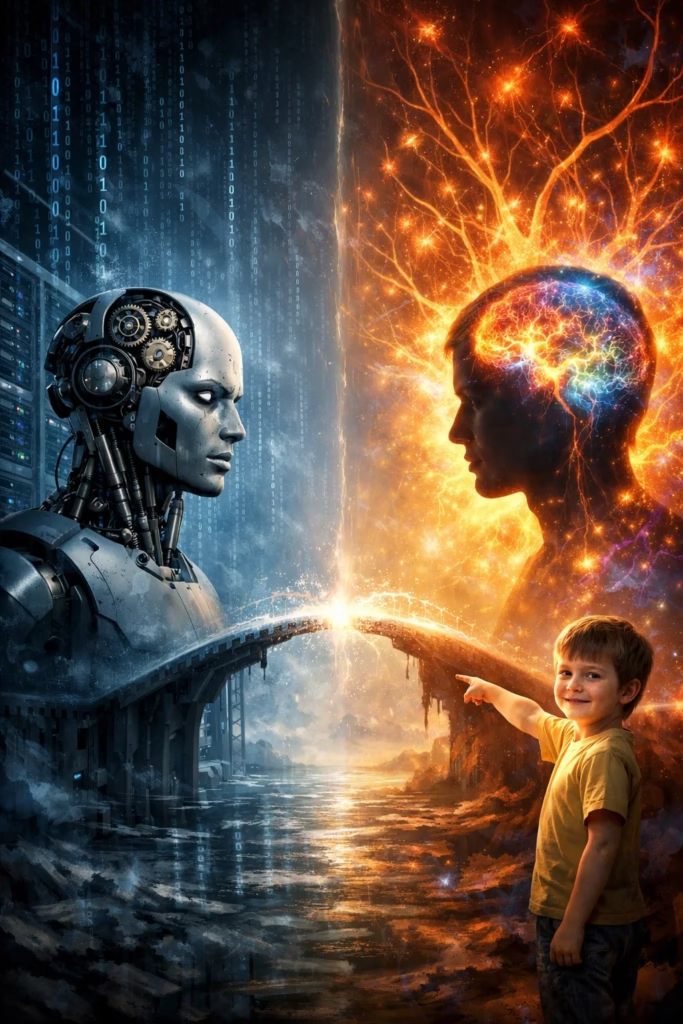
Penrose sharply criticizes what is called the “strong AI thesis” — the belief that a sufficiently complex algorithm can become conscious. This is, in his view, a modern dogma we accept without critical examination, like the adults in the tale of the emperor’s new clothes, who refuse to see that the emperor is naked, unlike the children unburdened by dogma and blind reverence for authority.
Why This Matters: Consciousness as a Bridge to Deeper Reality 🌉
Penrose’s position has far-reaching implications:
- Artificial intelligence will never be conscious — it can serve us, entertain us, help us, but it cannot become a subject
- Consciousness is not emergent — it does not arise simply when a system becomes sufficiently complex
- Physics must expand — to explain consciousness, we need new physics that goes beyond the standard quantum mechanical framework
Penrose reminds us that there is something in us that will never be replicated in silicon. That feeling when we grasp a mathematical truth, when we experience the beauty of art, when we are aware of ourselves — this is not an algorithm.
It is a window into a deeper layer of reality.
Criticisms and Controversies 🗣️
Of course, Orch OR theory has faced strong criticism.
The main objections:
- Decoherence — the brain is a warm, wet environment where quantum coherence is quickly lost
- Biological feasibility — microtubules do not show the properties needed for quantum computation
- Lack of experimental evidence — the theory is speculative and difficult to verify
Penrose and Hameroff respond to criticisms with newer research suggesting that quantum effects may persist in biological systems longer than previously thought, and point to the potential role of “fast vibrations” in microtubules.
But even critics acknowledge: Orch OR is one of the few serious quantum theories of consciousness that deserves attention, even if in its current form it is not sufficiently developed.
Conclusion: More Than an Algorithm 💫
Penrose teaches us something valuable.
In an age when AI amazes us with its capabilities, it is easy to think that consciousness is just another computational algorithm. That when we build a sufficiently complex program, it will simply “start up” and become conscious.
Penrose says: it will not.
Consciousness is not something an algorithm can attain, no matter how complex. It requires new physics, a deeper understanding of reality. It is a bridge to what we have yet to discover.
And as we prepare to step into an era of ever more powerful machines, it is good to have that reminder: we are something more than what can be computed.
Leave a Reply