
Introduction: A Dangerous Word – “Flat” ⚠️
When we say the universe is flat, many people’s first association will be – the flat Earth. An illusion as old as humanity itself, which the ancient Greeks already disproved by observing Earth’s round shadow on the Moon during eclipses.
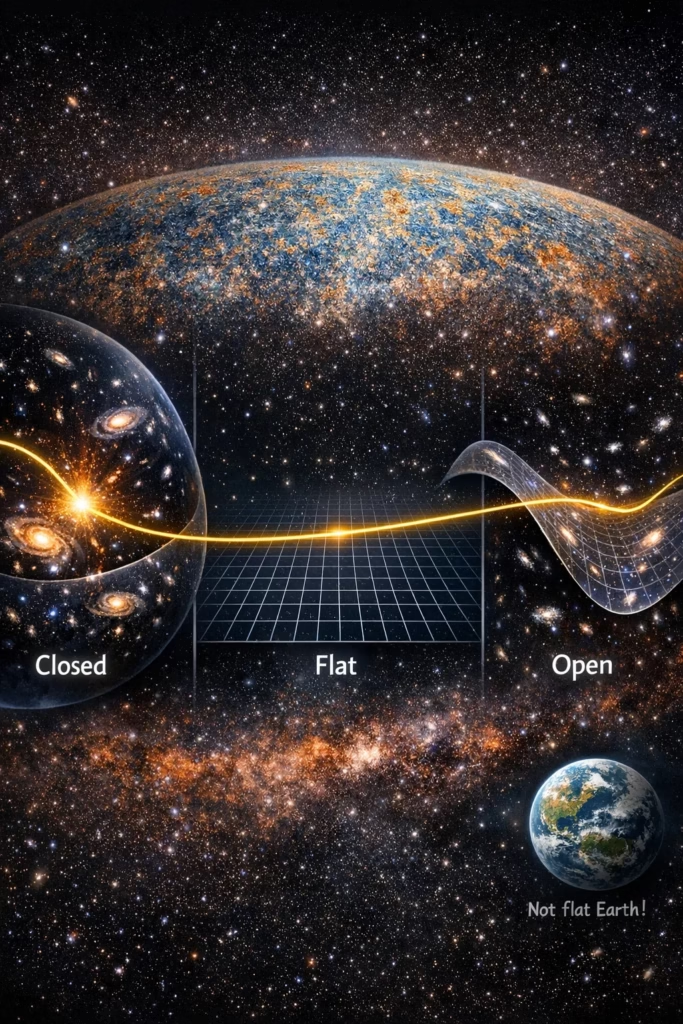
So let’s clarify immediately: we are not talking about Earth’s shape, but about the metric of space itself. About curvature on a cosmic scale – the kind determined by the total content of matter and energy in the Universe, exactly as Einstein’s general theory of relativity predicts.
Of course, local curvatures exist. Black holes bend space around them, stars and galaxies create their own gravitational “indentations.” But when we step back and look at the visible Universe as a whole – on scales of billions of light-years – the geometry becomes… flat. Almost perfectly so, with deviations so small they are difficult to measure.
This discovery shook the scientific community. And it led to one of the boldest ideas in modern cosmology.
Two Problems That Troubled Cosmologists 🤔
Before understanding why a “flat universe” is a problem, we must understand two cosmic challenges.
The first is the horizon problem. When we look at the cosmic microwave background radiation (CMB) – the afterglow of the Big Bang – it is astonishingly uniform. Two points on opposite sides of the sky, 28 billion light-years apart, have nearly identical temperatures. The problem? They have never been in causal contact. They could never have exchanged information, because the universe expanded too rapidly. So how can they be so perfectly synchronized?
The second is the “flatness” problem. The density of the universe, divided by the critical density, gives a parameter Ω (omega). Today, Ω is very close to 1 – between 0.9 and 1.1. But density changes over time. For us to have this value today, in the first moments of existence – at the Planck scale of 10⁻⁴³ seconds – it must have been fine-tuned with incredible precision. How precise? Imagine a number with sixty zeros after the decimal point, and then a one. That is not a coincidence. That is a fine-tuning that cries out for explanation.
Before 1980, cosmologists simply shrugged: “The Universe is simply like that. It started homogeneous and flat.”
Inflation: Alan Guth’s Brilliant Answer 💡
In 1980, Alan Guth proposed a solution that seemed like science fiction: inflation.
Imagine that in the first fraction of a second after the Big Bang – between 10⁻³⁶ and 10⁻³⁴ seconds – the universe experienced explosive expansion. The expansion factor? About 10⁵⁰ times. During that time, a piece of space the size of an atom stretched to the size of the visible universe.
This solves both problems at once:
- The horizon problem: Before inflation, our entire visible universe was compressed into barely 10⁻⁵⁰ light-years. All points were in causal contact, they were in a state of thermodynamic equilibrium with a uniform temperature. Then inflation stretched that small, uniform patch into an enormous, still uniform cosmos.
- The “flatness” problem: Imagine inflating a balloon. The larger the balloon, the flatter its surface appears. The same applies to the universe. Inflation stretched space so much that any curvature became negligible. Just as Earth appears flat to us standing in a meadow, so the universe appears flat to us because inflation made our visible portion astronomically large.
Confirmation from the Shadows 👁️
But inflation did not remain just a theory. It predicted something crucial: tiny quantum fluctuations, stretched by inflation to cosmic scales, became the seeds of all structures we see today – galaxies, stars, planets. These fluctuations left their mark on the CMB, in the form of tiny temperature differences of only 1/100,000.
When the COBE, WMAP, and Planck satellites mapped these fluctuations, they found exactly what inflation predicted. This was not mere speculation – it was confirmation.
But… What Switched Inflation On? 🔄
And here we come to the tricky questions.
Inflation explains how the universe became flat and uniform. But what triggered inflation itself? Some “inflation field,” a hypothetical quantum entity, must have existed. What “switched it on”? And, more importantly, what switched it off at just the right moment?
Guth and other theorists developed models of “eternal inflation” – in which inflation never completely stops, but continues forever in some regions of space, creating an infinite number of “pocket universes” with different properties. This leads us to the concept of the multiverse – the possibility that our universe is not alone, but merely one in an infinite sequence.
And here a problem arises: if there are infinitely many universes with different physical laws, why does ours have precisely these values of constants? That question leads to the anthropic principle – the idea that conditions in our universe are such because only in such conditions can an observer exist to ask questions.
Metaphysical Chill: 4.9% of Reality 😨
And finally, we come to what gives us a chill.
Our best theories, our most precise instruments, our sharpest minds – have managed to explain only 4.9% of what exists.
Ordinary matter – stars, planets, galaxies, you, me, everything we see and touch – constitutes less than 5% of the cosmos’s total energy.
The remaining 95% is divided between:
- Dark matter (about 26.8%) – an invisible substance we only feel through gravity, which holds galaxies together, but whose nature we do not understand
- Dark energy (about 68.3%) – an even more mysterious force accelerating the universe’s expansion, which we identify with vacuum energy, but with a discrepancy of 120 orders of magnitude
We live precisely in this chapter of the Universe’s history – as conscious beings hungry for answers about origin and meaning – when the properties of the vacuum itself dominate over all visible matter.
This is not merely a scientific problem. It is a metaphysical challenge. It is an invitation to humility and awe.
Conclusion: Humility and Awe Before the Cosmos 🌠
The universe is flat. Almost perfectly so. So flat that our best instruments are barely capable of measuring any deviation.
This flatness, this uniformity, this incredible fine-tuning of initial conditions – all of it speaks something profound about the nature of reality. Perhaps inflation is the answer. Perhaps the multiverse. Perhaps something we have yet to discover.
But what we know for certain is that we stand at the edge of vast ignorance. That 95% of the cosmos remains dark to us. And that this darkness should not frighten us – but inspire us.
For precisely in that ignorance lies space for discovery. For new questions. For new answers. For a new voyage across Dirac’s sea.
Leave a Reply