
Introduction: Eyes That Were Supposed to See Everything 👁️
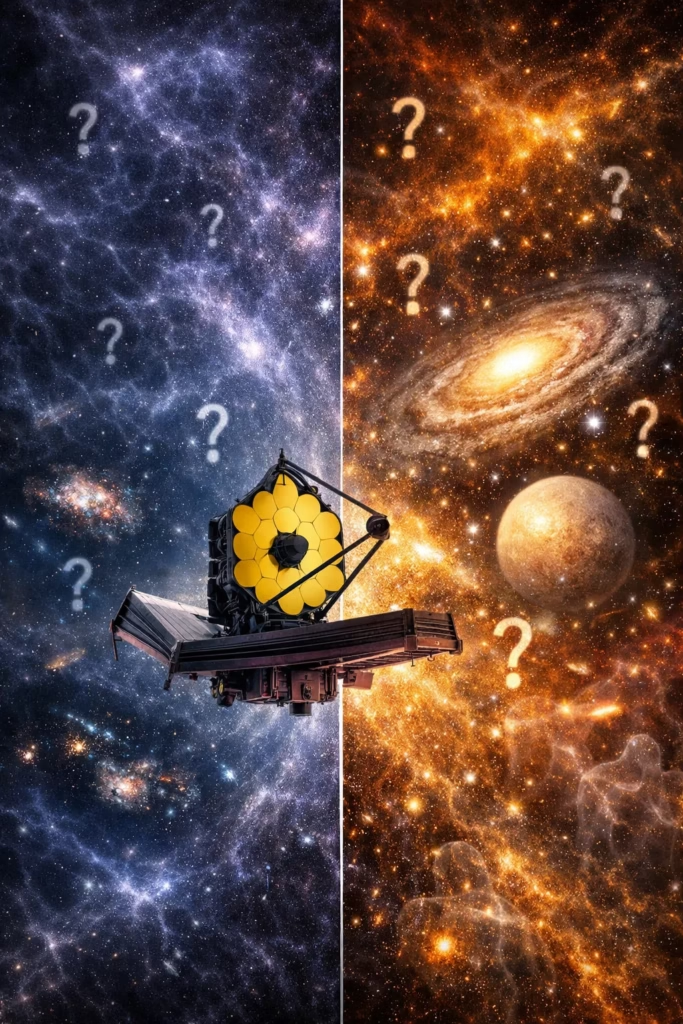
When the James Webb Space Telescope (JWST) launched on December 25, 2021, expectations were astronomical – in every sense of the word.
It was supposed to look further than ever before, to the first stars and galaxies, to the very dawn of time. It was supposed to confirm what we think we know: the standard cosmological model, inflation, the gradual maturation of the cosmos. It was supposed to give us a clear picture.
Instead, it brought – new questions. And new uncertainties.
The First Shock: Galaxies That Shouldn’t Exist 💥
JWST’s first images amazed the world. But when cosmologists scratched beneath the surface, shock followed.
The telescope discovered galaxies from a period when the universe was only 300-400 million years old – that are enormous and incredibly developed. According to standard models, they were supposed to be small, irregular, barely formed.
Instead, we saw massive, mature galaxies, with structures resembling today’s spiral and elliptical giants.
“These galaxies formed much earlier than anyone expected,” one researcher stated. “It’s like finding a full-grown adult where you expected a newborn child.”
The standard cosmological model (ΛCDM) predicts a gradual evolution of structures, through the hierarchical assembly of smaller units into larger ones. These observations challenge that model.
Dark Matter: The Invisible Skeleton That Wavers 🦴
Then there’s the dark matter problem.
For decades, it has been a central pillar of cosmology. An invisible substance making up about 27% of the universe, which we don’t see, don’t feel, but whose gravitational effects we measure – in galaxy rotations, in cluster motions, in gravitational lensing.
Mapping gravitational lenses shows enormous regions of dark matter holding galaxy clusters together. It is the skeleton upon which ordinary matter is “hung.”
But here’s the problem: we have never directly detected it.
Experiments deep underground, observations of cosmic radiation, particle strikes in detectors – all empty. Dark matter candidates (WIMPs, axions…) stubbornly elude us.
And increasingly, serious scientists are questioning: does dark matter even exist? Or is it just a sign that we don’t understand gravity on large scales? Or something else entirely?
Alternative: Parallel Universes and Higher Dimensions 🌍🌍🌍
And here we come to more speculative – but increasingly present – ideas.
What if what we call dark matter is actually not matter in our universe at all? What if it is the gravitational effect of matter belonging to a different, parallel universe?
Imagine higher-dimensional spaces connecting different universes. Matter from a neighboring world cannot interact with us electromagnetically – we don’t see it – but its gravity, “leaking” through dimensions, is felt here.
That would explain why we don’t detect it, yet feel its gravitational pull.
And what about those early, enormous galaxies? Perhaps they didn’t form in this universe. Perhaps they are remnants of a previous eon – as Penrose’s CCC theory suggests. Or they were “pulled in” from a neighboring universe through cosmic “bridges.”
Return to the Dirac Sea and the Holographic Principle 🌊
This brings us back to themes we’ve already explored on our voyage.
Penrose’s conformal cyclic cosmology (CCC) speaks of eons – an infinite sequence of universes, where each new eon is born from the ashes of the previous one. Information from past eons may survive in the structure of space, influencing the distribution of matter in the new one. Those early, overgrown galaxies could be such fossils – remnants of something that came before.
Susskind’s holographic principle tells us that our three-dimensional world may be just a projection of information inscribed on a two-dimensional boundary. Matter, energy, space, time – all are emergent phenomena from a more fundamental layer: information.
And the Dirac Sea, across which we have sailed so many times – that sea of potential states, virtual particles, quantum fluctuations – it may well be that very informational substrate. The set of quantum information manifesting in emergent time and space as a representation for us – the bearers of consciousness.
Does Any of This Make Sense? 🤔
The question is legitimate. And the answer is: perhaps.
Perhaps we stand at a turning point similar to the late 19th century, when physicists thought everything was explained – and then came quantum mechanics and relativity.
Perhaps our problems with dark matter, early galaxies, accelerated expansion – are not problems with our measurements, but problems with our picture of reality.
Perhaps we didn’t miscalculate. Perhaps we miscalculated the very conceptual framework.
And perhaps this very crisis – which James Webb deepened instead of resolving – will be what forces us to take the next great leap.
Conclusion: The Voyage Continues ⛵
James Webb didn’t bring answers. It brought new questions. And that – perhaps – is its greatest value.
Because it forces us to rethink what we took for granted. To go back to the drawing board. To consider possibilities we previously dismissed as too speculative.
Penrose’s eons. Susskind’s hologram. The Dirac Sea as an informational substrate. Parallel universes “leaking” through dimensions.
And as MilovanInnovation boldly sails across the Dirac Sea, one thing is certain:
The journey continues. And the best is yet to come.
For where all answers lie – there are no more questions. And questions are what drive us.
Leave a Reply