
How relativity, quantum mechanics, and observer theory shape our understanding of time – and why the future may already be here, we just can’t see it 🧊⚛️👁️
There is a growing consensus in leading scientific circles that spacetime should be viewed as a four-dimensional block in which the past, present, and future are equally real. This is not mere philosophical speculation – it is a consistent interpretation of the theory of relativity, supported by experiments and mathematical formalism.
But when we introduce quantum mechanics into this picture, things become bizarrely unclear and difficult to grasp from the standpoint of our everyday experience of reality. It is precisely at this intersection of relativity and the quantum world that a new, deeper picture of time begins to emerge.
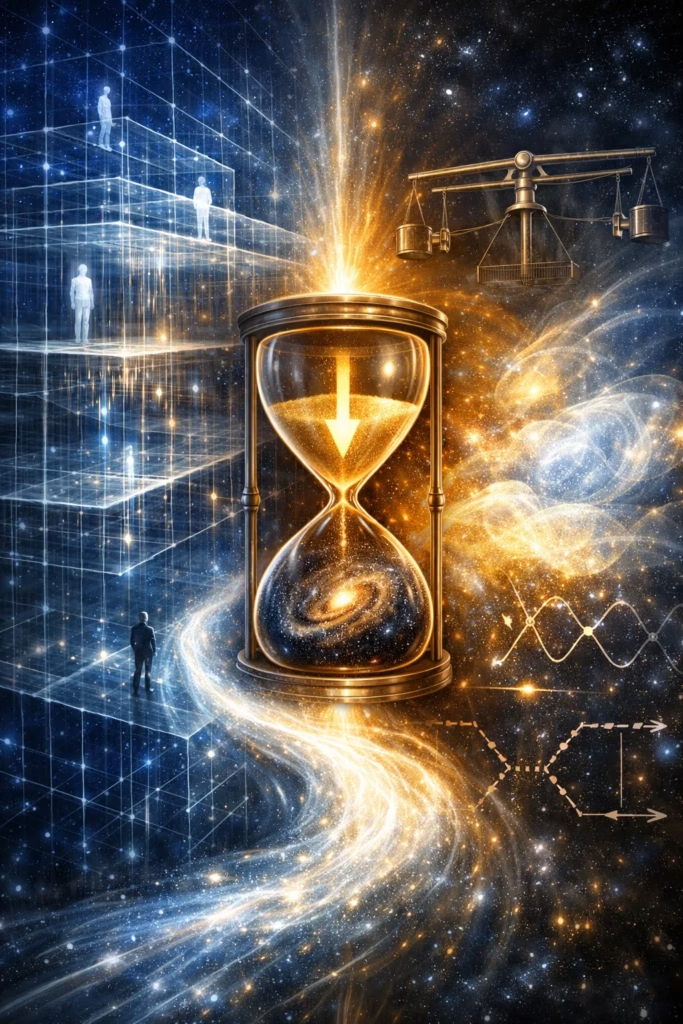
The Block Universe: When the Future Is Already Written 🧊📜
In special relativity, time is a fourth dimension, as real as the three spatial dimensions. Just as a point on the z-axis does not “disappear” when we move along it, neither do events in the past cease to exist – they are simply located elsewhere on the timeline.
This leads to the concept of the “block universe”:
- The past, present, and future exist simultaneously within the four-dimensional continuum.
- What we experience as the “now” is merely a slice through that block within our reference frame.
- Someone in a different reference frame may have a different slice – for them, our future may already be past, and vice versa.
This is not just theory – it has been experimentally confirmed through effects such as time dilation and the relativity of simultaneity. It is logically “digestible” and mathematically consistent.
But then quantum mechanics enters the scene and complicates everything.
Penrose’s Problem: Two Realities That Cannot Be Reconciled ⚛️🤔
Nobel laureate Roger Penrose has perhaps best defined the core problem:
There are two realities – the quantum and the classical.
- Quantum reality is more fundamental: particles need not have definite properties until measured; they exist in a state of superposition.
- Classical reality is what we observe: particles have definite position, velocity, energy. This is the everyday world in which time flows from past to future.
The question is: how does quantum reality become classical?
The mechanism proposed to explain this is wave function collapse – the reduction of a multitude of quantum possibilities into a single classical reality.
Penrose believes this collapse is not random, but is driven by gravity, specifically by the metric of spacetime at the microscale. In other words: the very structure of spacetime may be responsible for the transition from quantum to classical states.
Marković’s Statistical Nature: A Large Number of Observers Determines Reality 👁️📊
Here we arrive at a less well-known but exceptionally significant insight. Dr. Sima Marković, a Serbian physicist from the 1930s, developed the idea that wave function collapse has a statistical nature.
According to Marković, a single observer is not sufficient for the transition from quantum to classical. A large number of observers is required – almost like a kind of “reality show” in which the audience (observers) votes on what is significant, what remains, and what disappears.
This idea is remarkably modern and resonates with contemporary concepts such as:
- Quantum decoherence – interaction with the environment (which contains many particles) “selects” certain states.
- Relational quantum mechanics – properties are relative to the observer.
- QBism (Quantum Bayesianism) – quantum states are information, and reality depends on who possesses that information.
The Arrow of Time as a Statistical Phenomenon 🔄📈
If we accept Marković’s idea, then the arrow of time (the fact that time flows in only one direction) is not merely a consequence of the Second Law of Thermodynamics and the increase of entropy.
It is also a consequence of the large number of measurements and observers who, through their interactions, impose a direction on classical reality.
In other words: Classical time has a direction because there are many of us measuring and observing it. Without observers, at the quantum level, time may have no direction – or it may have a direction we cannot comprehend.
Feynman and Retrocausality: Moving Backward in the Quantum World 🌀🔮
One of the most exciting aspects of quantum electrodynamics (QED) is Feynman’s interpretation of antiparticles as particles moving backward in time.
In individual cases, at the quantum level, retrocausality is possible – an effect that precedes its cause, or information traveling from the future to the past.
This is not mere theoretical speculation – Feynman diagrams are mathematically equivalent and experimentally confirmed. They show that at the deepest level, nature makes no distinction between the directions of time.
But why then do we not see eggs reassembling themselves? Because we live in a statistical, macroscopic world where millions of interactions on average yield a direction. At the individual level, time is symmetric; at the collective level, it has an arrow.
Synthesis: Time as a Multi-Layered Phenomenon 🧩🌊
If we attempt to assemble all these pieces, we arrive at a picture of time as a multi-layered phenomenon.
At the relativistic level, time is a fourth dimension within the block universe, where past and future exist equally, and the present is merely a slice through that block within our reference frame.
At the individual quantum level, time is symmetric – allowing for retrocausality and Feynman processes where antiparticles travel backward. At this level, nature makes no distinction between directions.
At the collective quantum level, decoherence occurs – interactions with the environment begin to “select” certain states and gradually introduce direction.
At the classical statistical level, the large number of observers and measurements imposes a direction on time. Just as an individual gas molecule can move in any direction, but an entire gas in a room always expands – so too our consciousness, trapped in the macroscopic world, always experiences time flowing forward.
And finally, at the thermodynamic level, entropy increases, providing the macroscopic direction we register in everyday life.
Conclusion: The Future Is Already Here, We Just Can’t See It 🔮✨
Perhaps the deepest message of this synthesis is the following:
In the relativistic sense, the future already exists – it is part of the block universe, as real as the past. But we cannot “see” it because we are statistical, macroscopic observers whose consciousness functions in the direction of increasing entropy and collective measurements.
At the quantum level, time is symmetric and permits retrocausality. At the human level, we are constrained by the statistics of large numbers. Just as an individual gas molecule can move in any direction, but an entire gas in a room always expands – so too our consciousness, trapped in the macroscopic world, always experiences time flowing forward.
Perhaps a future theory of quantum gravity will succeed in reconciling these pictures. Until then, time remains the greatest enigma at the boundary of physics, philosophy, and human consciousness.
Question for you: Does it comfort or disturb you to know that your past and future already exist somewhere in the block universe? And what do you think about the idea that we, through our collective observation, create the arrow of time?
Leave a Reply