
Why a single quantum computer costs more than a luxury villa and is colder than deep space – and what hides behind the golden plates in those famous photographs ❄️💎🔬
This is the second part of our series on quantum computers.
In the first part, we explored how error correction – especially the new BB codes – allows us to protect more logical qubits with fewer physical ones. Now we go one level deeper: into the physical reality of the machine itself.
Because no matter how sophisticated the error‑correcting code, without stable, coherent qubits there is no quantum computation. And stability comes at a price – literally and physically.
Colder Than Any Place in the Universe 🌌❄️
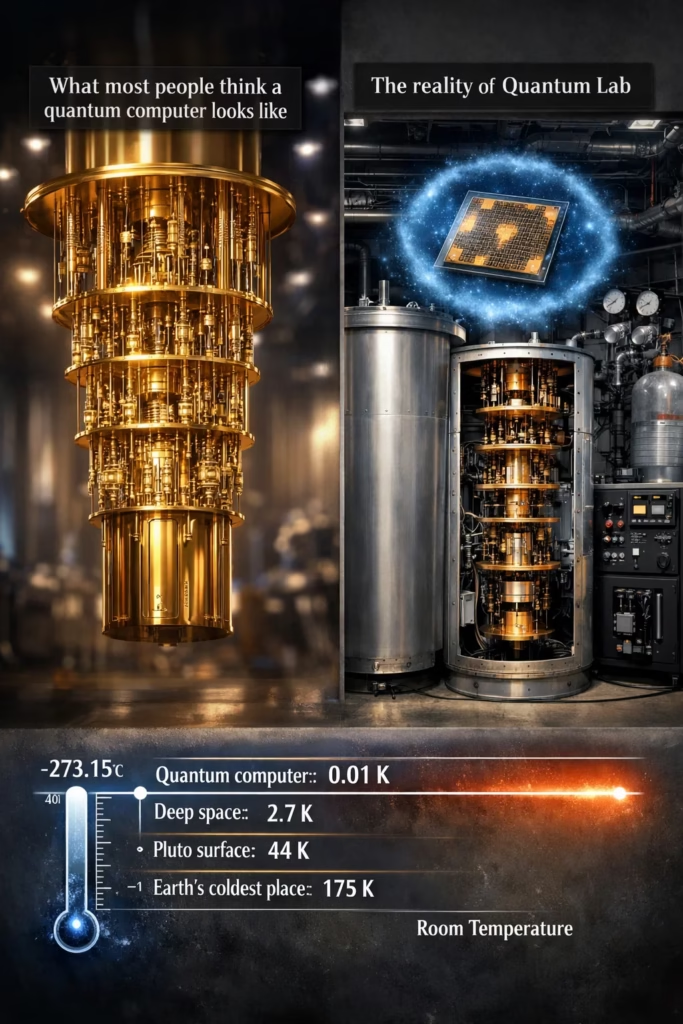
A quantum computer does not operate at room temperature. It does not even operate at liquid‑nitrogen temperature. It operates at temperatures between 10 and 100 millikelvin – that is between -273.14 °C and -273.05 °C.
To put this into perspective:
- The coldest place on Earth (the East Antarctic Plateau) is -98 °C.
- The bottom of the ocean is between 1 °C and 2 °C.
- All the outer planets are warmer: Mercury reaches -178 °C, Uranus drops to -224 °C, Neptune to -214 °C.
- Even the coldest part of interstellar space is -270 °C – still warmer than a quantum computer.
A quantum computer is colder than any natural place in the universe. The only place colder is theoretical absolute zero (-273.15 °C), which we cannot reach.
Why So Cold? 🧊⚛️
The reason lies in decoherence. A qubit’s power – its ability to be in a superposition of states 0 and 1 at the same time – depends on quantum coherence. Any unwanted influence from the environment, especially heat, destroys that coherence.
Heat is not just “hotness” – it is random oscillations of atoms. At room temperature, atoms oscillate billions of times per second, which would knock a qubit out of coherence in an instant. That is why the quantum computer is kept at a temperature where atomic motion is almost frozen.
Researchers are working on qubits that could operate at higher temperatures. A recent study showed that qubits begin to degrade at 170 millikelvin (-272.98 °C) [3]. The highest temperature at which quantum behaviour has been demonstrated is just above 1 Kelvin (-272 °C) [2]. There is still a long way to go to room temperature.
Debunking the Myth: What Is That Famous Image? 📸🔍
When you search for “quantum computer”, you come across pictures of a tall, cylindrical golden tower with stacked plates of decreasing size, connected by wires and supports.
That cylindrical structure is not the computer. It is the refrigerator.
What we see in those popular photos is a dilution refrigerator (cryostat) – the device that cools the actual quantum computer to near absolute zero. The “computer” itself – the quantum chips and the quantum processing unit (QPU) – makes up the smallest part of that structure, placed at the very bottom, at the coldest spot.
Components: From a Postage Stamp to a Two‑Meter Tower 🏗️
Quantum chips – the size of a postage stamp – contain the qubits. Google’s Willow has 105 qubits, Microsoft’s Majorana 1 has 8 qubits, IBM’s chips Eagle (127), Heron (133 or 156), and Nighthawk (120).
The Quantum Processing Unit (QPU) – the part that actually computes – consists of tens of chips. It is about the size of a nightstand and sits at the bottom of the cylindrical tower.
The dilution refrigerator – up to 2 metres tall – makes up the remaining 95% of the visual identity of a quantum computer. Its job: by mixing isotopes of Helium‑4 and Helium‑3, it creates liquid helium – the coldest liquid on Earth. The process is complex: gases are injected at room temperature, pass through a series of coolers, and at the bottom, in the mixing chamber, they become liquid helium at near‑absolute‑zero temperature. That mixing chamber is where the QPU resides.
To prevent vibrations that would generate heat, the whole system is mounted on a support frame and then covered by a metal vacuum can. In the lab, a quantum computer does not look like a golden tower – it looks like a silver, closed cylinder with no ornaments. Those shiny photographs are only for demonstration.
The Price of Cooling: A Million‑Dollar Refrigerator, Electricity for Several Households 💰⚡
This level of cooling does not come cheap. One dilution refrigerator costs between 300,000 and 1,000,000 US dollars. And that is only the refrigerator.
Its energy consumption is constant, 24/7:
- 5–10 kilowatts of electrical power continuously.
- That is 43,800–87,600 kilowatt‑hours per year.
- For comparison, an average household in developed countries consumes about 10,800 kWh per year.
- So one refrigerator consumes as much electricity as 4 to 8 average households.
And that is just the cooling. The setup of a quantum laboratory is worth hundreds of millions of dollars. IBM’s centre near Stuttgart, Germany, which began operation in mid‑2025, has capacity for 12 quantum computers – and currently hosts two. This partly explains why even most software engineers working in quantum computing have never seen one in person.
A Critical Look: Is This Path Sustainable? 🤔
All this leads to an important question: Is mass adoption of quantum computers even possible if each machine requires such infrastructure?
The answer is not simple. There are two directions of development:
- Improving existing superconducting technologies – developing new materials that would allow operation at higher temperatures (e.g., 20 K or even 77 K, the temperature of liquid nitrogen). That would dramatically reduce cooling costs and simplify infrastructure.
- Alternative technologies – trapped ions, photons, silicon spins, topological qubits. Each has different requirements – some operate at higher temperatures, but they face other challenges (scalability, speed, coherence).
Recent advances in high‑temperature superconductivity (hydrides under pressure, nickelates, new cuprates) give hope that qubits too could be cooled by less extreme means. However, the path from a laboratory sample to industrial application is long and uncertain.
The Link with Error Correction: Better Hardware + Smarter Code 🔗
In the first part of this series we saw that new BB codes dramatically reduce the hardware overhead needed for error correction. Even a modest improvement in the physical error rate from 10⁻³ to 10⁻⁴ (which better materials and more stable qubits could enable) yields 6 orders of magnitude improvement in the logical error rate. This means we do not need to chase perfect qubits – we can build them “good enough”, and let clever codes take care of the rest.
Better hardware and smarter error correction go hand in hand. Neither alone leads to a scalable quantum computer.
Conclusion: The Price of Entering a New Era 💎
A quantum computer is not just a chip on a table. It is a system worth hundreds of millions of dollars, demanding to maintain, hidden behind metal cylinders, colder than deep space.
But that price – material, energetic, engineering – shows how fundamental a shift we are talking about. Quantum computing is not just “faster computing”. It is a new kind of computation that requires a new kind of machine.
While researchers search for materials that could enable operation at higher temperatures, and while error‑correcting codes continue to improve, one thing is certain: the path to a practical quantum computer does not run through just one discipline. It is a union of physics, chemistry, materials science, engineering, and mathematics.
And we at MilovanInnovation will continue to follow every step of that path.
Question for you: Do you think the future of quantum computing lies in improving superconducting technologies (higher temperatures, better materials) or in alternative approaches (ions, photons, topological qubits)? And do you believe that in 20 years we will have a quantum computer on every desk?
Leave a Reply