
Why quantum operations must be reversible, how they are physically realized in superconductors, trapped ions, and topological systems, and why measurement is the only exception 🔄🌀🔧
This is the fifth part of our series on quantum computers.
In previous parts we explored error correction (BB codes), physical reality (dilution refrigerators, superconductivity), topological qubits (Majorana), and trapped ions. Now we descend to the level of what actually happens inside the machine: logic gates – the fundamental building blocks of every computer.
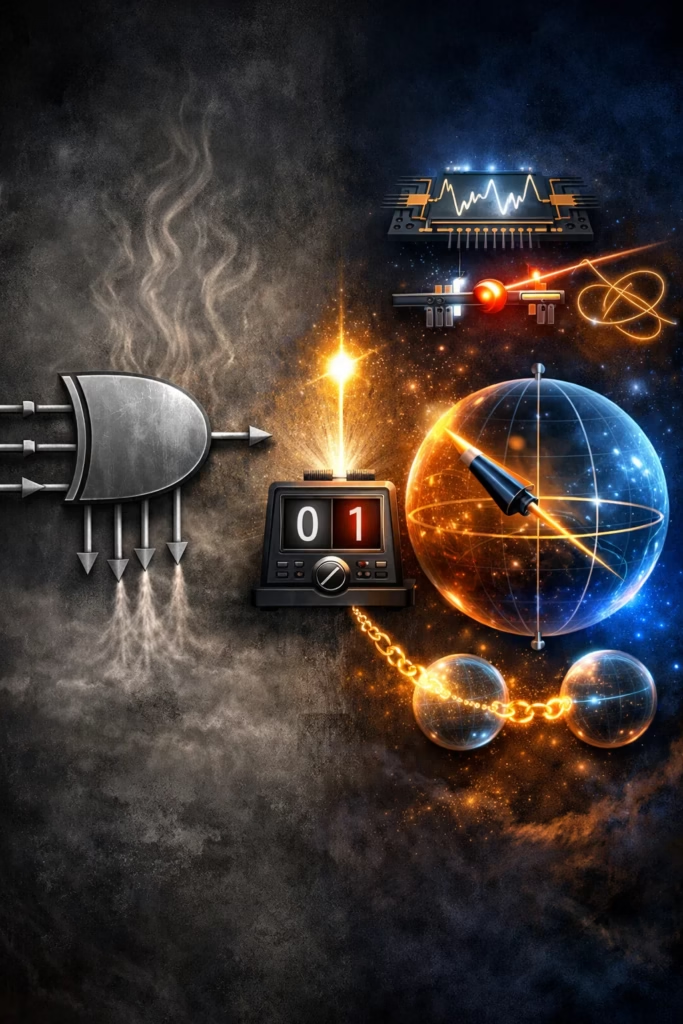
Whether we use superconducting qubits, trapped ions, or topological modes, every quantum operation reduces to precise manipulation of a quantum state. But while classical logic gates (AND, OR, NOT, NAND) are simple and irreversible, quantum gates must be reversible and act as rotations of the state vector in an abstract space. The reason lies in the very nature of quantum mechanics – and understanding these gates is key to building algorithms and performing error correction.
Classical Gates: When Information Is Lost
In a classical computer, everything reduces to binary operations on bits (0 or 1). One of the most fundamental gates is NAND (NOT‑AND). Its truth table looks like this:
| Input A | Input B | Output (A NAND B) |
|---|---|---|
| 0 | 0 | 1 |
| 0 | 1 | 1 |
| 1 | 0 | 1 |
| 1 | 1 | 0 |
Notice: for three different input combinations (00, 01, 10) the output is the same – 1. After performing a NAND, it is impossible to reconstruct the input from the output. Information is lost, the operation is irreversible. This is perfectly fine for classical computers – they work with macroscopic signals where information loss turns into heat (Landauer’s principle), but it does not hinder computation.
Quantum Gates: Reversibility as a Law
In the quantum world, the evolution of a state is described by the Schrödinger equation, which is time‑reversible. If we want to perform computation, we must use operations that are unitary maps – they preserve total information and can always be inverted.
Instead of NAND, quantum computers use gates like X (quantum NOT), CNOT (controlled‑NOT), and Hadamard (H). They act on qubits that can be in superposition.
- X gate acts like a classical NOT but in a quantum way: it rotates the state vector by 180° around the X‑axis on the Bloch sphere. If the qubit is in state |0⟩, it goes to |1⟩; if in |1⟩, it goes to |0⟩. But if it is in superposition (α|0⟩+β|1⟩), X swaps the amplitudes: it becomes β|0⟩+α|1⟩.
- Hadamard gate (H) creates superposition: |0⟩ → (|0⟩+|1⟩)/√2, |1⟩ → (|0⟩–|1⟩)/√2. This is a 90° rotation around a combined axis.
- CNOT gate is a two‑qubit gate: it has a control and a target qubit. If the control is in |1⟩, the target is flipped (X); if the control is in |0⟩, the target stays unchanged. CNOT is reversible (its inverse is itself) and enables entanglement.
Every quantum gate can be represented as a unitary matrix acting on the state vector. This is the mathematical way of saying: information is never lost – it is merely transformed.
How Are Gates Physically Realized? A Look at Three Technologies
Although gates are universal in a mathematical sense, their physical implementation depends on the hardware.
1. Superconducting Qubits
Here the qubit is realized as an anharmonic oscillator (transmon, fluxonium). Microwave pulses of specific frequency and duration drive Rabi oscillations – rotations of the state.
- X gate = π‑pulse (duration that flips the state).
- Hadamard = π/2‑pulse with appropriate phase.
- CNOT is performed using an additional coupling element (e.g., a resonator) that links two qubits.
Advantage: speed (nanoseconds), scalability (lithography). Disadvantage: short coherence time.
2. Trapped Ions
The qubit consists of two electronic levels of an ion (e.g., Yb⁺). Gates are performed with laser pulses tuned to resonance between those levels.
- Single‑qubit gates (X, H, phase) are achieved by laser pulses that drive Rabi oscillations.
- Two‑qubit gates (CNOT) use shared vibrational modes (phonons) of multiple ions in the same trap. The laser excites a vibration, and two ions become entangled through that mode.
Advantage: extremely long coherence times (minutes), very high gate fidelities (>99.9%). Disadvantage: slow gate execution (microseconds) and scalability challenges.
3. Topological Qubits (Majorana)
Unlike the others, topological qubits are not localized on a single particle – they are “smeared” across a structure. Gates are performed by braiding Majorana modes. When two modes are physically moved around each other, their quantum state changes in a way that corresponds to a logic gate.
Advantage: natural protection against local errors. Disadvantage: still in early stages; atomic‑scale precision is needed to create and braid the modes.
Measurement – The Only Irreversible Operation
When we want to read the result of a quantum computation, we must perform a measurement. Measurement is not unitary – it collapses the qubit into one of the classical states (|0⟩ or |1⟩) with probability given by the square of the amplitude. This loss of information is necessary to extract a classical result from the quantum world.
In all technologies, measurement is done through specific methods:
- Superconducting: dispersive readout via a resonator.
- Trapped ions: fluorescence (a laser drives a transition only in one state).
- Topological: still under development, likely using interferometry.
Why This Matters for the Entire Series
Gates are the language in which we write quantum algorithms. Without them, we cannot create superposition, entangle qubits, or perform error correction.
- In Part 1 (BB codes) we saw that error correction requires reliable gates – the smaller the gate‑level error, the smaller the hardware overhead.
- In Part 2 (cold) we explained why extreme temperatures are needed – they directly affect gate fidelity.
- In Parts 3 and 4 (topological, trapped ions) we saw how different technologies implement gates in their own ways.
Without a universal set of gates (like H, X, CNOT) we cannot run any non‑trivial quantum algorithm – from Shor’s factoring to molecular simulation.
Conclusion: From NAND to Rotations
Classical logic gates are blunt but efficient – they cut information and produce heat. Quantum gates are like a ballet in Hilbert space: every laser or microwave pulse is a choreography that rotates the state vector, preserving every shred of information.
Understanding these operations is not just academic – it is the key to understanding why quantum computers can be more powerful than classical ones. Because while classical gates work on bits, quantum gates work on vectors – and that is the space where the exponential advantage hides.
Question for you: Which approach to gate implementation seems most intuitive to you – microwaves in superconductors, laser harps in trapped ions, or braiding anyons in topological systems? And how would you explain the difference between a NAND gate and a CNOT gate to someone who has never heard of quantum computing?
Leave a Reply