
How microtubules in our neurons might sustain quantum coherence in the hot, wet chaos of the brain – and why remembering dreams behaves like wavefunction collapse 🧠⚛️🌀
This is the sixth part of our series on quantum computers.
In the previous five parts we journeyed from error correction through physical implementations (superconductivity, ions, topological qubits) to logic gates. We built a picture of the quantum computer as a machine requiring millikelvin temperatures, vacuum, and isolation from every unwanted interaction.
Now we ask a question that challenges even the boldest physicists: If quantum computing is so fragile, how does our brain – hot, wet, chaotic – function as the most complex system in the known universe? Could it be that nature solved the problem of quantum computing in its own way, under the very conditions we consider ordinary?
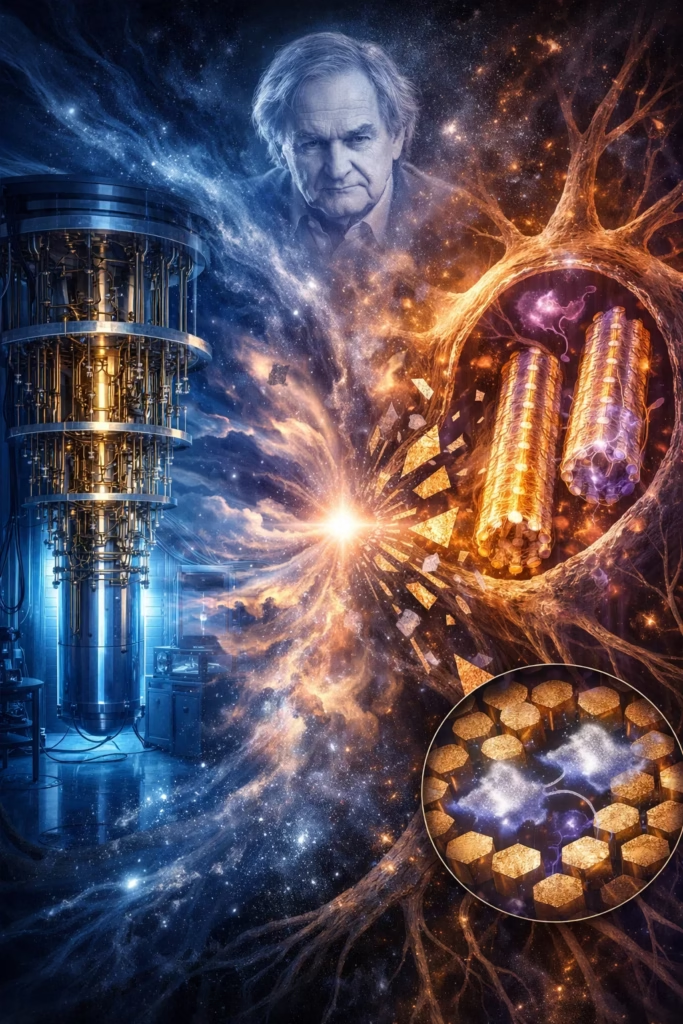
One of the most audacious theories of our time attempts to answer this: Orchestrated Objective Reduction (Orch OR) , proposed by Nobel laureate Roger Penrose (physicist) and Stuart Hameroff (anesthesiologist). MilovanInnovation has already explored Penrose’s cosmology (CCC) and his critique of mainstream physics – now we focus on the technical core of his argument about consciousness.
Paradox: Dilution Refrigerators vs. the Human Head
In the second part of the series, we saw that quantum computers operate at temperatures of 10–100 millikelvin (-273.14°C to -273.05°C). They require dilution refrigerators costing millions, complete isolation from vibrations, electromagnetic noise, and cosmic rays. Any unwanted interaction – decoherence – destroys the quantum state.
The human brain, on the other hand, operates at 37°C. It is teeming with moving ions, jumping neurotransmitters, oscillating membrane potentials. It is a hot, wet, noisy system – by all standards of quantum technology, a death trap for quantum coherence.
Yet our brain produces consciousness – a phenomenon that, according to Penrose, classical neuroscience will never fully explain. His conclusion: consciousness must have a quantum origin.
Microtubules: Candidates for Quantum Computing in the Cell 🧬🔬
Penrose and Hameroff did not look for quantum effects in synapses or axons – those are too large and noisy. They turned their attention to microtubules – protein structures that form the cytoskeleton of every cell, including neurons.
What are microtubules?
Microtubules are hollow cylindrical structures about 25 nm in diameter, built from tubulin proteins that organize into a lattice. Each tubulin can exist in two conformational states (“bent” or “straight”), reminiscent of two quantum states. Microtubules are organized in regular structures resembling crystal lattices, though they are made of protein – an ideal environment for long‑lasting quantum coherence.
As early as the 1980s, Hameroff noticed that anesthetics – which suppress consciousness – bind precisely to the hydrophobic pockets within microtubules. This was the first hint that consciousness is not merely an electrochemical phenomenon at the synaptic level, but something deeper, quantum, happening inside neurons.
Orch OR: How Does Quantum Collapse Work in the Brain? ⚛️🧠
Orchestrated Objective Reduction (Orch OR) is the theory that attempts to explain how microtubules could be quantum processors, and how their collapse gives rise to consciousness.
Quantum Coherence in Microtubules
According to the model, tubulins inside microtubules can form superpositions of conformational states – being both “bent” and “straight” at the same time. These quantum effects can propagate through the microtubule lattice via London dispersion forces (part of van der Waals interactions) , which are strong enough to sustain coherence on timescales of nanoseconds to microseconds – long enough for quantum computation, despite the warm environment.
How is coherence possible in a hot brain?
The answer lies in the organization of microtubules – their regular, nearly crystalline structure shields quantum states from thermal noise in a way that isolated molecules cannot. This is reminiscent of the topological protection we encountered with Majorana fermions – but here it is structural, not topological, protection.
Objective Reduction
Penrose had long been dissatisfied with the standard interpretation of wavefunction collapse (“measurement”). His contribution is objective reduction (OR) – the idea that every quantum superposition has a natural lifetime, determined by gravitational effects. When a superposition reaches a certain “mass” in spacetime (about 10⁻⁴³ seconds for elementary particles, much longer for larger systems), it spontaneously collapses into a single state.
In Orch OR, this collapse is not random – it is orchestrated by the microtubule network. Each such collapse constitutes a moment of conscious experience. A sequence of these collapses (up to 40 per second) creates the stream of consciousness.
Key idea: Consciousness is not a byproduct of computation – it is itself a process occurring in the quantum domain, and Orch OR provides a mathematical framework for it.
New Research: Has Penrose Been Vindicated? 🔬📈
For decades, Orch OR was dismissed as “speculative” and “unsupported.” However, in recent years experimental evidence has begun to accumulate.
Bandyopadhyay and Coherence in Microtubules
In 2014, a team led by Anirban Bandyopadhyay (National Institute for Materials Science, Japan) published a paper in which they directly measured quantum coherence in microtubules. Using terahertz spectroscopy, they found that microtubules exhibit vibrational resonances lasting up to nanoseconds at room temperature. This is far longer than expected for a wet, warm system.
Anesthetics and Quantum Effects
New research shows that anesthetics not only affect the hydrophobic pockets of microtubules – they measurably reduce the quantum coherence of microtubules before they affect synaptic activity. This suggests that anesthesia may work by suppressing quantum computation in microtubules, not just electrochemical processes.
REM Sleep and Wavefunction Collapse
One of the most intriguing arguments comes from the study of dreams. During REM sleep, our brain is highly active, yet dream recall is lost almost immediately upon waking – unless we wake during REM. Penrose and Hameroff suggest that this is because dreaming is a quantum process occurring in microtubules. When we wake, measurement (the attempt to recall) collapses the wavefunction, destroying the information.
This mirrors quantum decoherence: attempting to “read” a quantum state destroys it. Perhaps our dreams are not just chaotic images – perhaps they are genuine quantum computations that we cannot decipher with the classical tool of memory.
Criticisms and Open Questions
Of course, Orch OR is not universally accepted. The main objections are:
- Timescales: Quantum coherence in microtubules has been measured in nanoseconds, while conscious events unfold over milliseconds. The question is how to reconcile these two timescales.
- Topology: Although microtubules are regular, their size is still much larger than typical quantum systems. How is coherence maintained at that scale?
- Algorithms: Even if microtubules perform quantum computation, we have no clear idea which algorithms are executed and how they correspond to conscious experiences.
Penrose responds: “We don’t understand how the brain works, but that doesn’t mean it isn’t quantum. Before 1925, no one understood how the Sun produces energy – that didn’t mean it didn’t produce it.”
Connection to the Series: From Quantum Computers to Consciousness
This sixth part ties all the previous ones into a broader picture:
- Error correction (Part 1): The brain has no equivalent of BB codes. Instead, nature uses structural protection – microtubules are “factories” of coherence.
- Cooling (Part 2): Nature did not build a dilution refrigerator – it built protein lattices that protect quantum states despite the heat.
- Gates (Part 5): Instead of microwave pulses or lasers, nature uses vibrational modes (phonons) inside microtubules for quantum operations.
- Consciousness as a quantum process: If Orch OR is correct, then the human brain is not like a quantum computer – it is one of the most advanced quantum computers in the known universe.
Conclusion: Are We Quantum Computers?
Penrose’s message is not that we are “just” quantum computers – it is that quantum mechanics is not merely a tool for building faster machines. In his view, it is the key to understanding consciousness, and perhaps the very nature of reality.
While our dilution refrigerators cool qubits to millikelvin, our brain, at 37°C, performs quantum computations so complex that we still do not understand them. Nature solved the problem of quantum computing long before we even asked the question.
We are left to explore: will we one day build a quantum computer that matches the complexity of the human brain? And if we do, will it too become conscious?
Question for you: Do you believe that consciousness is a quantum phenomenon, as Penrose claims? Would knowing that your brain is a quantum computer change the way you think about yourself? And do you think artificial intelligence can ever achieve consciousness if it is not built on quantum principles?
Leave a Reply