
Before Penrose, before Hameroff, before “The Emperor’s New Mind” – a biomedical engineer asked a question that still echoes: what if consciousness is not something the brain produces, but something it only receives?
🧬 Introduction: The man who designed a catheter – and the universe
In 1977, while the world listened to punk and the Cold War reached its peak, a small book with an unusual title was published: “Stalking the Wild Pendulum: On the Mechanics of Consciousness”. Its author was not a philosopher, nor a neuroscientist, nor a theoretical physicist. He was Itzhak Bentov – an Israeli-American engineer, inventor, meditation practitioner, and a man without a formal university degree.
During his lifetime, Bentov patented a catheter for measuring intracardiac pressure and other medical instruments that revolutionized cardiology. But his true obsession was – consciousness. How did matter create it? Or, even bolder: did matter create it at all?
Bentov sought answers at the boundary between engineering intuition and mystical insight. His method was not mathematical formalism, but analogy – the universe viewed as a machine whose gears are vibrations and whose fuel is the void.
Although rarely cited in academic circles today, Bentov’s ideas found their way to an unusual place: the CIA’s secret “Gateway” program from 1983, which used binaural beats to induce altered states of consciousness. The report, classified as strictly confidential until 2003, drew directly on Bentov’s model of the body as an oscillator and the universe as a hologram.
Then, in 1979, Bentov died in the crash of American Airlines Flight 191 – the deadliest aviation accident in U.S. history to this day. His voice was silenced, but his ideas, like a pendulum that never rests, continued to swing through the decades.
🔬 Quantum complexity and informational consciousness: a link to our story
Before we dive deep into Bentov’s world, let us return to one of the central theses we developed in previous posts: consciousness as an emergent property of information processing.
In our post on the origin of life, we spoke about how the first protocells, through horizontal gene transfer, formed networks that processed information in ways that surpass individual components. Later, we suggested that eukaryotic cells – with their microtubules – could be nature’s first quantum computers.
Bentov, in his own way, reached a similar conclusion a decade before Penrose. He saw consciousness not as a product of computation, but as a fundamental field – something that space and time possess, not something they produce. But unlike reductionist models, Bentov remained true to an engineering perspective: even that field must operate according to some mechanical principles.
Those principles, according to him, are vibrations.
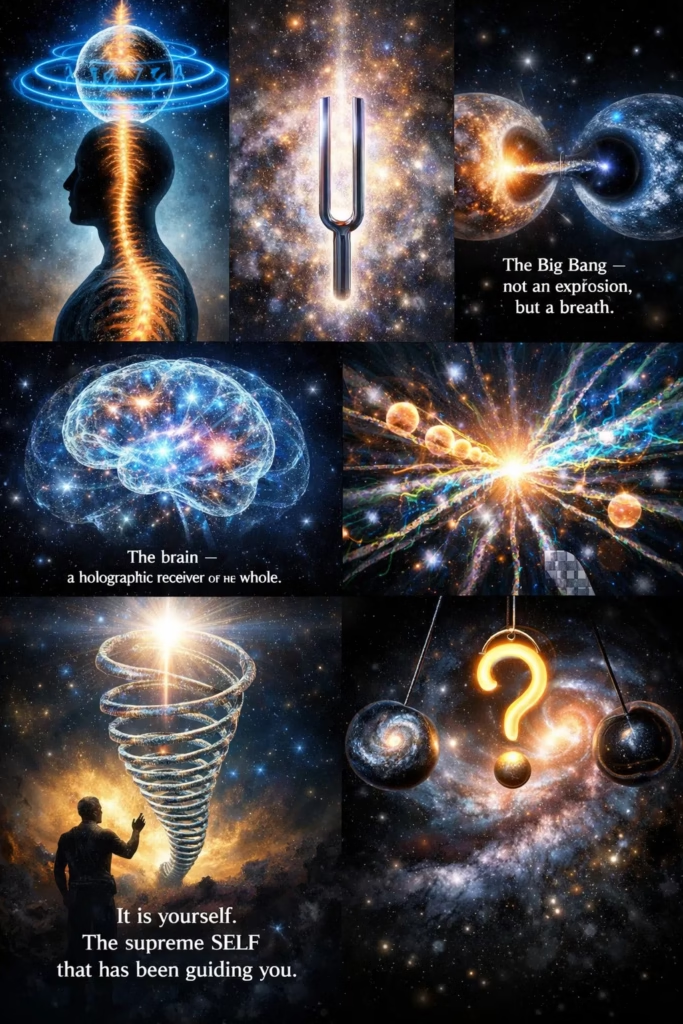
🌌 Fractal cosmos: The Big Bang as a breath, not an explosion
One of Bentov’s boldest ideas concerns the very structure of the universe. He did not see the Big Bang as a singular event at the beginning, but as part of a continuous cycle of compression and expansion – birth, development, and eventual disappearance. His model, inspired by contemporary observations of quasar distribution, describes the universe as a giant torus – a donut-like shape or a spiral that closes in on itself.
Matter emerges from a “white hole” at the top of an egg-like structure, travels along its surface, evolving into increasingly complex forms, only to eventually enter a “black hole” at the opposite end, where it – perhaps – returns to pure energy. In this model, time is not absolute; it is an internal property of the system – valid inside the torus, but not outside it. This is a concept reminiscent of what later physicists would call “time as an emergent phenomenon.”
This cycle, according to Bentov, repeats at all levels – from subatomic particles to galaxies. The universe is fractal. And consciousness, like matter, follows the same pattern.
🧠 The body as a resonant cavity: Schumann resonances and the brain
But Bentov did not merely philosophize about the cosmos. He also offered a physiological model – a mechanism by which consciousness immerses itself into matter.
According to Bentov, the human body is not just a biological machine, but a finely tuned oscillator. Every heartbeat sends a mechanical wave through the arteries, which travels up the spinal column and creates standing waves inside the skull. These waves have a frequency of about 7–8 Hz – which aligns remarkably well with the Earth’s fundamental Schumann resonance (7.83 Hz).
Bentov’s echoes of Tesla: Bentov discovered that human body oscillations at 7-8 Hz resonate with the Schumann resonance. In our post “Tesla Between Myth and Reality”, we wrote about how Tesla in 1899 detected standing waves in Earth’s ionosphere and estimated their frequency at about 8 Hz. Bentov, nearly eight decades later, suggested that human consciousness accesses precisely those frequencies – not by emitting them, but by tuning into them like a radio receiver.
Through meditation, breathing, or other techniques, these systems can synchronize. When that happens, according to Bentov, the nervous system becomes sensitive to nonlocal information fields – consciousness is no longer locked inside the skull. It becomes a receiver of a universal program.
“Bentov understood something we are only beginning to grasp,” writes one contemporary commentator. “The body is not a generator of consciousness – it is a transducer. The brain is an instrument that receives, processes, and translates into experience what already exists as a potential in the vacuum.”
🖼️ Holographic universe: Every part contains the whole
Perhaps Bentov’s most famous (and most influential) concept is the idea that the universe is a hologram – that every part of it contains information about the whole. In a holographic image, every fragment of a photograph contains the entire photograph, only at a lower resolution. Similarly, according to Bentov, every atom, every cell, every human being carries within itself an imprint of the entire cosmos.
This concept was not originally Bentov’s – he was inspired by the work of neurophysiologist Karl Pribram on the holographic nature of memory – but Bentov brought it into the mainstream of esotericism and connected it with consciousness. His idea: a universal mind exists as a vast, static holographic record – a “database” of everything that has ever happened, is happening, or will happen. Our consciousness is not the source of that information, but a processor that accesses it through the filter of the biological body.
This idea, though often dismissed today as “new age,” has interesting parallels with contemporary simulated universe theories or even with the holographic principle in string theory, independently developed by Gerard ‘t Hooft and Leonard Susskind. Bentov says: “The universe is a hologram, and our brain interprets it.” Physicists say: “Information about a volume of space can be encoded on its boundary.” Two languages, one intuition.
🧬 Bentov and Penrose – precursor or independent visionary?
When “The Emperor’s New Mind” was published in 1989, the world of theoretical physics was shaken by Roger Penrose – a mathematician whose contribution to the study of black holes and singularities was already legendary. Penrose posed a provocative thesis: human consciousness is non-algorithmic. It is not a matter of computation, no matter how complex. There is something in our experience of truth and mathematical intuition that no digital computer, however powerful, can mimic.
Penrose and his collaborator, anesthesiologist Stuart Hameroff, developed the theory of orchestrated objective reduction (Orch-OR). In it, consciousness arises when quantum superpositions in the microtubules of neuronal cells evolve coherently, only to objectively collapse at a certain moment (under the influence of quantum gravity) – and that collapse is the moment of consciousness.
Although there is no evidence that Penrose directly read Bentov, there are fascinating overlaps. Bentov considered the entire body an oscillator, with special emphasis on the cerebrospinal fluid and cranial waves, while Penrose and Hameroff focus on microtubules within neurons – nature’s quantum computers. Bentov spoke of standing waves and resonance at the Schumann frequency (7-8 Hz), while Penrose spoke of quantum coherence and the objective collapse of the wave function. Both, in their own ways, argued that the brain is not a generator of consciousness but a receiver – whether of a universal holographic field (Bentov) or of non-algorithmic mathematical truths (Penrose).
One of the key differences lies in the explanation of nonlocality. Bentov solved it with a holographic universe – consciousness is nonlocal because the information it processes is nonlocal. Penrose solved it with quantum mechanics – microtubules maintain coherence long enough for quantum nonlocality to become relevant at the macroscopic level.
But on one point they agreed: consciousness is not algorithmic. It is not a matter of programming. Both, in their own way, were an attack on the hard core of artificial intelligence that was triumphant at the time.
🌟 49 universes and the brilliant white light: Return to self
At the very top of Bentov’s cosmology lies a structure of 49 universes arranged in a spiral coil – each about 20 billion light-years in diameter. At the top of this spiral, Bentov writes, there is a brilliant entity that appears as dazzling white light. But it is not God in the traditional sense.
When the traveler of consciousness reaches that light, a surprise awaits: that light is oneself. The supreme architect and intelligence is the self, part of the void that has always existed. “That is YOU! It is YOUR OWN SELF, the supreme SELF that has been guiding you through a long and eventful journey back to yourself,” writes Bentov. Thus, we are – simultaneously – creators, actors, and observers of our own reality.
This is not mere pantheism. This is the radical implication of his model: if consciousness is a fundamental field that permeates the universe, then the difference between “me” and “the cosmos” is merely a matter of perceptual framework. By shifting that framework, past, present, and future become simultaneous.
🔮 Bentov today: Rejected by neuroscience, yet echoing in quantum biology
Let us admit – Bentov did not succeed. His ideas did not become part of mainstream neuroscience. There is no empirical evidence that standing waves in the aorta “launch the soul into orbit,” as his critics sarcastically note. Nevertheless, Bentov in many respects pointed in the right direction.
Today, research on heart-brain coherence, vagal tone, meditation and its influence on neural oscillations – all of this echoes what Bentov suggested nearly half a century ago. The notion of the “brain as a receiver” (rather than a generator) of consciousness is now being seriously considered within field theories of consciousness, such as those of John Joe McFadden or Karl Pribram.
Bentov was not a scientist in the classical sense. His ideas were more of a map for future research than a finished product. But that is precisely what makes him akin to Tesla: a man who, based on intuition and engineering sensibility, sensed layers of reality that formalism has yet to reach.
🧩 Conclusion: The pendulum that returns
Bentov’s pendulum has never stopped swinging. His books have become cult classics in esoteric circles, but their influence is slowly seeping into more serious waters. When researchers in 2025 write that “microtubules may be a quantum medium for consciousness” or that “consciousness is not a product of the brain but a field,” they are, knowingly or not, walking a path that Bentov cleared.
Penrose provided theoretical depth. Hameroff offered experimental hypotheses. But Bentov was the first – and perhaps the bravest – to pose the question that still seems too radical for the academic community: what if consciousness is fundamental, and matter emergent?
We at MilovanInnovation will not give a final answer. But we will continue to search.
Because, as Bentov wrote: “Consciousness pervades everything.”
And perhaps – just perhaps – even us.
“The limits of my language mean the limits of my world.” – Ludwig Wittgenstein
And Bentov would add: the limits of the world are not where matter ends, but where our willingness to explore it ends.
We continue the search.
☕ If you wish to support topics like this – exploration on the edge of science, intuition, and curiosity – you can treat me to a coffee. Every contribution goes directly into research, books, and unpaid hours.
👉 buymeacoffee.com/milovaninnovation
Thank you for being part of this story.
Leave a Reply