
Dating from the Middle Ages to the 1st century, blood that does not decay, pollen of Jerusalem, and an image no one painted – why the saddest day of Christianity still puzzles laboratories
🕯️ Introduction: The silence of Good Friday
Today we do not celebrate. Today we remember. Good Friday is the only day when the Church does not serve the Liturgy – because the Bridegroom has been taken, because the Light has been extinguished, because God has seemingly withdrawn from His own stage.
In the silence of this day, two material testimonies have defied both science and doubt for centuries: the Shroud of Turin and the True Cross. One bears the image of a crucified body. The other is supposedly the wood on which that body hung.
Are they authentic? The scientific answer is – complicated. But what is certain: regardless of the final verdict, they remain the most powerful material witnesses to the events that shaped the foundations of the Christian faith.
This post is our gift to your curiosity on this saddest, yet deepest, day.
📅 The dating problem: From a medieval forgery to the 1st century
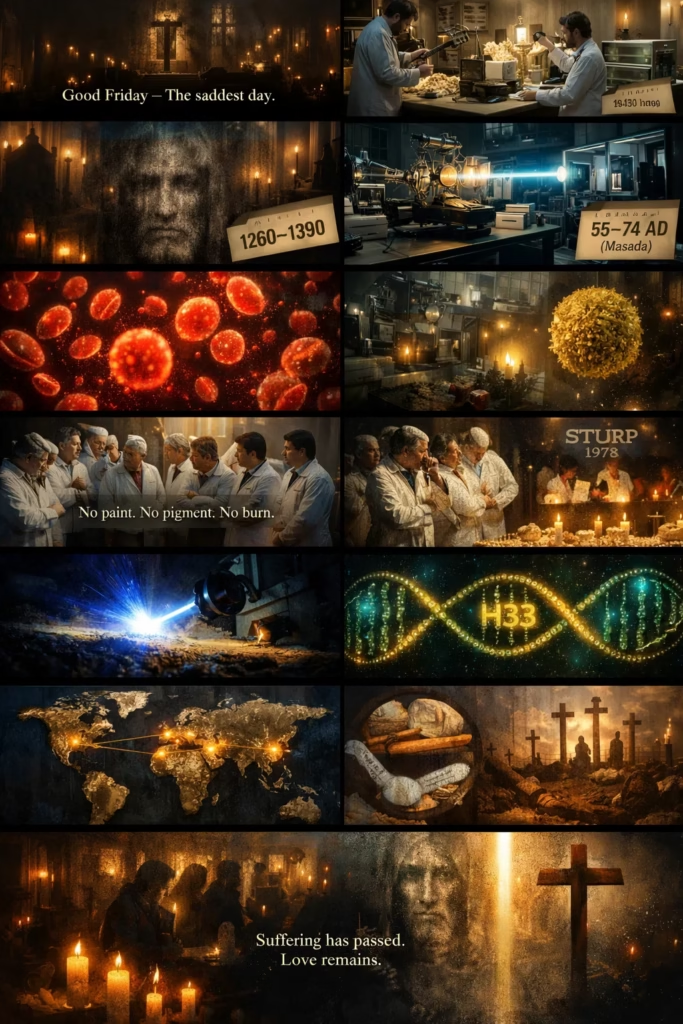
In 1988, a controversial radiocarbon (C14) dating placed the shroud in the period 1260–1390, declaring it a medieval forgery. For decades, this analysis was considered “final” proof against authenticity.
However, that analysis has been seriously challenged. Studies have shown that the sample was not properly cleaned and was taken from parts of the shroud that had suffered contamination over the centuries (fires, repairs, touching).
Wide-angle X-ray scattering (WAXS), applied in 2022 to a sample from the same area as the C14 analysis, showed complete compatibility with a sample from Masada (Israel) dated 55–74 AD. In other words: the structural degradation of the cellulose on the shroud corresponds to a fabric 2,000 years old.
More recent studies (2024, 2025, 2026) continue to complicate the picture. One DNA study published radiocarbon ranges on two threads of 1451–1622 and 1642–1800, suggesting later repairs, while another confirmed Middle Eastern origin and the presence of a rare haplogroup H33 pointing to the Levant.
Conclusion: the 1988 C14 dating is no longer considered final. Physics has returned the shroud to the 1st century.
🩸 Blood: Unusual properties that baffle scientists
Traces of human blood of blood type AB (the rarest group, found in only 3-5% of the world’s population) have been identified on the shroud. The blood is of Semitic origin.
Even more intriguing: the blood on the shroud shows no signs of decay, even though it remained on the fabric for more than 40 hours after death. Under normal conditions, blood that dries on fabric begins to decompose within days – this is absent.
Furthermore, the image and the blood are in such a relationship that the blood must have reached the shroud before the image was formed – which rules out the possibility that the image was painted. If someone had painted the body, the blood would be over the paint, or the paint would have smeared. Here the order is clear: first blood, then the image.
🌿 Pollen: The botanical signature of Jerusalem
Pollen grains of plants that grow exclusively in the Jerusalem area have been found on the shroud. Among them is the plant Akuvit Hagalgal (Gundelia tournefortii), which tradition says was used to make the crown of thorns.
This is one of the strongest pieces of evidence that the shroud resided in the Holy Land at some point in its history. Pollen could not have arrived by chance – it is fine, sticky, and specific. Its presence testifies to a long stay in the region.
🖼️ The formation of the image: A mystery beyond the Middle Ages
The STURP project (1978) – which gathered 33 top scientists (most of them non-believers) from NASA’s Jet Propulsion Laboratory and Los Alamos laboratories – proved that the image on the shroud was not created by physical contact, burning, paints, or pigments. Scientists to this day do not know how it was formed.
Italian researchers (ENEA) proposed that the image could have been created by a short, intense burst of ultraviolet radiation (UV laser) – a technology that did not exist in the Middle Ages. Only such an energy pulse could cause a color change on the surface of the fibers to a depth of only one fifth of a thousandth of a millimeter – which is exactly what is seen on the shroud.
This is technology that did not exist in the 1st century, nor in the Middle Ages, but only in the 20th century. Either – someone or something else created that image.
🧬 Latest DNA research (2026): More questions than answers
In April 2026, a comprehensive DNA study was published showing that the shroud over the centuries was exposed to people and environments from all over the world – the Mediterranean, India, and even North America. The findings are described as a “diverse mosaic of genetic traces.” This does not help determine who the original “man of the shroud” was, but it confirms that the relic traveled for centuries and was touched by many.
The presence of the rare haplogroup H33 – found today mainly among Druze in the Holy Land, Jordan, Lebanon, and Syria – supports the thesis that the shroud at some point resided in the Middle East.
✝️ The True Cross: From Empress Helena to fragments in hundreds of churches
According to tradition, the True Cross was found by Empress Helena (mother of Constantine the Great) in 326 AD during her pilgrimage to Jerusalem. At the site of Christ’s crucifixion – today the Church of the Holy Sepulchre – three crosses were reportedly found (Jesus’s and those of two thieves). The authentic cross was identified by the miracle of healing a sick woman.
Scientific analysis of wood fragments kept as relics of the True Cross around the world is extremely difficult, primarily due to the impossibility of sampling and the enormous number of fragments (medieval relic trade led to alleged pieces of the True Cross being found in hundreds of churches).
Nevertheless, studies have examined some fragments:
- Optical microscopy and radiocarbon dating have been applied to several fragments, with varying results (some date to the 1st century, others to later periods).
- Pollen and plant remains on some relics match the vegetation of Jerusalem.
However, because it is impossible to establish continuity from the 4th century to the present with certainty, most scientists remain cautious.
🕊️ Conclusion: Two testimonies, one Good Friday
What we can say with certainty:
- The 1988 C14 dating is no longer considered final; new physical methods (WAXS) indicate an age of 2,000 years.
- Biological traces (pollen, DNA, haplogroup H33) confirm the Middle Eastern origin of the shroud.
- The blood is of Semitic type AB, does not decay, and reached the shroud before the image was formed.
- The method of image formation still has no acceptable scientific explanation unless one accepts the hypothesis of an extremely short and powerful pulse of energy, akin to laser radiation – a technology that existed neither in the 1st century nor in the Middle Ages.
- DNA studies show that the shroud traveled for centuries and was touched by people from all continents.
- The True Cross remains powerful in Church tradition, but scientific confirmation of the authenticity of specific fragments is extremely complex and often impossible.
Yet, what is most important: both the Shroud of Turin and the True Cross, regardless of the final scientific verdict, remain the most powerful material witnesses that, on Good Friday and every other day, remind us of the events that shaped the foundations of the Christian faith.
A scientist may dispute dates. But they cannot dispute the impact. Billions of people over two thousand years have found meaning, hope, and redemption in that crucifixion. That is a fact above any laboratory.
“Truth is what stands despite not being proven.” – unknown author
And Good Friday reminds us: sometimes the deepest truths do not come from a microscope, but from silence.
Suffering has passed. Love remains.
☕ If you wish to support topics like this – exploration at the border of science, faith, and curiosity – you can treat me to a coffee. Every contribution goes directly into research, books, and unpaid hours.
👉 buymeacoffee.com/milovaninnovation
Thank you for being part of this story.
Leave a Reply