
Dear friends, travelers between science and spirit,
Last year on Holy Saturday I wrote about the phenomenon of the Holy Fire – a mystery that has challenged both faith and science for centuries. Today, in the midst of the worst tensions in a century, as the world dangerously approaches the brink of World War III and as the war in the Middle East shows no sign of calming, something unexpected happened. The security situation in Jerusalem is alarming. Israeli authorities reopened the holy complex only after it had been closed for 40 days due to the war with Iran. The streets of the Old City were under heightened police surveillance, and many wondered – would the ceremony take place at all?
It did.
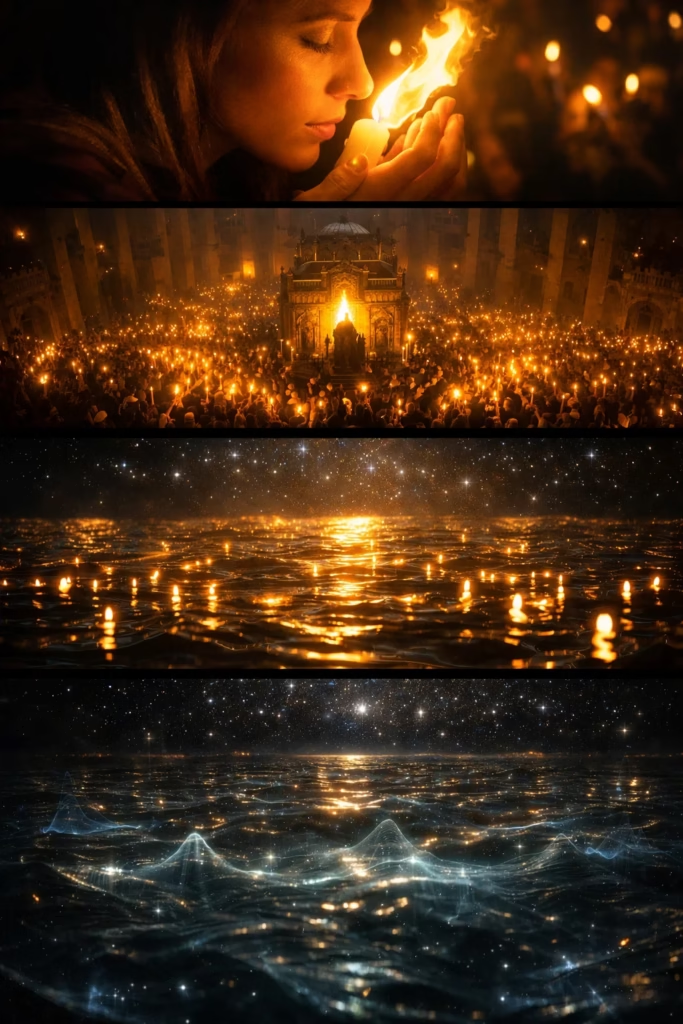
Thousands of faithful filled the Church of the Holy Sepulchre. In prayer, in silence, in anticipation. And then – light. Patriarch Theophilos III, as usual, entered the Edicule and after only a few minutes came out with lit candles. And what is especially significant – despite the war, despite the fear, despite everything – those present witnessed the same phenomenon that has for centuries repeated its silent victory over dark times. A flame that does not burn in the first minutes. Light that passes from candle to candle, out of darkness into light.
Imagine this scene: darkness, tensions, war literally at the doorstep – and then, out of the tomb, light emerges. As if through symbolism we are told – no matter how hopeless things seem, hope has not disappeared.
Holy Fire 2026: between control and miracle
What makes the ceremony particularly convincing is not the flame itself, but the rigor of the inspection that precedes it. The church is thoroughly searched and sealed beforehand to ensure there is no hidden source of fire. The Patriarch is examined by Israeli authorities before entering the tomb, to confirm he possesses no technical means of ignition. This oversight has existed for centuries – once performed by Turkish soldiers, today by Israeli police. And despite this, the fire appears.
Science has not yet offered a definitive explanation. Some attempts have been made to explain the phenomenon by chemical reactions, but none have been confirmed under the actual ritual conditions. Some researchers point to similarities between the Holy Fire and the Shroud of Turin, suggesting the source of light might be of the same origin. Others, like Greek journalist Dimitris Alikakos, claim it is a hoax, but he recently lost a court case against the Jerusalem Patriarchate, which sued him for spreading fake news.
And it is precisely here that room for speculation arises – not empty speculation, but the kind that expands the boundaries of our understanding.
The quantum mind and collective consciousness
In last year’s post I asked: can emotional unity, strong faith, and the spiritual energy of thousands of people gathered in one place affect the physical properties of the environment?
Quantum physics teaches us that the act of observation can change reality, that particles can be entangled over distance, and that systems exist in a state of superposition until observed. This is not mysticism – this is experimentally confirmed fact of the micro-world. The question becoming increasingly relevant is: can this principle extend to macroscopic phenomena? Can collective consciousness – synchronized attention of thousands of people – create conditions for a temporary anomaly in the behavior of matter?
This brings us to the concept of collective consciousness, described in some interpretations as a field that emerges from the interaction of individual consciousnesses and can affect physical reality. Quantum coherence and the observer effect provide a theoretical framework for understanding the connection between individual consciousness and collective experience. If consciousness is part of a quantum field, then a critical mass of focused attention – such as in the Church of the Holy Sepulchre – could act as an “observer” at the macroscopic level.
Return to an abandoned genius: Dirac’s sea and the informational basis of reality
And now we come to the most important part – connecting with our series of posts on the Dirac Sea and the nature of reality.
In 1930, faced with the problem of infinite negative energies in his equation, Paul Dirac proposed a revolutionary concept: the Dirac Sea – an invisible “sea” completely filled with negative energy states. The electron, according to this model, does not move through empty space but through this sea, and the positron is merely a “hole” in that sea.
Decades later, this idea takes on new life. Contemporary research in quantum information suggests that a negative information sea could be more fundamental than the space-time and matter we experience. In this model, what we call reality – particles, fields, space, time – emerges from a deeper informational layer. The consciousness of the observer, their knowledge of the measurement choice, acts like a “hole” in the informational sea and determines whether the system will manifest as a wave or as a particle.
This is not mere philosophy. This is a serious attempt to unite quantum theory and information theory into a coherent picture of reality – a picture in which information and consciousness are not byproducts of matter, but its building blocks.
Us in the Quantum Sea
Within our series “Emergent Spacetime: Is the Dirac Sea the Key to a New Physical Paradigm?” we explored precisely this: is space-time an illusion emerging from a deeper quantum-informational layer? And in the most recent post “Us in the Quantum Sea: Is Consciousness a Wave in the Dirac Sea?” we posed a question that reaches the very heart: if space-time is an illusion, and the Dirac Sea is the fundamental quantum-informational substance – what then is our consciousness?
If the wave function and information are more fundamental than what we experience as matter and energy in the space-time of our existence, then a phenomenon like the Holy Fire takes on completely new light. Perhaps it is not a supernatural miracle in the traditional sense, but a macroscopic quantum anomaly – a moment when collective consciousness, synchronized by prayer and faith, becomes coherent enough to “break” the surface of our emergent space-time and cause a temporary collapse of the wave function at the macroscopic level.
In other words: perhaps the Holy Fire is not a “miracle” that breaks the laws of physics. Perhaps it is proof that the laws of physics we know are not final – that beneath them lies a deeper layer of information and consciousness from which everything emerges.
Why is this important right now?
At a time when the world is sliding into catastrophe – when wars are being fought, tensions are at a peak, when hope seems to be fading – such phenomena are not merely religious rituals. They are signals. Reminders that the reality we experience is not the only possible one. That there is a deeper layer of existence in which light, hope, and unity are more fundamental than darkness and chaos.
The Dirac Sea is infinite. It is an ocean of potential from which everything emerges. And we – our consciousness, our faith, our collective attention – may be waves on the surface of that sea. Sometimes, when we are sufficiently aligned, those waves can become so powerful that for a moment they change the very nature of the surface.
The Holy Fire is such a wave. It does not explain everything. But it reminds us of something we may have forgotten: that reality is not solid, that consciousness is not a mere epiphenomenon of the brain, and that hope – even in the darkest times – has its own quantum weight.
Final thought
Dear readers, MilovanInnovation continues to explore phenomena at the crossroads of science, consciousness, and the unknown. The Holy Fire of 2026 is not just another ceremony – in light of our series on the Dirac Sea and emergent reality, it is a possible experimental proof that collective consciousness can affect material reality.
And while the world around us resembles the dark Edicule before the fire appears – let us remember: light always comes. Sometimes from the tomb. Sometimes from the sea. Sometimes – from within ourselves.
Easter is the symbolic triumph of life over death, but in the light of quantum theory, it may also be the triumph of information over entropy, consciousness over void. Christ is risen – and perhaps, just perhaps, the wave function within us rises as well.
📌 Follow the series “Dirac Sea” for a deeper understanding of these ideas. Next chapter: is consciousness a wave in the Dirac Sea – and what does that mean for our understanding of immortality?
– MilovanInnovation
Leave a Reply