Dear explorers at the crossroads of science and spirit,
In previous posts, we plunged into the Dirac Sea – that infinite ocean of quantum information, filled with negative energy states from which particles spring forth. We explored how discrete spacetime tests the stability of that sea, and how Penrose’s gravitization of quantum theory offers a solution: gravity as the great smoother that irons out quantum fluctuations, leaving us a smooth spacetime on large scales.
Today we take a step further and ask a question that changes everything: what is this sea made of? What is its internal structure, its “hydrodynamics”? The answer lies in one of the most beautiful mathematical constructions ever created – the Standard Model of particle physics – concisely written as SU(3) × SU(2) × U(1).
This formula is no mere mathematical abstraction. It is the score according to which the symphony of the three fundamental forces is played. And that same score reveals that forces, at their deepest level, are the striving of fields to return to a state of symmetry.
🎼 Three Stanzas of a Symphony: Gauge Symmetries and Force Carriers
Let us dive, for a moment, into the mathematical structure behind this beauty. Each fundamental force is described by a gauge symmetry group, and its carriers (gauge bosons) are the generators of that symmetry.
🔵 U(1) – The Electromagnetic Force and One Photon
This is the most elegant symmetry. The unitary group U(1) has only one generator – the photon. Mathematically, it is a complex phase that rotates the wave function of a charged particle. The freedom to perform a local phase transformation at every point in space, while leaving the equations unchanged, demands the existence of the photon as a compensating field.
The photon, therefore, is the guardian of symmetry. When an electron changes direction, the broken symmetry is “ironed out” by the emission or absorption of a photon. The force we feel as electromagnetism is a manifestation of the return to equilibrium.
🟡 SU(2) – The Weak Force and Three Virtual Gauge Bosons
The special unitary group SU(2) has three generators – the , and bosons. They are the carriers of the weak nuclear force, responsible for radioactive decay and fusion in the hearts of stars.
The matrix describing SU(2) transformations is a unitary 2×2 matrix with unit determinant. The three generators are, in essence, the Pauli matrices – the same ones that describe the spin of the electron. This group “rotates” particles in the abstract space of weak isospin, turning electrons into neutrinos, up quarks into down quarks.
At high energies, this symmetry is perfect and all three bosons are massless (virtual, like the photon). What we observe as distinct forces – electromagnetism and the weak force – is a consequence of spontaneous symmetry breaking. The Higgs mechanism gives mass to the W and Z bosons, “shattering” the perfect SU(2) symmetry at low energies and separating the picture into two apparently different forces.
🔴 SU(3) – The Strong Force and the Octet of Gluons
The special unitary group SU(3) has eight generators – the eight gluons that carry the strong nuclear force. They are the bearers of quark “color” (red, green, blue and their anti-colors), binding quarks into protons, neutrons and all atomic nuclei.
Mathematically, SU(3) is described by a unitary 3×3 matrix with unit determinant, acting on a three-dimensional complex color space. The eight generators are the Gell-Mann matrices – a generalization of the Pauli matrices for three dimensions. This theory, called quantum chromodynamics (QCD) , possesses an astonishing property: the further apart quarks are, the stronger the force between them becomes. Any attempt to separate them creates new quark-antiquark pairs. Quarks are forever confined – “confined” – within their SU(3) cages.
🌊 The Dirac Sea as an SU(3) × SU(2) × U(1) Ocean
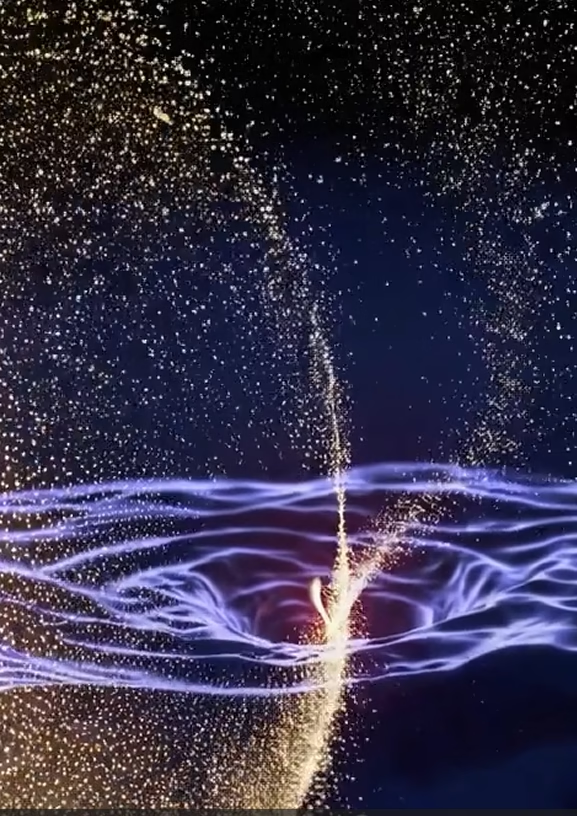
Now we arrive at the crucial insight: all of this – all three forces, all carriers, all symmetries – are part of the Dirac Sea. The sea is not empty; it is dynamic, structured and alive. Its “water” is not homogeneous, but made up of all quantum fields in their ground states.
When a Dirac electron (a solution of the Dirac equation) sails through this sea, it does not travel alone. It is an excitation of the electron field “immersed” in all other fields. Any breaking of symmetry – whether the acceleration of an electron, the decay of a neutron or the collision of quarks – manifests itself as a return to symmetry, and that return we feel as a force.
This is why the three forces are internal properties of the sea:
- Electromagnetism (U(1)) is the simplest ripple – a gentle ruffling of the phase.
- The weak force (SU(2)) is a more complex vortex – a threefold play of isospin.
- The strong force (SU(3)) is a deep, powerful ocean current – an eight-armed whirlpool of color structure.
All of them, at sufficiently high energies (above ~ GeV), are part of a single unified field. Their “differentiation” and “distinction” that we see at low energies is a consequence of spontaneous symmetry breaking – the Higgs mechanism is the iceberg that froze the ocean and separated its currents into three distinct forces.
💨 Gravity as the Wind: An External Influence Outside the Sea
But where does gravity fit in this picture? It is not part of the sea. It is not one of the currents, not a ripple, not a vortex. It is not inscribed in SU(3) × SU(2) × U(1).
Gravity is the wind. An external force blowing across the surface of the ocean.
And just as wind creates waves on water – without changing the water’s chemical composition, without becoming part of it – so too does gravity act on the Dirac Sea. It does not participate in the gauge symmetries, it is not carried by a force-carrying particle (the graviton), but is rather a manifestation of spacetime curvature.
Here we return to Penrose. The foaming of the sea’s surface is objective reduction (OR) – Penrose’s gravitational collapse of the wave function. When quantum superpositions within the sea become sufficiently “massive” (in terms of energy and curvature), the wind of gravity creates a wave on the surface. That wave is the transition from quantum to classical. The wind does not dive into the sea, it does not become a gluon or a photon, but it shapes everything that emerges from the sea into the observable, classical world.
This also resolves the ancient mystery: why is gravity so incredibly weak compared to the other forces? Because it is not the same kind of force. It does not live in the sea, it lives above the sea. It is geometry, not a field.
🌌 A Magnificent, Unified Picture
Now we can see the whole picture:
- The Dirac Sea is an infinite ocean of quantum fields whose elementary excitations are particles, and whose interactions are dictated by SU(3), SU(2) and U(1) gauge symmetries.
- Symmetry breaking (spontaneous and dynamic) creates the differences between forces at low energies, but at high energies everything melts into a single unified field – a single, symmetrical silence before the wind began to blow.
- Gravity is the wind – the only “force” that is not part of the sea. It does not originate from a gauge symmetry, but from the curvature of spacetime. Its influence is the collapse of the wave function, objective reduction – the foaming on the surface that translates quantum into actual.
- Dark energy is what remains after the wind has calmed most of the waves – it is the silent, persistent whisper of the ocean that could not be cancelled.
🔗 Toward New Physics
This picture – SU(3) × SU(2) × U(1) as the internal symphony of the Dirac Sea, and gravity as its external smoother – is not just a poetic metaphor. It suggests a path toward unification. A path where we do not try to forcibly cram gravity into the Standard Model, through quantization and gravitons, but accept that its nature is different.
Gravity is not just another fish in the sea. It is the wind that shapes the waves. And Penrose, with his model of objective reduction, may be the first captain who has learned to read that wind.
This post continues of“🌊Ψ Dirac and the Idea of Discrete Spacetime”.
Leave a Reply