Dear explorers,
When we sailed in previous posts through the Dirac Sea, the Standard Model, discrete spacetime and quantum archaeology, the shadow of two giant figures always loomed in the background – Roger Penrose and Stephen Hawking. Their story is not just the history of science. It is a living dialogue between two of the deepest principles of reality: gravity and quantum mechanics.
Today we do not sail forward, but pause to survey the horizon behind us. Because to understand where we are going, we must also understand where we come from – from one of the most sublime collaborations in the history of human thought.
🧭 Two Minds, One Revolution
In the 1960s, at the University of Cambridge, fate brought two men together. Roger Penrose, a mathematical physicist, was already obsessed with the problem of gravitational collapse. Stephen Hawking, a young physicist newly diagnosed with motor neuron disease, was searching for a deeper understanding of the cosmos. Together, they changed everything.
Their collaboration was not just the fruit of two extraordinary intellects. It was a synergy of geometric intuition and cosmological vision. Penrose brought new mathematical tools – topology, the concept of trapped surfaces, the global structure of spacetime. Hawking applied those tools to the entire Universe, asking questions no one before him had dared to ask.
🏆 A Shared Victory: The Singularity Theorems (1965–1970)
In 1965, Penrose published a revolutionary paper: under very general conditions, gravitational collapse inevitably leads to a singularity – a point of infinite density where the laws of physics break down. This was not an approximation, not a special case. It was a rigorous geometric proof that black holes – and their hearts – are inevitable consequences of Einstein’s theory.
Hawking immediately saw the significance. But while Penrose observed the collapse of stars and black holes, Hawking looked in the opposite direction – towards the beginning of time. If gravitational collapse led to a singularity, must not the expansion of the Universe have begun from a singularity? Together with Penrose, Hawking extended the singularity theorems to cosmology, proving that the Big Bang was a singularity – the point where space, time and matter came into being.
Paradoxically, Hawking may have grasped the cosmological implications of the theorem more deeply than Penrose himself. While Penrose remained focused on black holes and collapse, Hawking built an entire cosmogony from that theorem – a vision of a Universe with a beginning, middle and end. His doctoral dissertation, “Properties of Expanding Universes”, and subsequent works turned the singularity theorems into the foundation of modern cosmology.
⚡ The Great Schism: The Black Hole Information Paradox (1974–2015)
But just when they seemed inseparable, a rift emerged that would last for decades.
In 1974, Hawking published his most famous paper: black holes are not entirely black. Due to quantum effects near the horizon, they emit radiation – Hawking radiation – and slowly evaporate. This was the first successful application of quantum mechanics to a gravitational system. But it carried a terrifying consequence: if a black hole evaporates, the information about the matter that fell in is lost forever.
This was a direct challenge to one of the most sacred principles of quantum mechanics – unitarity, which holds that information is never destroyed, only relocated. Hawking argued that gravity violates this principle. Penrose, though generally skeptical of quantum orthodoxy, took the opposite position here: information cannot be lost.
Their debate, which also involved John Preskill and Kip Thorne, became legendary. In 2004, Hawking publicly “conceded defeat” and paid off the bet – yet many consider that the paradox was never truly resolved. In his later work, Penrose suggested that information could be preserved through the mechanism of cyclic cosmology: what falls into a black hole gets “re-recorded” into the next eon, in accordance with CCC cosmology.
🛤️ Two Paths to Unification
The rift over black holes was only a symptom of a deeper difference in approach to the unification of physics.
Hawking’s path: His starting point was quantum mechanics. He sympathized with string theory, believed in the sum over all possible histories (Feynman’s path integral) and together with Jim Hartle developed a model of no-boundary cosmology – a Universe without a beginning in time, where the Big Bang is merely a point in complex time, as smooth as the North Pole on a globe. Hawking wanted to “tame” gravity with quantum mechanics.
Penrose’s path: His starting point was the geometry of spacetime. His twistor theory from 1967 attempted to build fundamental physics from light rays in Minkowski space – before gravity was even included. Though he later admitted that twistor theory in its original form may not be correct (because it requires zero curvature, while observations point to a positive cosmological constant), his approach remains radically different: we should not quantize gravity, we should gravitize quantum theory.
Both were searching for the same final horizon, but from opposite shores. Hawking believed quantum mechanics would swallow gravity. Penrose believed gravity would swallow quantum mechanics – or at least reshape it through objective reduction.
🌅 Convergence on the Horizon
Despite all differences, the irony is that their views eventually drew closer.
In his later years, Hawking began to question standard quantum mechanics, suggesting that information might be preserved through non-trivial topological structures of spacetime. Penrose, for his part, acknowledged that Hawking radiation is real and that quantum effects near the horizon play a role that must not be ignored.
Both ultimately suspected that time is not fundamental. Both searched for a deeper, timeless description of reality. And both believed that the answer lies at the meeting point of gravity and quantum indeterminacy – the very place where our series on the Dirac Sea was born.
Perhaps the most beautiful expression of this convergence is precisely the famous Wheeler-DeWitt equation: the wave function of the Universe in which time does not exist. Hawking built his no-boundary cosmology upon it; Penrose sees in it a hint that the collapse of the wave function is that which creates time.
🏅 The Human Dimension: Nobel 2020
In 2020, Roger Penrose received the Nobel Prize in Physics – for the proof that black holes are a robust prediction of General Relativity. Half the prize went to him; the other half was shared by Reinhard Genzel and Andrea Ghez for the discovery of a supermassive black hole at the center of our galaxy.
Stephen Hawking was not on the podium. He died in 2018, on Pi Day (March 14), on the birthday of Albert Einstein. The Nobel Prize is not awarded posthumously – a rule that, in this case, was especially painful.
In interviews after the award, Penrose emphasized what many had already thought: that Hawking deserved a place on that podium. Their joint singularity theorem was the cornerstone upon which the modern understanding of black holes and cosmology was built. Had Hawking lived two more years, he would almost certainly have stood shoulder to shoulder with his old collaborator and rival.
There is something deeply moving in this. Two minds that debated for decades about information, singularities and the fate of the Universe – in the end shared the same fate as their black holes: one “evaporated” before the horizon of recognition, but the information about his contribution has not been lost. It lives in every paper, every theorem, every page written since those days in Cambridge.
🌊 Epilogue – The Dirac Sea and Two Captains
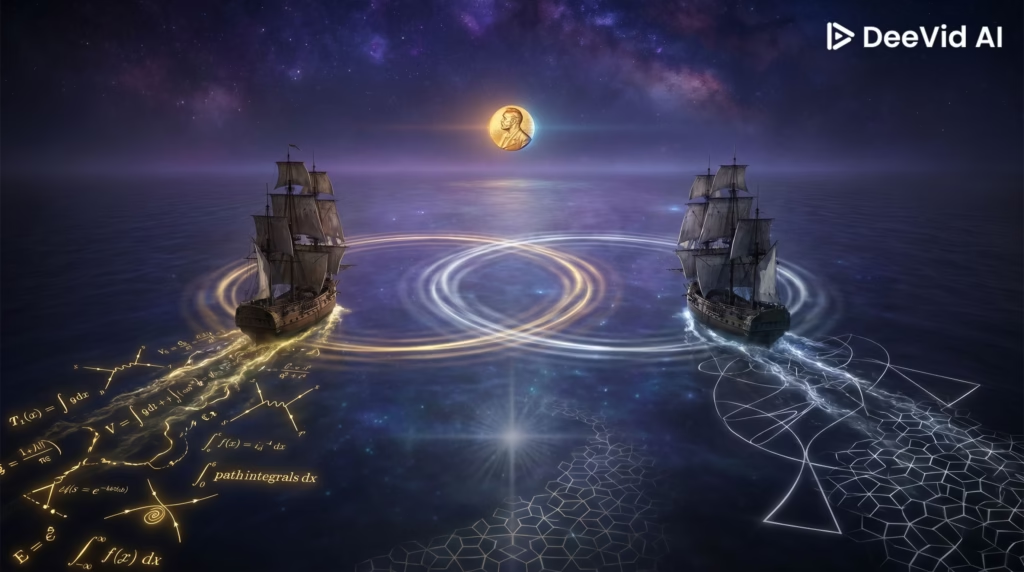
Somewhere on the infinite Dirac Sea, on the surface foaming with quantum fluctuations and gravitational wind, two ships sail. One is heading toward the horizon where gravity is quantized. The other sails toward the shore where quantum mechanics is gravitized.
Their captains – Penrose and Hawking – have not exchanged signals for years now. But their wakes cross on the water, their maps complement one another, their mathematical worlds reflect one another.
Their story is not finished. It continues in us – in the billion-atom experiment that will test Penrose’s mechanism, in the Big Ring that perhaps whispers Hawking points, in every new wave equation of the Dirac Sea.
For as long as there are explorers ready to dive, the sea is always clear.
This post continues the series begun with “⚛️ Quantum Archaeology: Reading the Past from the Dirac Sea” and continued through “🌊Ψ Dirac and the Idea of Discrete Spacetime”, “🌊🌀 Symphony of the Sea: SU(3) × SU(2) × U(1) and Gravity as Wind over the Dirac Ocean”, “🌌🔄 The Big Ring and the Echo from a Previous Eon” and “⏳🌊 The Wave that Measures Time”.
Leave a Reply