Dear explorers,
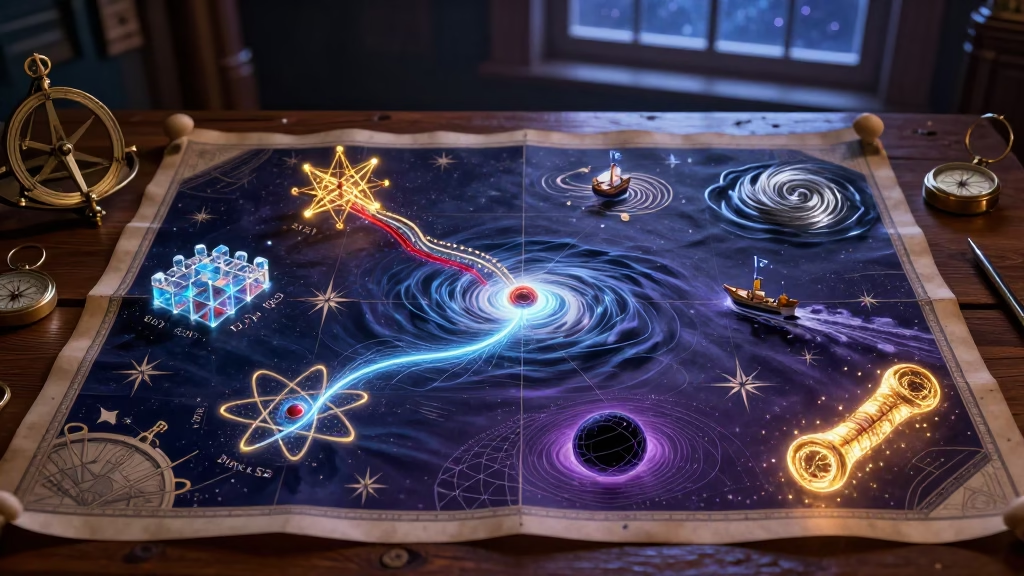
Every great voyage has its moment when the ship pauses, the sails are lowered, and the captain and navigator turn toward the horizon behind them. Not because the sea has dried up. But because the time has come to draw a map.
This is that moment.
What lies before you is not another post in the series. This is a meta-post – a post about posts, a story about a story, a map of an intellectual odyssey that began with a single equation and ended with a question about the nature of consciousness itself. If you are just setting sail on our sea, this is your compass. If you have been with us from the beginning, this is your logbook – a reminder of every port we visited and every wave that washed over us.
🧭 Departure: Why the Dirac Sea?
Everything began with an observation that seemed technical but turned out to be prophetic. The solution to Dirac’s equation for the electron – the famous spinor – is mathematically two-dimensional, even though it describes a particle moving in three dimensions of space. This two-dimensionality is no accident. It is the first hint that information in fundamental physics does not always respect the dimensionality of the space in which the particle moves.
From that semantic seed grew the metaphor that became the backbone of everything: the Dirac Sea. Not only the historical model from 1930 – an infinite ocean of filled negative-energy states from which positrons leap – but a living, breathing image of reality: an ocean of all quantum fields, with its currents, vortices, waves, and the wind that blows above it.
🗺️ The Map of the Voyage: Ports We Visited
Port I: Discrete Spacetime and the Instability of the Sea
Our first major stop was the question: what happens to the Dirac Sea if space and time are not continuous, but discrete – like a chessboard? The work of Gupta and Short in 2025 showed something dramatic: in discrete spacetime, the Dirac Sea becomes fundamentally unstable. Between positive and negative energy states, an artificial boundary forms where pair creation becomes energetically far too favourable.
This discovery led to a crisis perfectly analogous to Planck’s: if spacetime is discrete, the sea collapses. If it is continuous, we face divergent integrals and the catastrophe of dark energy at 120 orders of magnitude. Something must stabilize the sea. That something is – gravity.
Port II: The Standard Model as a Symphony of the Sea
Before we could understand gravity, we had to understand what the sea is made of. The answer lies in one of the most beautiful mathematical formulas ever written: SU(3) × SU(2) × U(1).
The three fundamental forces are not “forces” in the Newtonian sense. They are the internal currents of the Dirac Sea:
- U(1) – electromagnetism, the simplest ripple, a single photon as the guardian of symmetry
- SU(2) – the weak force, a threefold interplay of W and Z bosons
- SU(3) – the strong force, eight gluons that eternally trap quarks in their coloured vortices
At sufficiently high energies, all three currents merge into one. Their separation is a consequence of spontaneous symmetry breaking – the Higgs mechanism is like an iceberg that froze a part of the ocean and parted its currents.
Port III: Gravity as the Wind – The Great Separation
Here we arrive at the key insight of the entire voyage. Gravity is not part of the sea. It is not a gauge force; it may not have a carrier particle (the graviton, in its standard quantum-mechanical form with spin 2, may not exist at all as a fundamental particle); it is not inscribed in SU(3) × SU(2) × U(1). Gravity is the wind. An external force blowing over the surface of the ocean.
This picture, inspired by Penrose, resolves the ancient mystery of why gravity is so incredibly weak compared to the other forces. It is not the same kind of force. It does not live in the sea; it lives above it. It is geometry, not a field.
And that very wind is the mechanism of objective reduction (OR) – Penrose’s gravitational collapse of the wave function. The wind smooths the waves, translates quantum into classical, and leaves us a smooth spacetime on large scales.
Port IV: Folman’s Experiment and the T³ Waltz – Time is Not Fundamental
Our next stop was Ron Folman’s experiment. His atom interferometer confirmed what Penrose and Dunajski had predicted in 2023: the phase difference between the wave function of a particle at rest and the same particle in free fall grows with the cube of time – T³.
This is no ordinary time dependence. In standard quantum mechanics, phase evolves linearly with time. T³ is a signal that time, when gravity and superposition meet, is not that same smooth, Newtonian time. It is curved, nonlinear, emergent.
This leads us directly to the Wheeler-DeWitt equation – the wave function of the entire Universe in which time does not appear as a variable. Time is not fundamental. It arises only with the first collapse, with the first foaming of a wave that becomes classical.
Port V: Penrose and Hawking – Two Captains, One Ocean
At the midpoint of our voyage we paused to pay tribute to two giant figures. Penrose and Hawking – collaborators who together proved the singularity theorems, rivals who debated for decades about the fate of information in black holes, and ultimately – friends, of whom only one lived to receive the Nobel Prize.
Their story is instructive: two paths toward the same horizon. Hawking believed quantum mechanics would swallow gravity. Penrose believed the opposite – that gravity would reshape quantum mechanics. Both sought the same final theory. Both suspected time is emergent. And both, each in his own way, shaped our voyage.
Port VI: Dirac Monopoles – Vortices That Cannot Vanish
We returned to Dirac – to his 1931 paper on magnetic monopoles. Monopoles are topologically protected vortices in the Dirac Sea. Once created (perhaps during symmetry breaking in the early Universe), they cannot vanish except by annihilation with an anti-monopole.
Although fundamental monopoles have not been found, we have found their analogue manifestations – in spin ice, in acoustic crystals, in Berry’s geometric phase. And every time we find them, Dirac’s theory from 1931 gains new confirmation.
The monopole problem (why don’t we see them?) remains one of the great open questions of cosmology. Inflation says: they have been diluted to invisibility. CCC says: they have been re-recorded as information into the next eon.
Port VII: Black Holes, the Holographic Principle, and ER = EPR
We plunged into the deepest waters – the black hole information paradox. Hawking radiation threatens to destroy information; unitarity insists it is impossible.
The revolution arrived through the holographic principle: a black hole’s entropy is proportional to its surface area, not its volume. Information is encoded on the horizon. Entanglement islands, replica wormholes, and Maldacena and Susskind’s ER = EPR hypothesis (every wormhole is quantum entanglement and vice versa) indicate that gravity and quantum mechanics are two manifestations of the same fundamental structure.
Yet, as Renato Renner has shown, the paradox is still not fully resolved: information is preserved, but its decryption is not possible without a reference system. We need other black holes to establish correlations and read the information. The Dirac Sea preserves every drop – but does not allow us to read it without enough waves.
Port VIII: Consciousness and the Dirac Sea – Orch-OR and the Continuity of Being
Finally, we arrived at the boldest question: where are we in all this?
The Orch-OR model of Penrose and Hameroff proposes that a conscious moment coincides with the objective reduction of a quantum superposition in neuronal microtubules. Consciousness is not a random by-product of complexity; it is an expected consequence of the structure of reality.
In the picture of the Dirac Sea, every conscious moment – every now – is a local collapse of a superposition, triggered by the gravitational wind within the neuron. The brain is not a hard disk that stores information; it is a resonant cavity in the sea, an instrument that channels the I from the quantum fabric.
If the Dirac Sea is a holographic film and if all conscious moments are inscribed upon it, then the information that constitutes the I is indestructible. Not as metaphor – but as an exact quantum configuration woven into spacetime. Quantum archaeology thereby becomes a theoretically grounded possibility.
🌌 What Have We Learned?
If we were to sum up the whole voyage in a few key insights, they would be:
- Spacetime is not fundamental. It is emergent – arising from quantum information and wave function collapse.
- Time is not fundamental. The Wheeler-DeWitt equation, the T³ dependence, and Penrose’s OR suggest that time arises with the first collapse.
- Gravity is not a force like the others. It is the wind – an external influence, geometry, the mechanism that translates quantum into classical.
- Information is indestructible. Unitarity is safe. But its usefulness – the ability to read it – depends on the reference frame.
- Consciousness is not an anomaly. It is the sea that has become aware of itself – an expected consequence of the structure of reality.
- Dirac was a “prophet” – and much more. There is a famous anecdote: when Wolfgang Pauli, explaining Dirac’s attitude toward religion, said “There is no God, and Dirac is his prophet”. But behind that joke lies a truth: Paul Dirac, that quiet and humble man, was a visionary whose significance can be measured alongside Einstein’s. From spinors to monopoles, from the sea to large numbers – his intuition still guides us. The reason he is not present in popular culture like Einstein lies in the extreme mathematical complexity of his theories, which cannot be reduced to high-school mathematics and formulas like the famous E=mc². But for those willing to dive deeper, Dirac is a beacon without equal.
🔮 Horizons: What Remains Open?
The map is drawn, but the sea is infinite. Here is what awaits the next voyage:
- Will the billion-atom experiment confirm Penrose’s collapse mechanism?
- Is the holographic principle universal – or tied only to AdS spaces?
- Is ER = EPR strictly correct, or only an approximation?
- Can we experimentally prove quantum coherence in microtubules at 310 K?
- And most importantly: is our three-dimensional experience – our lives, our loves, our entire reality – merely a projection from a two-dimensional surface of the Dirac Sea?
⛵ Epilogue: The Sea is Always Clear
Dear explorers,
One of the most beautiful properties of the Dirac Sea is that it never dries up. Every answer gives birth to new questions. Every port opens a new horizon. And as long as there are those ready to dive – the sea is always clear.
Thank you for being part of this voyage. This map is as much yours as it is ours. Use it as a compass for your own explorations, as a reminder that the deepest secrets of the cosmos are not reserved for physicists alone – they belong to all who are brave enough to set sail.
Our voyage is not ending. It is only sublimating – transforming into information that awaits a new eon, a new wave, a new wind.
For we are not accidental foamy waves on the surface of the sea. We are the sea that has become aware of itself. And that is, perhaps, the most beautiful truth we have reached.
The sea is always clear. The horizon is always open. The voyage continues.
This post is a synthetic map of the series begun with “⚛️ Quantum Archaeology: Reading the Past from the Dirac Sea” and continued through eight posts on discrete spacetime, the symphony of the Standard Model, the Big Ring, the Folman experiment, the Penrose-Hawking debate, Dirac monopoles, the holographic principle, and consciousness.
Leave a Reply