This post continues the series on Tesla’s work, in which, by demystifying his achievements, we uncover the greatness of his engineering genius – a genius that still poses a challenge for analysis and mathematical modeling today.
Introduction: More Than an Ordinary Coil
We often imagine the Tesla coil as a dramatic device that creates lightning bolts at science fairs. At its heart, it is an air-core resonant transformer that converts a relatively modest input voltage into an extremely high output voltage at high frequency. Its genius lies not only in creating a spectacle, but in an entirely new concept of generating and transmitting energy.
Two Classic Configurations
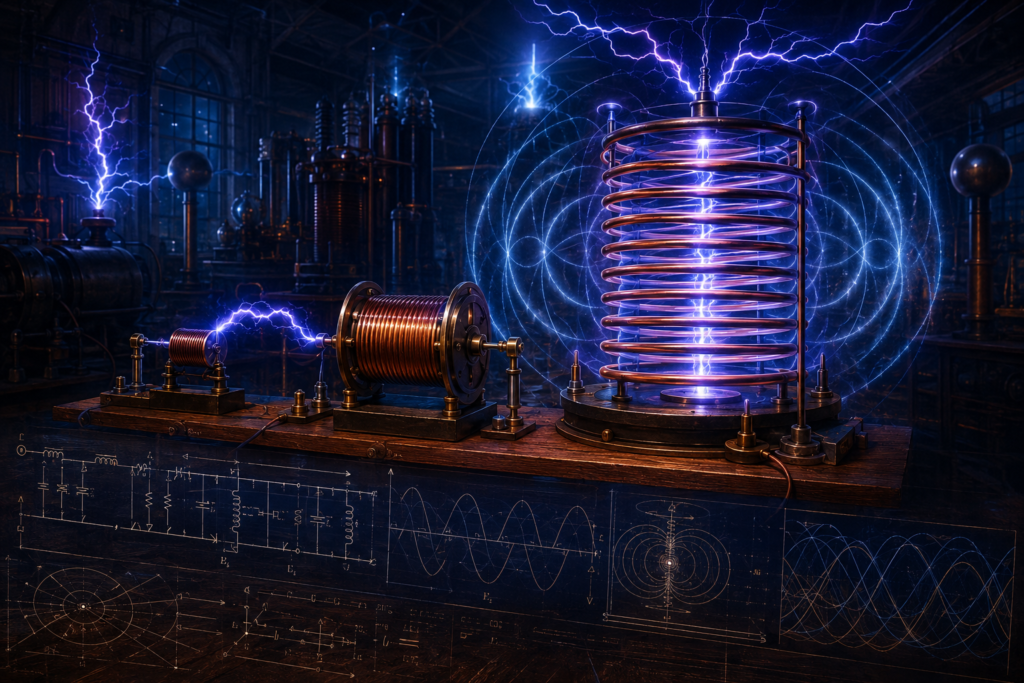
- Classic Tesla Coil: A two-coil system where the primary winding creates a strongly oscillating magnetic field.
- Tesla’s “Magnifier” (Amplifying Transmitter): A three-coil system where the secondary circuit is split into two parts for significantly greater efficiency.
💡 Detailed Analysis: The Role of Each Coil in the Magnifier
The third coil is no ordinary addition; it is the key element of Tesla’s “magnifier.” This configuration separates the functions that are combined in the classic Tesla coil, and each of the three coils has a clearly defined, specific role.
The primary creates the initial magnetic field and consists of just a few turns (usually 3 to 5) with very low inductance. It is connected to the secondary through an extremely tight inductive coupling. The secondary acts as a “driver” – it does not resonate independently but is part of the global circuit, tasked with stepping up the voltage, like a conventional transformer, to levels of several hundred thousand volts. It achieves a very high coupling coefficient with the primary, reaching values up to *k* ≈ 0.6.
Unlike the first two, the extra coil is a resonant amplifier and energy emitter. What makes it special is that it has no direct magnetic coupling with either the primary or the secondary. It is excited solely by the signal from the secondary, and for the system to function, its inductance (moment) must dominate over the rest of the circuit.
Extra Coil – Solving the Insulation Problem
This division of roles brings an enormous practical advantage. In the classic Tesla coil, the secondary is simultaneously part of the transformer and the resonant circuit, meaning extreme voltage appears at its terminals, easily causing insulation breakdown. The magnifier solves this problem elegantly: the output voltage from the secondary (now part of the “driver” section) is not sent directly into the ether, but instead excites the extra coil, a precisely tuned helical resonator. This third coil, through the principle of resonant amplification, further raises the voltage to the desired several million volts. Since this extreme voltage appears only at the ends of the extra coil, which is physically separated, the “driver” section (primary and secondary) operates at a much lower voltage and can be more tightly coupled without the danger of arcing.
🔬 Mathematical Modeling and the “Unfinished Story”
This is the heart of the mystery. While the basic principle is clear, precise mathematical modeling of Tesla’s magnifier remains a challenge today. Tesla’s system with an extra coil does not behave like an ordinary transformer with lumped parameters. Instead, it is a “slow-wave helical resonator” with distributed parameters.
- Distributed Element Model: More contemporary analyses treat the extra coil as a long line (transmission line) with distributed parameters (inductance, capacitance), rather than a simple coil. The wave propagation velocity through it is drastically reduced (to just 1% to 10% of the speed of light), enabling the creation of standing waves of enormous amplitude.
- Nonreciprocal Inductance: Even the famous physicist Paul Drude studied Tesla’s transformer and predicted that its mutual inductance was nonreciprocal. Although this is today considered an artifact of incorrect energy interpretation in the model, this finding reveals just how subtle the system’s behavior is.
- The “Triple Resonance” Problem: The extra coil, connected to the secondary, does not resonate independently. Together, they form a single “global” resonant circuit of extremely complex behavior. Analytically calculating its resonant frequency is exceedingly difficult, and engineering practice often resorts to empirical rules and computer simulations (e.g., Simplorer, Microsim).
- Empiricism and a “Feel”: Even the most experienced Tesla coil builders often speak of the need for “balancing” and a “feel” when tuning the system, which only confirms that a complete theory elegantly explaining all aspects does not yet exist. Mathematical descriptions of Tesla’s magnifier at a satisfactory level did not appear until 50–100 years after his work.
🌍 Conclusion: Tesla Ahead of His Time
Still, open questions remain, and Tesla’s work continues to inspire. Was there a fourth resonant circuit? Some researchers suggest that the system functioned as a “quadruple resonant system” that, in addition to the three coils, included the Earth as the fourth element – an idea that aligns with his concept of wireless energy transmission through the planet.
Tesla’s magnifier with its third coil was not only a triumph of engineering but also a vision. By separating the roles of transformation and resonance, he solved practical problems and stepped into operating regimes that elude simple theoretical models. Precisely this “unfinished story” in its modeling, this tension between a functional device and an incomplete theory, still inspires engineers and scientists to search for a deeper understanding. The secret of the extra coil lies in unraveling the subtleties of distributed parameters and resonant phenomena at the edge of possibility.
Leave a Reply