This post continues our renewed series on Tesla, in which we now, with greater technical and scientific depth, re-examine his most important insights. Today we return to one of Tesla’s deepest fascinations – birds – and discover how that love gave rise to inventions and ideas that modern science is only now beginning to understand.
🔬 Two Patents, Two Worlds of Innovation
Tesla’s passion for birds was not merely romantic. It was deeply engineering. Two of his patents best demonstrate this.
Patent 1,061,206 – A Pump Inspired by the Avian Heart
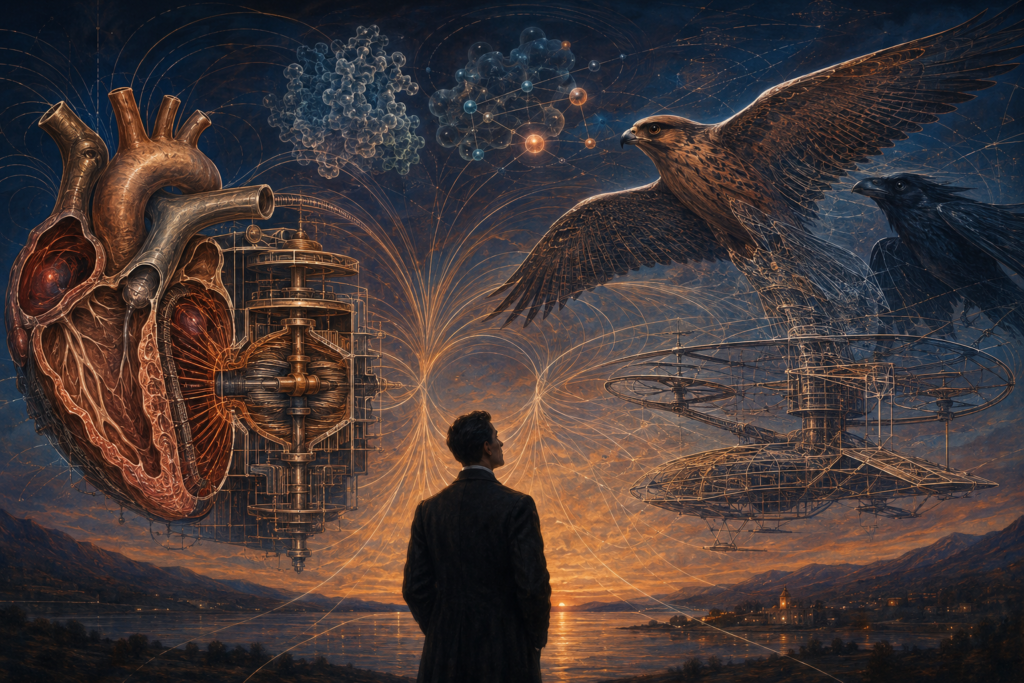
In 1913, Tesla patented a turbine pump whose concept was directly borrowed from the anatomy and physiology of a bird’s heart. The avian heart is an evolutionary peak of efficiency: four-chambered, with completely separated circulatory paths, capable of sustaining the incredible metabolism of flight. Tesla’s pump, like the heart, uses the principle of laminar flow through centrifugal acceleration, without pistons and valves, relying on rotating discs that create a consistent, pulse-free fluid flow. This was a radical departure from the pump technology of the time and a precursor to today’s highly efficient turbine pumps for medicine and industry.
Patent 1,655,113 – A Flying Vehicle Inspired by the Falcon and the Raven
Fourteen years later, in 1927, Tesla filed a patent for an aircraft that combines the flight techniques of two masters of the air: the falcon and the raven. From the falcon, he adopted vertical take-off and diving – the ability for sudden ascent and controlled high-speed descent. From the raven, he borrowed gliding and maneuvering in air currents – the ability to stay aloft with almost no wing flapping by using air currents. Tesla’s aircraft was meant to function on the “helicopter-airplane” principle, with tilting rotors enabling both vertical lift and horizontal flight. This concept was realized decades later in modern tilt-rotor aircraft like the V-22 Osprey, and at the time Tesla sketched it, aviation was still in its infancy. He didn’t just have a vision – he had a technical solution.
🧲 Tesla’s Intuition: Birds Read the Earth’s Magnetic Field
What is, however, even more fascinating than these patents is Tesla’s understanding of how birds function on a fundamental level. Tesla claimed that birds navigate their flight by reading the Earth’s magnetic field and that their brains operate at extremely high frequencies. In his time, these claims seemed like mystical speculation. Today, they are confirmed in laboratories.
Modern quantum biology has discovered a mechanism that elevates Tesla’s intuition to a level of incredible accuracy. Proteins called cryptochromes have been found in the retina of birds’ eyes. When a photon of light strikes this protein, it creates a radical pair – two molecules with unpaired electrons – that exist in a quantum entangled state. Even the extremely weak Earth’s magnetic field (only 25–65 microtesla) affects the delicate balance of these entangled spins, favoring one quantum state over another. The bird doesn’t “feel” this signal – it sees it. Literally. The magnetic field is projected into its visual field as a transparent filter or a compass overlaid on its sense of sight. This is Tesla’s claim, made a century ago, confirmed in the laboratories of the 21st century.
And not only that. Recent research suggests that quantum coherence in a bird’s brain can last long enough to enable navigation over thousands of kilometers. In other words, birds are living, whispering proof that macroscopic quantum effects are not just the domain of cold laboratory crystals – they are part of everyday biology.
🧠 “Birdbrain”: From Insult to Scientific Wonder
Yet another of Tesla’s claims has recently received spectacular scientific confirmation. The pejorative term “birdbrain” has become scientifically obsolete in light of discoveries that birds possess a neural density and efficiency that surpasses the human brain.
Unlike the human brain, where neurons are relatively large and spaced apart, the avian brain is packed with exceptionally dense neural units. Their connectivity is such that signals travel along shorter paths and with fewer losses. The result is a brain that works faster and more efficiently – literally at higher frequencies. Last year brought serious breakthroughs in the study of avian intelligence: it was discovered that birds, before mammals (including primates and humans), developed advanced intelligence, complex communication, and cultural transmission of knowledge from generation to generation. Crows use tools. Pigeons recognize human faces. Parrots understand the concept of zero. Songbirds learn songs from older birds – a form of culture resembling human language.
Tesla sensed that speed and that efficiency before anyone had the tools to measure it.
🎯 Conclusion: The Engineer Who Listened to the Universe Through Wings
Tesla’s obsession with birds was not the escapism of a lonely genius. It was a laboratory. In birds, he saw what he sought in his coils: perfect resonance, flawless efficiency, a direct connection to the forces that shape our world. His pump is not just a copy of a heart – it is a machine that breathes. His aircraft is not just an imitation of wings – it is an engineering response to the falcon and the raven. And his conviction that birds see the magnetic field and think at higher frequencies – that was not mysticism. That was an intuition that outpaced quantum biology by nearly a full century.
Today, when neuroscientists and quantum biologists confirm what Tesla claimed in the 1920s, we must ask ourselves: was Tesla simply ahead of his time, or did he possess the ability to directly sense frequencies we are still learning to measure?
What do you think? Was Tesla’s connection to birds mere inspiration, or proof that his mind operated on an entirely different frequency from ours?
Leave a Reply