This post is the last in our renewed series on Nikola Tesla. After journeying through his inventions, visions, patents, and spiritual explorations, we now close the circle – with the story of what happened after his death, how his legacy was preserved against all odds, and what his work means for us today.
⚰️ January 7, 1943: Death Without a Will
Nikola Tesla died alone, in hotel room 3327 of the New Yorker Hotel, on January 7, 1943. He was 86 years old. Official documentation states that Tesla died without a will – no legally valid document specified what should happen with his enormous quantity of manuscripts, patents, models, and personal belongings.
The New York court issued a ruling on his estate. Since there was no will, an executor was appointed to manage the legacy. The legal heir, the person entrusted by the court with Tesla’s property, was Sava Kosanović, Tesla’s nephew – the son of his sister Marica.
🛡️ Sava Kosanović: Savior, Not Plunderer
Sava Kosanović’s role went far beyond merely executing a court decision. Although he has often been contested precisely because of his political affiliation – he was a communist, a diplomat of the Kingdom of Yugoslavia, and later of the FNRY – it is precisely his persistent and complex actions that we owe for the fact that Tesla’s legacy exists as a whole at all and is preserved today in Belgrade.
In contemporary public discourse, especially in certain circles, there is a negative perception of Kosanović. His communist convictions and high state positions in socialist Yugoslavia lead some to suspect that he exploited Tesla’s legacy for political purposes. However, historical documents show something quite different. After being appointed ambassador of the FNRY to the USA in 1946, Kosanović engaged New York attorneys to fully settle all of Tesla’s outstanding debts. Only after all financial burdens were resolved could he proceed with the acquisition and transport of the legacy.
Without his engagement, administrative persistence, and knowledge of the American legal system, Tesla’s legacy would almost certainly have been scattered, sold off, or ended up in the hands of various creditors. His role is, objectively speaking, crucial for the preservation of a national and cultural treasure. We may debate Kosanović’s politics, but we cannot deny that it was he who saved Tesla from oblivion.
🔥 Cremation: A Pragmatic Decision, Not Tesla’s Wish
Immediately after his death, on January 12, 1943, Tesla was buried according to the Orthodox rite – first in a chapel, and then in a crypt at the Ferncliff Cemetery in New York. This respected the customs of the time and his family tradition.
However, in March of the same year, just two months later, Sava Kosanović made the decision to have Tesla’s body exhumed and cremated.
Why? There is not a single written document – will, letter, or statement – in which Tesla explicitly requests to be cremated. Cremation was not Tesla’s personal wish, at least not one that was ever recorded. It was a pragmatic decision by his heir, likely motivated by practical reasons: cremated remains are far lighter and cheaper to transport over great distances. In this case, it opened the way for eventual transfer to Belgrade – which happened in 1957, when the urn with Tesla’s ashes was brought to the Nikola Tesla Museum.
This is also the main reason why controversies persist to this day: part of the public considers that Orthodox tradition was violated, while others point out that it was the only possibility for Tesla’s mortal remains to return to his homeland at all. The truth is, as usual, somewhere in between – Kosanović’s decision was driven by logistics and love for his uncle’s work, not by ideology.
💸 Debts: The Price of Visionary Genius
Tesla did die in debt, but it is important to understand why. He was not poor – on the contrary, he was extremely wealthy on multiple occasions. However, his character and vision led to financial ruin.
The main source of debt was the Wardenclyffe Tower. After terminating his extremely lucrative contract with George Westinghouse – thereby giving up future royalties from alternating current, which would have made him a billionaire – Tesla poured all his money and enormous loans, primarily from banker J.P. Morgan, into building his most ambitious project: the tower on Long Island for wireless energy transmission.
We wrote about this visionary project in detail in one of our earlier posts. Tesla did not manage to prove economically viable wireless power transmission over great distances. When Morgan realized the project would not yield profit, he pulled financial support. In 1917, the tower was demolished, and its remains were sold as scrap iron to pay off the debts.
This is the most tragic trait of Tesla’s life: the man who invented the future did not know how to sell it. His investors wanted a quick return on their investment, and Tesla offered a revolution. And at that point, their paths diverged.
🌐 From the Second to the Fourth Industrial Revolution
Fortunately, Tesla’s ideas did not end as scrap iron.
His inventions and ideas marked the Second Industrial Revolution – the one that brought electrification, alternating current, wireless communications, and the progress that made our way of life possible. Without Tesla’s patents, the world would look different – and not in a better sense.
But his financially unsuccessful projects, above all the Wardenclyffe Tower and the “World System,” did not disappear. They continued to inspire future generations of engineers. Today, within the framework of the Fourth Industrial Revolution, Tesla’s ideas and concepts are being realized through:
- Wireless telecommunications technologies – from 5G networks to satellite internet, Tesla’s vision of global wireless connectivity has become a reality.
- Robotics and automation – his 1898 patent for remote control is the direct ancestor of today’s drones and autonomous vehicles.
- A new approach to energy – renewable sources, wireless energy transmission over short distances, and concepts of distributed energy networks.
🔭 The Unfinished Task: What Tesla Leaves to Us
Yet, part of Tesla’s visions remains unfinished – and perhaps the most important part.
Free and universally available energy. Tesla believed that energy should be like air – accessible to everyone, everywhere, at no cost. That vision sounds utopian today, but in an era of climate change and energy crises, the question of universal access to clean energy is becoming a question of survival, not ideology.
Weather and climate control. Tesla dreamed of irrigating deserts and creating fertile soil where none had ever existed. Today, as we face droughts, floods, and extreme weather events, his ideas about electromagnetic influence on the atmosphere gain new weight.
Humanistic visions. Tesla believed that technology should serve humanity, not the other way around. His dream of technology accessible to every person, development in harmony with nature, and a new approach to medicine – these are tasks that stand before us and the future generation of engineers and scientists.
It seems this is a matter not only of sustainable development, but of the very survival of humanity on the only planet we have. Tesla knew this more than a century ago.
🕊️ A Lighthouse in the Dirac Sea
Although we are closing this series, Nikola Tesla remains a lasting inspiration for MilovanInnovation – one of the most powerful lights illuminating the development of present and future technologies. And a harbor to which we shall return.
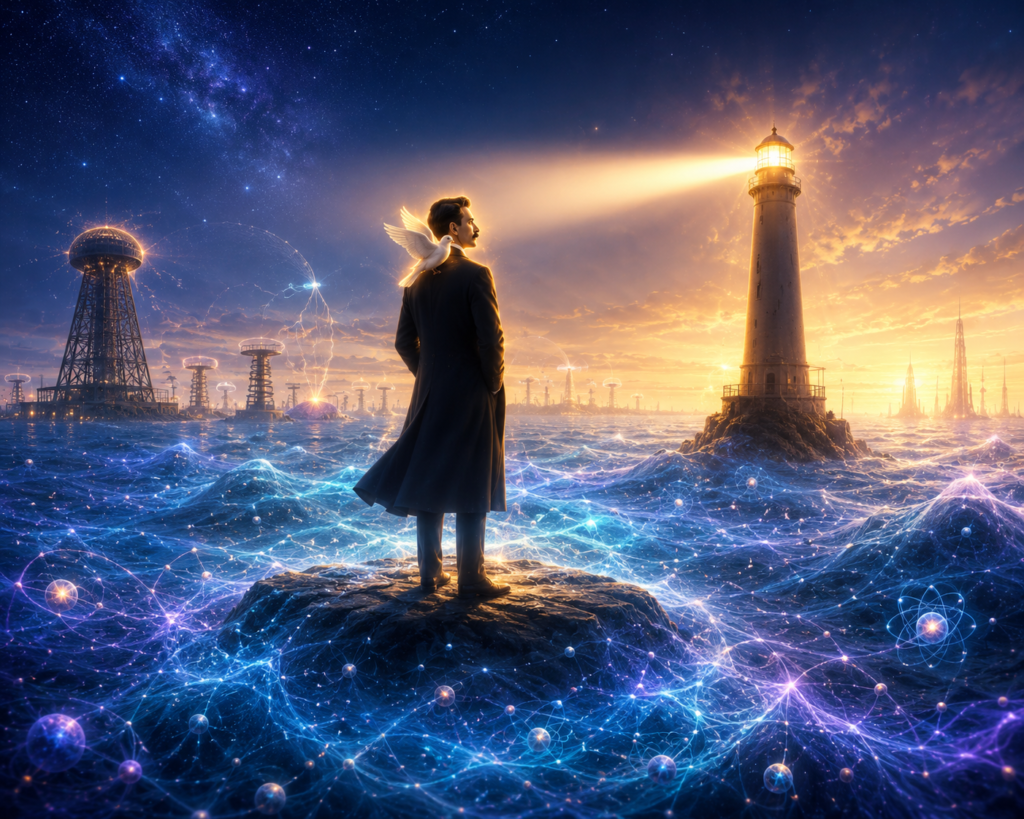
I imagine him like this: Nikola Tesla and his white dove, together on an island in the Dirac Sea – that endless ocean of quantum fluctuations, virtual particles, and zero-point energy. He stands there, thin and tall, with that gentle, absent smile of his, as the dove alights on his shoulder. And they shine. Both of them shine. Like an eternal lighthouse for our voyage toward the final truths.
He did not flee the world. He is waiting for us. Waiting for us to catch up with what he saw.
Thank you for being with us on this journey. This is not the end – this is only a station. Tesla is still calling us. And we, as always, continue to sail.
Leave a Reply