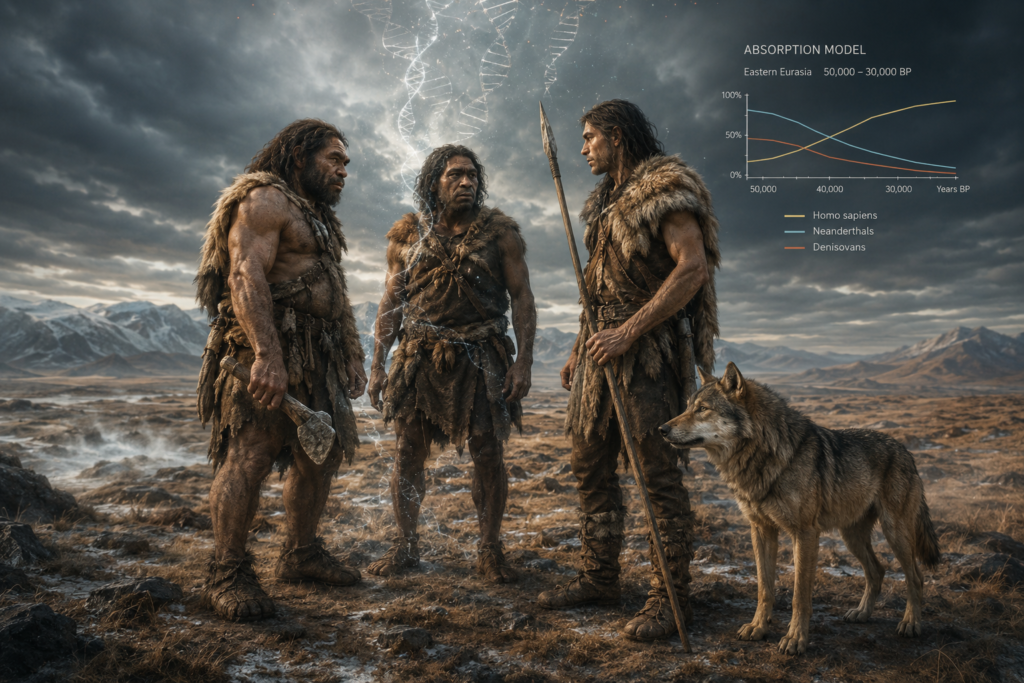
For a long time, we thought that human evolution was a linear story: one branch won, and all others simply went extinct. Today we know that the truth is far more complex and fascinating. Instead of replacement, there was absorption.
🧬 Timeline of Encounters: When Worlds Met
About 60,000 years ago, a small group of Homo sapiens left Africa. By then, Eurasia was already ruled by Neanderthals (who had been there for more than 200,000 years), while the east belonged to the mysterious Denisovans. These encounters were not simple “meetings” – they shaped our genetic code and our history.
Overlap in Europe and Asia
Neanderthals and modern humans shared Europe for at least 5,000–10,000 years before Neanderthals finally disappeared around 40,000 years ago. In Asia, Denisovans survived longer – their presence has been recorded until 32,000–48,000 years ago.
But not all encounters were peaceful. The first waves of migrants (such as the population that lived in northern Europe about 45,000 years ago and produced characteristic leaf‑shaped stone tools) disappeared completely without any trace in modern DNA. Humans tried to colonise Eurasia several times, but their populations often died out before they could establish themselves.
🧬 Mixing and Genes: How Our Relatives Moved Into Our DNA
Today we know that all non‑Africans carry 1–4% Neanderthal DNA, while Oceanians (e.g., Papua New Guinea) have an additional 4–6% Denisovan DNA. These percentages are the result of at least two main waves of interbreeding:
- An early wave with Neanderthals (about 50,000–60,000 years ago, probably in the Middle East)
- A later wave with Denisovans (about 45,000 years ago, probably in Southeast Asia)
But these percentages hide even more fascinating details. The Neanderthal genes we carry are not evenly distributed – some regions of our genome are particularly “Neanderthal‑rich”, while others (such as areas related to speech and social cognition) are strikingly “clean”. This suggests that some Neanderthal alleles were beneficial and retained, while others were harmful and quickly eliminated by natural selection.
Welcome Genes: What Did We Inherit from Our Relatives?
Neanderthal genes gave us:
- A stronger immune system – alleles that helped our ancestors fight off new pathogens outside Africa
- Adaptation to colder climates – genes for fat metabolism and bone density
- Hair and skin colour – variants associated with lighter pigmentation
- Even a tendency toward allergies and depression (less desirable inheritance)
Denisovan genes also left their mark:
- The EPAS1 gene – enables adaptation to high altitudes (passed on to Tibetans)
- Enhanced immunity to viruses and bacteria (discovered in the latest studies from 2025–2026)
- Variants linked to lipid metabolism and cold resistance
👻 The “Ghost” in the Genome: Even Deeper Roots of Mixing
Neanderthals and Denisovans were not the only relatives we mixed with. The latest genetic research from 2025/2026 has revealed the existence of a so‑called “super‑archaic” population – ancient hominins that split from our lineage more than 1.5 million years ago.
This mysterious population left a trace in the genes of modern humans, especially in Africa. According to studies published in 2026 (Rogers et al., Durvasula & Sankararaman), some West African populations derive 2–19% of their genetic ancestry from this “super‑archaic” population, which diverged from the common ancestor of Neanderthals and modern humans more than 1.5 million years ago. This super‑archaic population interbred not only with the ancestors of modern humans, but also with the common ancestors of Neanderthals and Denisovans, as well as with Denisovans themselves. Research suggests there were at least two distinct super‑archaic populations – one that contributed to Eurasian archaic hominins (Denisovans and the common ancestors of Neanderthals and Denisovans) and another, African one that mixed with the ancestors of all modern humans and contributed as much as about 20% of the genome of early modern humans in Africa. This is evidence that inter‑species mixing was the rule, not the exception, throughout human evolution.
🧠 Who Was Smarter? Cognitive Differences and Superiority
One of the key questions is: why did we survive, while Neanderthals and Denisovans did not? Were we smarter?
The answer is not simple. Neanderthals had brains of similar or even slightly larger volume than modern humans, and archaeological evidence shows that they:
- Made sophisticated stone tools
- Controlled fire
- Buried their dead
- Cared for the sick and elderly
- Made jewellery from eagle talons (indicating symbolic thinking)
Nevertheless, the latest research points to subtle but crucial differences in brain architecture and attention. Neurogenetic studies have revealed that modern humans have 48 genes related to attention that differ in Neanderthals and Denisovans. These genetic differences affected:
- The speed and efficiency of signal transmission in the brain
- The ability to sustain complex attention (necessary for advanced planning)
- Social cognition and cooperation over long distances
Perhaps the greatest advantage of Homo sapiens lies in our ability to connect large groups and exchange information over distances. Neanderthals lived in small, isolated groups, which limited the flow of ideas and genes. In contrast, modern humans developed larger social networks (real ones, not virtual or digital) that enabled faster spread of technological innovations and population growth.
🐕 Dog – Human’s Best Ally: How Animal Domestication Tipped the Balance
But there is another, often overlooked advantage of Homo sapiens, one not directly related to our brain – the ability to domesticate other species. Neanderthals and Denisovans, as far as we know, left no traces of animal domestication. We did. And early.
The First Friend: The Dog
The latest genetic and archaeological research published in 2025 and 2026 (Bergström et al., 2026; Scarsbrook et al., 2026; Romano et al., 2025) has pushed back the dates of dog domestication. The oldest unequivocal evidence of dogs living alongside humans dates to about 15,800 years ago – dog fossils from Switzerland and Germany show that they were genetically completely separate from wolves and were buried together with humans. Even earlier finds, such as those from Bàsura Cave in Italy, show traces of humans and dogs from 14,400 years ago, walking together, their tracks intersecting, indicating simultaneous movement. The dog was the first domesticated animal, long before sheep, goats or cattle.
What did the dog bring to Homo sapiens?
- Exceptional sense of smell and hearing – dogs could sniff out prey or predators long before humans would notice them.
- Speed and strength – in hunting, dogs were irreplaceable allies, able to chase and catch prey that was beyond human reach.
- Night guard – with dogs, humans could sleep more safely, as dogs would warn them of approaching danger.
- Warmth and companionship – in the icy conditions of Europe, dogs shared body heat and provided emotional support.
Neanderthals had no dogs. There is no archaeological or genetic evidence that Neanderthals domesticated wolves. When H. sapiens arrived in Europe, they arrived with a four‑legged ally that gave them a huge advantage in hunting, protection and survival. That was an advantage that the superior physical strength of Neanderthals could not overcome.
Livestock and Milk: Food in Times of Scarcity
After the dog paved the way, the domestication of other animals followed. Sheep, goats and cattle were domesticated in the Neolithic, but their impact on the later survival of Homo sapiens was decisive. These animals provided:
- A reliable source of meat – instead of depending on hunting success, humans could slaughter their own livestock.
- Milk – in times of scarcity, milk was a vital source of protein and fat. The emergence of lactose tolerance (which developed independently in several populations about 5,000–10,000 years ago) further enhanced this advantage.
- Hide, wool and bone – for clothing, shelter and tools.
Neanderthals and Denisovans had neither dogs nor livestock. They relied solely on hunting and gathering. When food became scarce – and during glaciations and megadroughts that happened often – their populations shrank dramatically. Homo sapiens, on the other hand, had a safety net in the form of their animals.
🔥 Why Did They Disappear? Struggle for Dominance and Climate Impact
The latest extinction models (from 2025) show that two key factors were responsible for the disappearance of Neanderthals: demographic collapse and climate change.
Mathematical Model of Genetic Absorption
One of the most convincing models, published in Scientific Reports in 2025, shows that no violence or superiority was needed for Neanderthals to disappear. It was enough that over 10,000–30,000 years a small group of modern humans (just a few hundred) gradually mixed with Neanderthals in Europe. Because of a slightly higher birth rate among modern humans (even a 1–2% difference), Neanderthal genes were gradually “diluted” until they vanished. Neanderthals were not killed – they were absorbed.
Climate Change
At the same time, climate change further hampered Neanderthal survival. Sudden temperature and vegetation swings between 55,000 and 30,000 years ago in the past reduced the areas suitable for their way of life. However, even these changes were not sufficient on their own to cause extinction – they acted in synergy with the arrival of H. sapiens.
The Fate of the Denisovans
Denisovans probably disappeared under similar circumstances, but with one key difference – their territory was huge (from Siberia to Southeast Asia and Tibet), and the last traces (rib fossils dated 32,000–48,000 years old from the Tibetan Plateau) show that they survived longer than Neanderthals, probably in isolated mountain areas.
🏆 Why Did We Win? Key Advantages of Homo sapiens
What set us apart from our relatives were several key advantages:
- Long‑range social networks – Our ability to maintain contacts over great distances (confirmed by exchange of tools and ornaments across thousands of kilometres) enabled faster spread of innovations and greater genetic diversity.
- Advanced technology and symbolic culture – Although Neanderthals also made tools, modern humans developed more complex tools (e.g., spear throwers) and symbolic systems (art, jewellery, body decoration) that strengthened group identity and cooperation.
- Higher reproduction rate – Even a small difference in birth rate (1–2%) is enough to lead to complete population replacement over 10,000 years.
- Dietary flexibility and migration – Modern humans adapted more quickly to new environments and exploited more diverse food sources, enabling faster colonisation of new areas.
- Animal domestication – This is an often overlooked advantage, but it was crucial. The dog was first, followed by other animals – sheep, goats, cattle. These animals provided a reliable source of food, warmth, protection and raw materials. Neanderthals and Denisovans had nothing like it.
✨ Conclusion: The Victory of Assimilation and Alliance
The next time you look at a European or an Asian, remember that inside each of us lives a small part of Neanderthal, Denisovan and perhaps even some “super‑archaic ghost”. Our story is not a story of a pure lineage winning, but of successful assimilation – how one branch absorbed all the others, retaining their useful traits while their bodies were left to oblivion.
But our victory was not only genetic. It was also ecological and social. We brought with us dogs and livestock, we built cooperation networks that stretched thousands of kilometres, and we learned to use every resource nature offered.
The next time you pet your dog, remember – it was precisely such a creature, more than 15,000 years ago, that may have tipped the balance in the struggle for survival between two human species. The dog was and remains human’s best ally.
Nature, it seems, hid the most successful survival strategy in genetic diversity, cooperation and – the ability to forge friendships beyond the boundaries of our own species.
☕ If you wish to support topics like this – research at the intersection of palaeontology, genetics and curiosity – you can buy me a coffee. Every contribution goes directly into research, books and unpaid hours.
buymeacoffee.com/milovaninnovation
Thank you for being part of this story.
Leave a Reply