
Dear explorers,
In our previous voyage, through Wojciech Zurek’s Quantum Darwinism, we touched upon one of the deepest properties of quantum reality – the difference between classical and quantum composite systems. This post is for those who wish to dive deeper, to the very mathematical fabric of the Dirac Sea. Here we shall use Dirac notation – the very same notation our captain laid down as a foundation – to understand why the sea in which we sail is infinitely richer than any classical ocean.
🧩 Classical Composition: The Cartesian Product
Imagine two classical systems. A ball at position and another ball at position . The state of this system with two balls is simply an ordered pair:
This is the Cartesian product. If you know the state of the whole, you automatically know the state of each part individually. The parts are independent. The whole is the sum of its parts. The dimension of the state space is (in the sense of the number of degrees of freedom), and the number of possible states is the product of the numbers of states of the individual systems.
In the classical world, when two systems interact and separate, they carry their individual properties with them. They are separable. Their shared history creates no mysterious connection.
🧬 Quantum Composition: The Tensor Product
The quantum world is radically different. Here, composite systems are described by the tensor product of Hilbert spaces. If you have two quantum systems, one in a Hilbert space of dimension , and the other in of dimension , their joint state space is:
whose dimension is the product of the dimensions: .
This is not merely a technical difference. It is an ontological difference. The tensor product contains far more states than you would expect based on classical intuition.
📐 Formal Definition of the Tensor Product
For two vectors and , their tensor product (often also written as ) is a bilinear form with the property:
and analogously for the second factor.
If and form bases of their respective spaces, then forms a basis of the space . Every state in can be written as a linear combination of these basis vectors.
🔗 Entanglement: States That Are Not Products
And now comes the essence. There exist states in that cannot be written as a tensor product of subsystem states. Such states are called entangled.
The simplest example is the famous Bell state for two qubits (two electrons, each with spin 1/2):
This state is pure – it is a single vector in the four-dimensional space . But it cannot be written as for any and Try it: you would need to find and such that their product yields for the term and for the term . This is impossible.
📊 What Does This Mean for Subsystems? The Density Matrix
When the state of the whole is pure but entangled, the state of a subsystem is not pure. It is mixed. Mathematically, it is described using the state density via the partial trace (the sum of the diagonal elements of the tensor describing subsystem B):
For the Bell state, we obtain:
This is a maximally mixed state. The von Neumann entropy of this state is (for a qubit). This means we know nothing about the state of electron A – it is completely indeterminate, like a fair coin toss. And yet, the state of the whole is completely definite and has entropy zero.
This is the heart of Zurek’s postulate (o): a known whole does not guarantee known parts. In the classical world, knowing the whole automatically means knowing the parts. In the quantum world, the whole is more than the sum of its parts – it contains correlations that belong to no single part alone.
🧠 Why Is This Crucial for the Measurement Problem?
Zurek here takes the next, fateful step. The measurement problem arises precisely because subsystems exist.
When a system (S) interacts with a measuring apparatus (A), their joint state evolves unitarily:
This state is pure. But the apparatus does not have its own pure state. It has not shown either “0” or “1” – it is in a superposition of both. The same holds for the system. No subsystem has a definite state.
And here the problem arises: how does a single concrete outcome emerge from this entangled state?
Zurek’s answer – which we have already encountered through Quantum Darwinism – is that the environment (E) enters into interaction with the apparatus. It acts as a vast sea of particles that continuously “measure” the apparatus, copying the information about the outcome. And only those states whose information is efficiently copied – which “win” the Darwinian race – become part of objective reality.
🌊 The Connection to the Dirac Sea
And now we can see why our Dirac Sea is so rich.
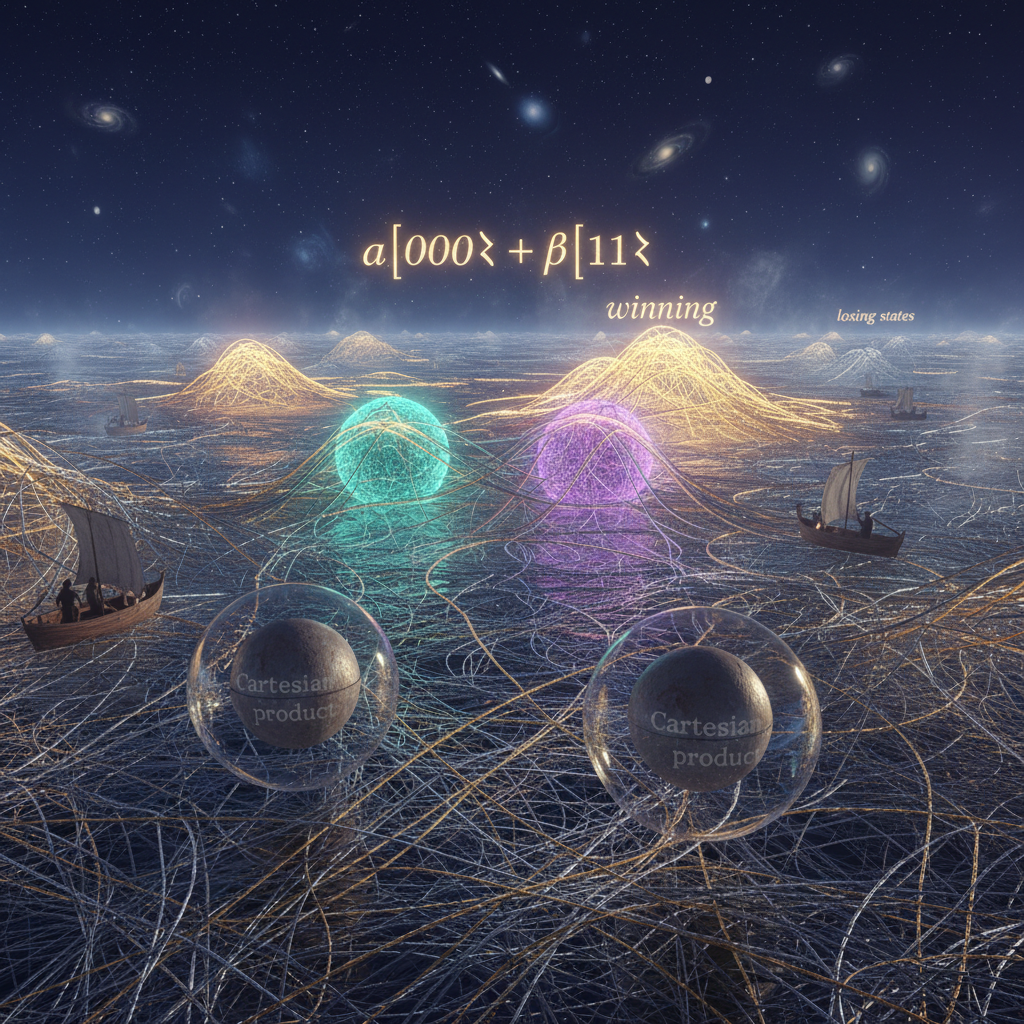
If the sea were built from classical systems – if its parts were connected by the Cartesian product – each wave would be independent. The whole would be a mere sum of its parts. The sea would be shallow.
But the Dirac Sea is built tensorially. Its parts are entangled. The state of one part of the sea is not independent of the state of another part. And it is precisely that entanglement that allows information to flow, to be copied, to compete – and finally for objective reality to emerge.
Zurek’s postulate (o) – that the state of a composite system is a vector in a tensor product – is what makes the Dirac Sea a sea, and not a collection of separate puddles. It is what makes our voyage meaningful at all: because the waves are not isolated. They are part of a single whole.
🔮 Horizons: What Do We Still Not Know?
The tensorial structure of the quantum world is the source of its richness, but also the source of its mysteries. It explains why entanglement is possible. But it does not explain:
- How exactly does the environment “choose” one outcome? Quantum Darwinism describes the mechanism of selection, but the very act of “choice” remains statistical – described by the Born rule.
- What exactly is the environment? Where does the system end and the environment begin? This is the question of the Heisenberg cut, which neither Zurek nor anyone else has definitively resolved.
- How does entanglement behave in the presence of gravity? When curved spacetime enters the game, the tensorial structure may no longer suffice. This is the place where Penrose’s OR perhaps offers a deeper answer.
⛵ Epilogue: A Sea That Is More Than the Sum of Its Waves
In the Dirac Sea, the whole is always more than the sum of its parts. Every wave is connected to every other. Every particle carries the shadow of all other particles with which it has ever interacted. And it is precisely that entanglement – that tensorial weaving – that makes the sea what it is: infinitely richer than any classical ocean.
Zurek understood this. His postulate (o) is not merely a mathematical formality. It is an ontological statement about the nature of reality: parts do not exist before the whole. They come into being only when the whole “gives birth” to them through decoherence and selection.
And we, as conscious waves on the surface of that sea, have the privilege of witnessing that birth. Every time we see a chair, a star, or one another – we see the winner of a constant, unceasing, tensorial struggle for existence.
The sea is always clear. The horizon is always open. And entanglement – entanglement is what makes the sea a sea.
This post continues the series begun with “⚛️ Quantum Archaeology: Reading the Past from the Dirac Sea”, continued through the map of the quantum odyssey, posts on the observer paradox, Bohmian mechanics, quantum complexity, eigenstate thermalization, entropy, infinities, broken symmetries, dark matter, the Andromeda paradox, negative frequencies, the Jung–Pauli synchronicity, and Quantum Darwinism.
Leave a Reply