
Dear explorers,
In our previous voyages we dove into the tensorial fabric of the Dirac Sea and discovered why the whole is always more than the sum of its parts. Today we sail toward one of the boldest interpretations of quantum mechanics – toward Quantum Bayesianism (QBism), whose leading proponent and founder is Christopher Fuchs.
This is no ordinary voyage. QBism offers not just another interpretation – it offers a radical reexamination of the very nature of quantum theory. And, in a surprising way, it returns to waters already explored by Jung and Pauli: to waters where the subjective and the objective intertwine.
As Fuchs says: “Quantum mechanics does not describe the world. It describes our experience of the world.”
🎲 What Is Quantum Bayesianism?
At the heart of QBism lies a seemingly simple, yet deeply subversive idea: the wave function is not a description of objective reality – it is a degree of belief of the observer.
Recall Bayes’ theorem in probability theory. It describes how we update our beliefs based on new evidence. If you believe there is a 30% chance of rain tomorrow, and then you see dark clouds on the horizon, your belief updates – now you think the chance of rain is 70%. That is not a change in the atmosphere; it is a change in you.
QBism claims the wave function behaves in the same way. When a physicist calculates the wave function of an electron, he is not describing some hidden reality of the electron. He is describing his personal expectations about what will happen when he performs a measurement. When he performs the measurement and obtains a result, his wave function “collapses” – not because something physically happened to the electron, but because he has updated his beliefs.
🧠 Fuchs’ Revolution: From Quantum Information to QBism
Christopher Fuchs was not always a radical. His journey toward QBism began in the world of quantum information – in an attempt to understand what quantum systems really do when they “communicate”.
In an interview for Quanta Magazine, Fuchs recounted how, as a student, he was fascinated by quantum mechanics, but also deeply dissatisfied with the standard answers to the question “what does the wave function really mean?” He tried everything – Copenhagen, Many-Worlds, Bohmian mechanics – but no interpretation gave him peace. They all seemed to be hiding something.
The turning point came when he began to think about quantum mechanics through the lens of information. If quantum mechanics is a theory about information, why should we regard that information as objective? Information always belongs to some agent – someone who receives it, processes it, uses it. The wave function, Fuchs concluded, is not an immanent property of the atom. It is an immanent property of the agent’s knowledge about the atom.
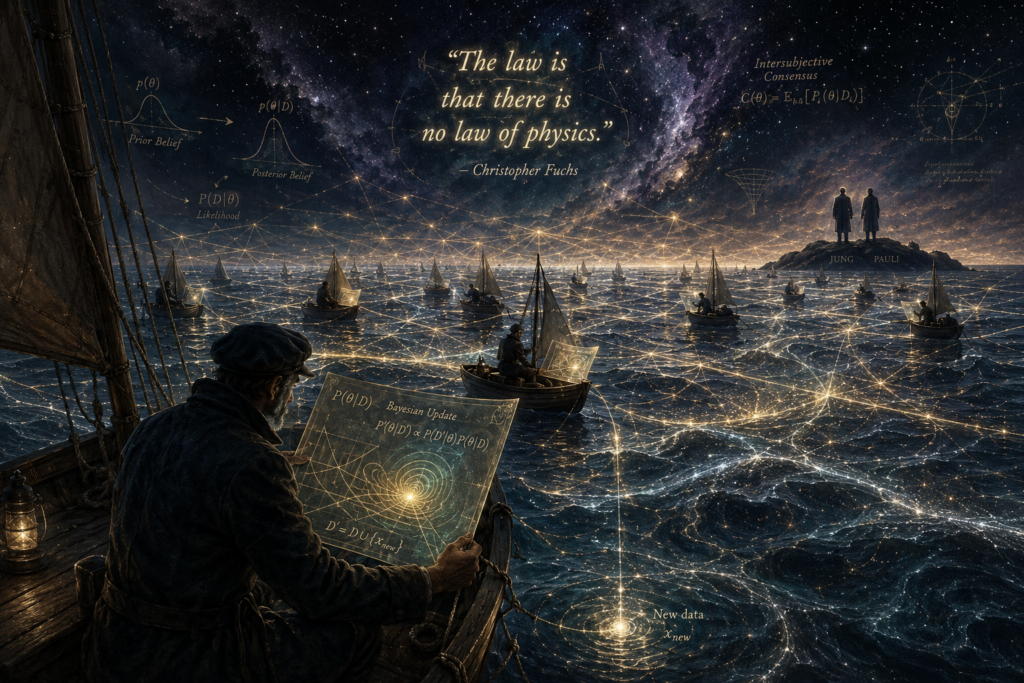
In one particularly striking moment from the interview, Fuchs summed up his stance in Wild West style: “The law is that there is no law of physics.” This is not nihilism; it is a radical call to reexamine where laws come from. They are not carved into the universe waiting for us to discover them. They are our laws – rules that we, as agents, have built to systematize our experience of the world. They describe our understanding, not reality itself.
In our picture of the Dirac Sea, this means the following: every captain on their ship has their own personal map of the sea. That map is not the sea – it is the captain’s understanding of the sea, their predictions about where reefs and currents lie. When the captain drops a sounding line and measures the depth, they update their map. The sea has not changed; the captain’s knowledge has.
🏛️ Epistemology Over Ontology
What makes QBism radical is its stance that the question of ontology – the question of what is real – is wrongly posed.
Ever since Dirac, Einstein, and Bohr, physicists have tried to answer the question: “What is the world really?” QBism answers: “You have posed the question wrongly.” Quantum mechanics, Fuchs claims, is not a theory about the world. It is a theory about how we, as agents in the world, acquire knowledge about it and how we use that knowledge to predict future experiences.
This stance has deep roots in the history of philosophy – from Kant, who argued that we cannot know the “thing in itself” (Ding an sich), but only its manifestations through our sensory and cognitive categories. QBism is, in a certain sense, a Kantian interpretation of quantum mechanics: the wave function is a form of our perception, not a property of the external world.
🔗 The Connection to Jung and Pauli
And here QBism unexpectedly meets the Jung–Pauli synchronicity.
Recall Pauli’s idea of the psychoid background (Hintergrund) – a level of reality that precedes the division into mental and physical. For Pauli, synchronicity was a “breakthrough” from that background into both domains simultaneously. Meaning and causality are not separated there.
QBism comes from an entirely different direction, but arrives at a similar place: the boundary between the subjective and the objective is blurred, and perhaps does not exist fundamentally. The wave function is subjective (the belief of an agent), but its predictions are intersubjectively verifiable (all agents agree on the probabilities).
The difference is that Pauli searches for an ontological background – for what is. Fuchs is content with epistemology – with what we know. Pauli asks: “From what does synchronicity emerge?” Fuchs answers: “That question may not be for us to pose. We can only describe how we acquire knowledge.”
🧩 QBism and Quantum Darwinism
How does QBism relate to Zurek’s Quantum Darwinism, which we wrote about in the previous post?
Zurek tries to explain how objective reality emerges from the quantum substrate through Darwinian selection of information. He provides a mechanism for the emergence of consensus among observers.
Fuchs would say: “Zurek is right in his description of the mechanism, but wrong in his ontological interpretation. He thinks he is describing how the world becomes objective. I think he is describing how we become more certain in our beliefs.”
In QBism, what Zurek calls the “objective state” is nothing other than a state in which all agents are sufficiently confident that they can act as if it were real. But that does not mean it is real in an ontological sense. It only means it is useful to treat it as such.
In the Dirac Sea, this means there is no “true” map of the sea. There is only a web of maps that are sufficiently mutually consistent that captains can sail without colliding.
⚠️ Critiques and Open Questions – and Why This Approach Is Useful
QBism is not without its critics – and those critiques are serious.
The problem of intersubjectivity. If the wave function is a personal belief of an agent, how is it that all agents agree on its predictions? Fuchs answers that it is because all agents live in the same world and receive similar sensory impressions. But that does not explain why their beliefs converge – it merely states that they do.
The problem of solipsism. If all we have is our own beliefs, where are other people? Are they too just “beliefs” in my mind? Fuchs rejects solipsism and insists that QBism is not subjective idealism – but the line is thin.
Where is the boundary of the agent? If the wave function is the belief of an agent, who is the agent? A human? A cat? A bacterium? A quantum computer? This is the question of the Heisenberg cut in a new guise – and QBism has no definitive answer to it.
Yet, even if we are not adherents of subjectivist approaches, such interpretations are valuable. They remind us that we can never fully exclude our own subjectivity. And, perhaps more importantly, we always find it easier to notice the subjectivity of others than our own. Richard Feynman summed this up in one of his most famous statements: “The first principle is that you must not fool yourself – and you are the easiest person to fool.” QBism is, in that sense, an invitation to intellectual humility – to an acknowledgment that even our most precise laws are always woven through with our own beliefs.
🔮 Horizons: Toward Quantum Complexity
QBism, like Quantum Darwinism, is a bridge to a deeper understanding. It tells us how we acquire knowledge of the Dirac Sea. But it does not tell us what the sea is in itself.
And here we return to quantum complexity – a theme we will dedicate ourselves to in the next, exclusive voyage. For quantum complexity is a measure of how hard it is to get from one state to another. If a state is the agent’s belief (QBism), and the transition between states is computation (quantum gates), then complexity is a measure of how hard it is to change one’s belief about the sea. And there, epistemology, ontology, and physics merge into a single magnificent whole.
⛵ Epilogue: The Sea as a Web of Beliefs
In QBism, the Dirac Sea is neither purely objective nor purely subjective. It is intersubjective. It is a web of beliefs shared by all captains – not because it is “real” in some transcendent sense, but because it is useful to treat it as such.
And perhaps that is the deepest lesson of our entire voyage: reality is not given. It is constructed. Not by an individual mind, but by a community of agents who continuously exchange information, update their beliefs, and build consensus.
The Dirac Sea is alive. It breathes through every captain who drops a sounding line. Through every physicist who calculates a wave function. Through every I that asks: “What is real?”
The sea is always clear. The horizon is always open. And reality – reality is that in which we are sufficiently confident to sail together.
This post continues the series begun with “⚛️ Quantum Archaeology: Reading the Past from the Dirac Sea”, continued through the map of the quantum odyssey, posts on the observer paradox, Bohmian mechanics, quantum complexity, eigenstate thermalization, entropy, infinities, broken symmetries, dark matter, the Andromeda paradox, negative frequencies, the Jung–Pauli synchronicity, Quantum Darwinism, and the tensorial sea.
Leave a Reply