Dear explorers,
In our previous voyages we dove into Turok’s quadratic gravity and discovered that above the Dirac Sea there exists an atmosphere of ghosts – a Krein space from which the gravitational wind blows. But there is an even deeper question, hidden at the very heart of the equations that describe the entire universe. A question that has troubled physicists ever since the days of Dirac and Wheeler.
Why does the fundamental equation of quantum cosmology contain no time at all, and yet we experience it as a flow?
Today we sail toward an answer proposed in 1983 by Don Page and William Wootters – an answer that was first experimentally illustrated in a quantum-optics laboratory in 2013. And which, in an almost perfect way, fits into our picture of the Dirac Sea.
🕰️ The Problem of Time and the Page-Wootters Mechanism
Recall the Wheeler-DeWitt equation, about which we have already written. It is the wave function of the entire universe – and in it there is no time. It is stationary, timeless, like the frozen sea we spoke of in the post on entropy.
Page and Wootters proposed an elegant mathematical answer in 1983. Their central idea can be written in a single line. It starts from the assumption that the entire universe is in a pure but stationary state:
This means that the wave function of the universe nowhere depends on an external time. However, if the universe can be decomposed into two subsystems – a clock (C) and the rest (S) – which are in an entangled state of the form
then the relative state of subsystem S, conditioned on reading clock C in state , is precisely . For an internal observer who reads the clock, the state of the rest of the universe passes through a series of values parameterized by the “time” that clock shows.
In the continuous version, if the total Hamiltonian is of the form , the condition directly yields:
This is the Schrödinger equation for subsystem S, with time being not an external parameter, but an internal coordinate defined by the state of the clock. Time is a relational connection between subsystems – it emerges from entanglement.
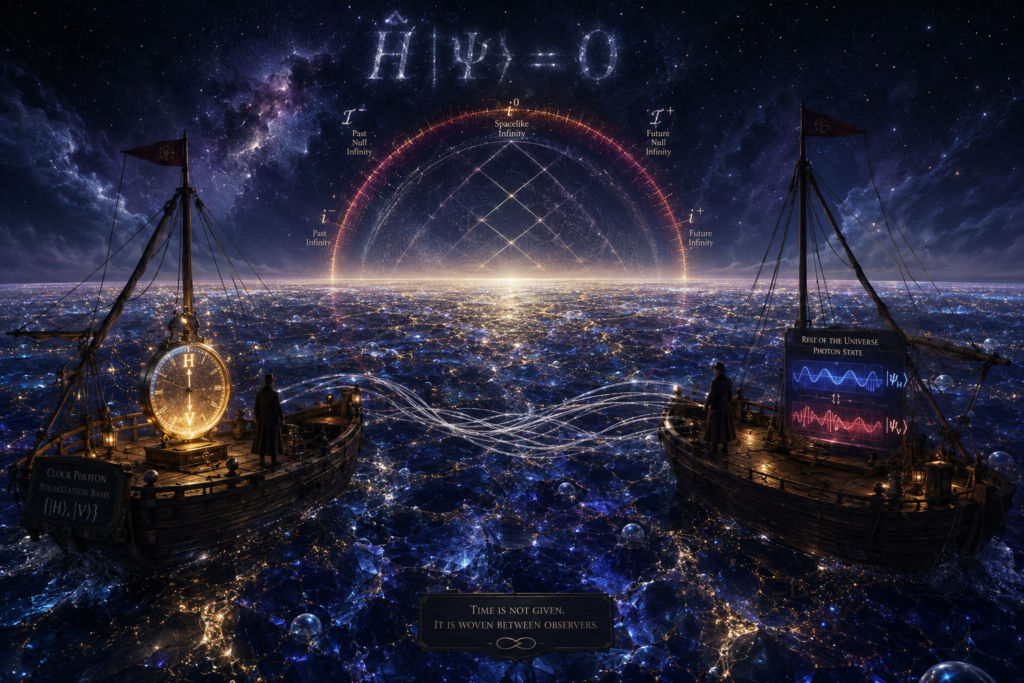
In our picture of the Dirac Sea, this means the following: there is no single universal time flowing for all ships. Every ship has its own clock – its own reference frame – and time flows as that clock measures it. The sea is timeless; time is in the relation between the ship and the sea.
🔬 The 2013 Experiment: Time in the Laboratory
This elegant construction remained on paper for decades, until 2013 when it received its first experimental illustration. The paper titled “Time from quantum entanglement: an experimental illustration” (E. Moreva, M. Gramegna, G. Brida, L. Maccone, C. Brukner) demonstrated the mechanism on the simplest possible system.
Instead of the whole universe, the researchers constructed a miniature “universe” of only two photons – one playing the role of the clock (C) and the other playing the role of the system (S). Instead of continuous time, discrete time with two moments was used, and instead of complex interactions, quantum entanglement of polarization states served the purpose.
The state of the photon pair was prepared as:
Horizontal polarization of the clock corresponds to “time 0”, and vertical to “time 1”. The states of the system and are states at two different moments. Crucially, in the total state ∣ there is no time parameter at all – it is static, completely analogous to the stationary state of the universe in the Page-Wootters formalism.
👁️ Two Perspectives: External and Internal Observer
The experiment neatly reveals two fundamentally different perspectives.
The external observer – one who has access to the entire state – sees only a static, entangled photon pair. Nothing changes, nothing evolves. They behold a “block universe” in miniature. There is no time evolution operator acting on the total state, because it is an eigenstate of the total Hamiltonian with eigenvalue zero.
The internal observer – one who has access only to the clock – behaves differently. When they measure the polarization of the clock, they obtain one of two outcomes. The conditional state of the system, after the measurement, is:
- If the clock is in , the system collapses into (“moment 0”).
- If the clock is in , the system collapses into (“moment 1”).
For the internal observer, the state of the system changes – they see a discrete time evolution. Time is defined exclusively through correlation with the clock state. In the experiment, this was verified by quantum tomography: after measuring the polarization of photon C, the state of photon S was reconstructed and matched the expected sequence.
In our picture of the Dirac Sea, the external observer is God – they see the whole sea at once, without time. The internal observer is the captain on a ship – they see only their clock and the waves around them, and for them time flows. Both perspectives are legitimate. They are complementary.
🌊 Connection to the Dirac Sea: A Relational Definition of a Particle
This brings us to one of the deepest connections with everything we have written about so far.
In quantum field theory, the division into positive and negative frequencies – which defines what is a particle and what is an antiparticle, what is a “hole” in the Dirac Sea – is not absolute. It depends on the choice of time coordinate. In the Rindler frame, an accelerated observer sees a thermal ensemble of particles where an inertial observer sees a cold vacuum.
If time is not fundamental, but emerges from entanglement with a specific clock, then the very definition of the Dirac Sea becomes relational. What one internal observer (with their clock) calls a particle may, for another, be a virtual fluctuation. The Dirac Sea thus becomes a holographic film that is projected differently depending on the chosen internal time.
🔥 Entropy and the Arrow of Time
The Page-Wootters mechanism explains how a parameter that looks like time can emerge from a stationary state. But it does not explain why time has a direction – why entropy grows, why we remember the past but not the future.
The answer lies in thermodynamics and quantum information. When a subsystem (clock + rest) interacts with many degrees of freedom (the environment), decoherence occurs. The von Neumann entropy of the subsystem increases monotonically until the system reaches equilibrium. In the Page-Wootters picture, this increase in entropy defines the direction of time for the internal observer: they will always observe the state evolving in the direction in which correlations become ever more intricate and information ever harder to access.
Time emerges from entanglement. But its direction emerges from the second law of thermodynamics – from the fact that the initial state of the clock and system was low-entropy. In this light, Landauer’s principle (erasing memory inevitably raises entropy) further strengthens the link between information, thermodynamics, and the flow of time.
🧠 Quantum Complexity: The Internal Time of a Wormhole
The most spectacular modern incarnation of the idea that time can emerge from quantum entanglement comes from AdS/CFT correspondence and the concept of quantum complexity – which we have written about in detail in one of the previous voyages.
In holographic dualism, a wormhole connecting two black holes has the property that its length grows linearly with time:
which is dual to the growing number of elementary quantum gates needed to describe the entangled state on the boundary. That complexity of the state behaves as an internal time – it flows even after thermal entropy has reached its maximum.
In the context of Page-Wootters, the clock need not be a simple degree of freedom like photon polarization; it can be an entire network of entanglements whose complexity generates the feeling of the passage of time. The two-photon experiment from 2013 is the most minimal possible realization of this idea, but the true richness of time – its continuity, irreversibility, and complexity – lies precisely in the growing complexity of a large quantum system.
🧠 Penrose’s Objective Reduction: Breaking the Block
The Page-Wootters mechanism, even when enriched with entropy and complexity, still yields only a unitary picture: time is a parameter along which unitary evolution unfolds, and different moments exist simultaneously in the total state. This is a sophisticated block universe, in which the flow of time remains a subjective experience of the observer, not an objective physical phenomenon.
Penrose has argued for decades that such a picture is incomplete. To break out of the block universe and obtain an objective now with a genuine flow of time, a process is needed that violates unitarity and selects a single history. His proposal is objective reduction (OR) – the spontaneous collapse of the wave function triggered by gravitational instability of superposed spacetime geometries.
In the context of the Page-Wootters state , OR would be a physical mechanism that continuously projects this state onto a single concrete moment (one branch), thereby “breaking” the timeless superposition and creating an objective, irreversible sequence of events. Penrose suggests that these reductions also occur in the brain (in neuronal microtubules), thus connecting consciousness with the objective flow of time.
The 2013 experiment does not include OR – it is purely unitary – but precisely for that reason it poses a sharp question: do we need, in addition to entanglement, a collapse as well in order to fish out from the timeless sea a single true “now”?
⛵ Epilogue: The Sea, the Clock, and the Wave
In the Dirac Sea, time is not fundamental. It is a relational connection between the ship and the sea, between the clock and the system, between the observer and the observed. The two-photon experiment from 2013 showed that this is not merely a philosophical speculation – it is a physical fact, measurable in a laboratory.
But the question remains: is it enough? Do we need, in order to explain why we feel that time flows, also a collapse – Penrose’s OR, the gravitational wind that breaks the timeless block?
Perhaps the answer is both yes and no. Perhaps time, like everything in the Dirac Sea, is emergent – it arises from entanglement, gains direction from entropy, richness from complexity, and objectivity from collapse. And perhaps it is precisely that multi-layeredness that makes time so mysterious, so elusive, and so deeply human.
The sea is always clear. The horizon is always open. And time – time is a wave born between two ships.
This post continues the series begun with “⚛️ Quantum Archaeology: Reading the Past from the Dirac Sea”, continued through the map of the quantum odyssey and all our previous voyages.
Leave a Reply