Dear explorers,
In our previous voyages we traversed vast expanses. We saw how time emerges from entanglement (Page-Wootters), how gravity perhaps blows from an atmosphere of ghosts (Turok), and how our beliefs shape the sea itself (QBism). Now it is time to confront all those insights with one of the most radical, yet also most deeply coherent interpretations of quantum mechanics – Relational Quantum Mechanics (RQM) , created by Carlo Rovelli.
This is not just another port. It is a fundamental change of perspective from which the entire archipelago of our knowledge is seen anew.
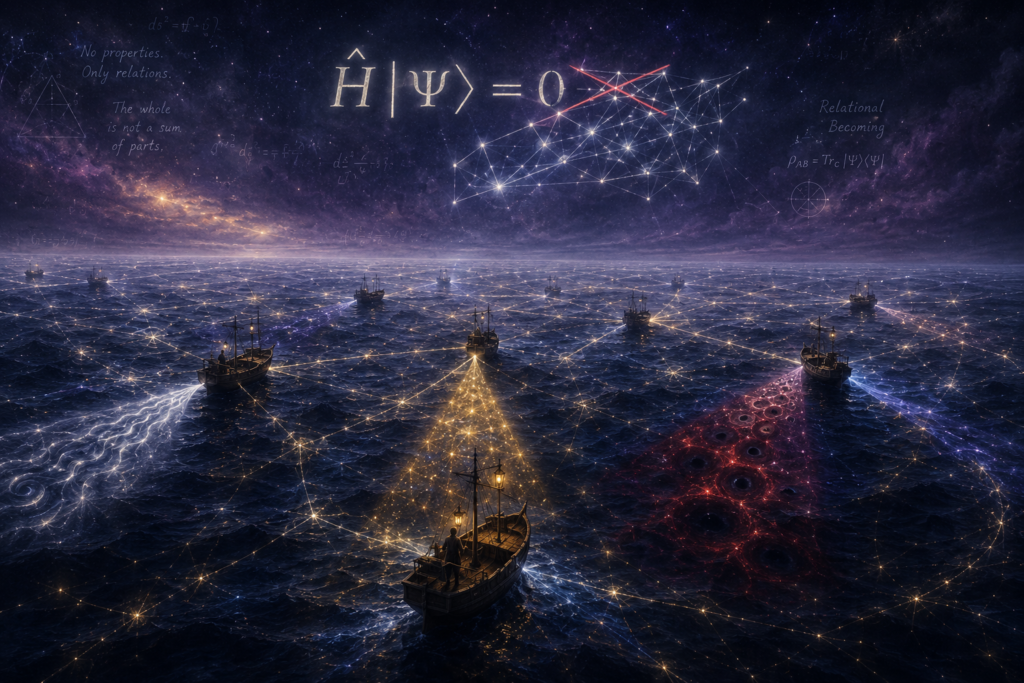
Rovelli starts from a premise that is simple, yet whose consequences are dizzying: properties do not belong to objects in themselves, but exclusively to their mutual relations. The universe is not a collection of substances with fixed characteristics, but a web of interactions in which quantities are defined solely through how one system “sees” another.
In our language: The sea does not exist without the ships. A wave does not exist without interaction with a keel.
🧩 The Dirac Sea – An Empty Field That Is Not Empty for Everyone
Recall our voyage through negative frequencies. In quantum field theory, the division into particles and antiparticles – the definition of the vacuum – depends on the decomposition of the field into positive and negative frequencies, and that decomposition is not invariant under a change of reference frame. In the Rindler frame, an accelerated observer detects a thermal spectrum where an inertial observer sees a cold vacuum.
RQM places this relational feature into its very ontology:
- There is no absolute Dirac Sea. What one system (say, a detector with a defined time axis) registers as a real particle may, for another system in a different state of motion, be a virtual fluctuation.
- The vacuum is not a universal stage, but a state of the field relative to a particular class of observers. The Dirac Sea is filled with waves that are the consequence of an interaction between the reference system and the quantum field, not just the quantum field in itself.
This fits perfectly with Rovelli’s thesis from Helgoland: “Objects” such as photons or electrons do not possess permanent properties; they acquire definite values only in interaction – when they collide with other systems. The Dirac Sea is precisely the infinite reservoir of such potential interactions, which become actualized only through a relation.
⚡ Flashes, Complexity, and Time
Rovelli describes the history of a particle not as a continuous trajectory, but as a sequence of discrete “flashes” – interactions in which definite values are manifested. Between two interactions, the question of where the particle is and what it is doing loses physical meaning.
This picture has a direct connection with the idea of quantum complexity, which we treated in detail in previous voyages:
- In AdS/CFT correspondence, the interior of a black hole (the wormhole) grows with time, and that change is dual to growing complexity – the number of elementary operations (gates) needed to reach the observed state from a reference state.
- In the language of RQM, each flash (interaction) represents an elementary quantum event – a relation. A sequence of flashes for a given subsystem creates its history, and the number of those flashes (their “hierarchical depth”) measures how far the system is from the initial reference state.
- Complexity is a measure of the number and structure of relational events. It naturally grows as the web of interactions branches out.
In this picture, time is not an external parameter, but an internal property of a chain of interactions. Recall the Page-Wootters mechanism and the two-photon experiment from 2013, which we wrote about in the previous post: a clock is any system whose variables serve to number the flashes. For an internal observer, the state of the system changes with the reading of the clock. RQM provides this mechanism with an ontological foundation: time is what counts the flashes.
🧠 Penrose and Rovelli – Two Kinds of “Now”
This is the point where RQM and Penrose’s program show both similarities and a sharp difference.
Similarity: Both approaches reject the idea of a single, objective camera in the sky that sees absolute reality. In RQM, every system has its own perspective; in Penrose’s picture, reality is concretized through a sequence of objective reductions occurring everywhere, including in the brain.
Difference: RQM introduces no physical collapse. Interaction is unitary relative to an external observer, and what an internal observer experiences as a “fact” is simply an update of their information after the interaction. Penrose, by contrast, insists that a real, physical collapse (OR) is needed, triggered by the gravitational instability of a superposition, to break the block-structure of spacetime and generate an objective flow of time.
In RQM, the block universe remains: all events exist in the web of relations, and the flow of time is a perspectival illusion of subsystems. For Penrose, that is not enough – the flow must be objective, and OR is the mechanism that creates it.
In RQM, the question of the foliation of the time stream is resolved by the fact that the past simply is the set of all past interactions that a given system has registered; it is fixed for that system, but there is no absolute past independent of a system. Every ship has its own history, inscribed by flashes on its keel.
🧩 Wigner’s Friend Paradox – Finally Resolved?
Recall the paradox of Wigner’s friend and the Frauchiger-Renner experiment, which we wrote about in one of our most difficult voyages. RQM offers a natural way out:
- For Wigner, his friend and the particle are in an entangled state until Wigner measures his friend. When he does so, he obtains an outcome consistent with the friend’s experience – but that does not mean the friend’s fact existed before Wigner’s measurement in any absolute sense.
- For the friend, the fact exists from the moment of his measurement.
Both perspectives are valid and need not be reduced to a single “higher” truth. RQM thus avoids the contradictions that Frauchiger and Renner derived under the assumption of absolute facts and universal quantum states.
In the Dirac Sea, this means the following: every captain has their own map of the sea, drawn on the basis of their flashes (measurements). Those maps may differ, but when captains enter into interaction – when they exchange signals – their maps become consistent. There is no “true” map; there is only a web of mutually aligned perspectives.
🧪 Tunneling in Relational Quantum Mechanics – No Trajectory, Only Flashes
RQM does not claim that the wave function is a mere expression of subjective knowledge (as in QBism), but that all physical quantities – including the position of an electron – are defined exclusively through interactions. An electron possesses no trajectory through a barrier, nor does it “squeeze” through it in any classical sense. There exist only discrete events: flashes in which the electron enters into interaction with some other system and on that occasion manifests definite values, such as the place of detection.
In the case of tunneling through a p-n junction, the relevant flash is the interaction of the electron with the crystal lattice on the p-side, after it had previously been localized (through an earlier interaction) on the n-side. The wave function is not a material wave leaking through the barrier, but a mathematical tool that gives the probability that the next flash – the next relation – will occur at a given location.
When a quantum mechanic solves Schrödinger’s equation for a potential barrier and obtains a non-zero transmission coefficient, they are calculating precisely that: the relative frequency with which an electron, prepared on one side, will end up in an interaction on the other side. The question “how is that physically possible” – if the energy is insufficient – rests on the assumption that the electron must “pass through” the barrier. RQM rejects that assumption.
Between two flashes, the electron has no defined position, nor energy in the classical sense. It is simply neither on one side nor on the other in any absolute sense; it is in an entangled relationship with its environment, from which only the next interaction extracts a definite outcome.
The Dirac Sea, as an infinite reservoir of fluctuations, allows the system, on short time scales, to “borrow” energy from the vacuum and realize an event that is classically forbidden. RQM translates this picture into its own language: what is for one system (electron and barrier) a virtual fluctuation becomes, for another (a detector), a real particle. Tunneling is precisely the limiting case: an interaction on the p-side establishes the electron as a real particle relative to that detector, while the same process, seen from the perspective of some other system without that interaction, would remain only a virtual possibility within the Dirac Sea.
🔮 Synthesis – From the Relational Web to the Dirac Sea and Back
In light of everything we have discussed so far, RQM offers a framework that:
- Makes the Dirac Sea relational: the division into particles and antiparticles is not absolute, but is defined relative to the measuring system. The sea is the same, but its image depends on the ship observing it.
- Interprets quantum complexity as a measure of the number of relational events (flashes), connecting the growth of complexity with the flow of time for an internal observer. The more flashes, the further the ship is from its starting shore.
- Considers Penrose’s OR unnecessary for explaining consciousness and the flow of time – but does not rule out the possibility that gravity sets limits to unitary evolution. RQM can be supplemented with Penrose’s threshold as an additional mechanism, but RQM itself does not venture deeper into these waters.
- Resolves the question of consensus through interaction: the truths of different observers become consistent precisely when they communicate, and the question of absolute truth is avoided. That is, in a sense, also an answer to QBism – consensus is not a matter of belief, but a matter of interaction.
- Gives the Andromeda paradox a natural place: there is no absolute now; each observer has their own plane of simultaneity defined by their state of motion, and those planes are simply different, none of them “wrong”. Every ship has its own “now” – and that is fine.
⛵ Epilogue: A Sea of Relations
RQM is not new physics. It is a radically different reading of the existing formalism – a reading that throws out absolute reality and introduces a world composed exclusively of relations.
In the Dirac Sea, this means that waves do not exist by themselves. They exist only in relation to the ship that measures them. There is no “true” sea. There is only a web of perspectives – a web of interactions, flashes, relations – that is so rich and consistent that it appears to us as a solid, objective reality.
Is that enough to understand consciousness, time, and the structure of the vacuum? Or is an additional principle needed – such as Penrose’s OR, or Turok’s ghosts, or something entirely new? That remains one of the most exciting open questions of contemporary fundamental physics.
And that is precisely why our voyage does not end. For every new flash – every new interaction with the sea – reveals a new layer, a new relation, a new horizon.
The sea is always clear. The horizon is always open. And reality – reality is a web of relations waiting to be woven.
This post continues the series begun with “⚛️ Quantum Archaeology: Reading the Past from the Dirac Sea”, continued through the map of the quantum odyssey and all our previous voyages.
Leave a Reply