Dear explorers,
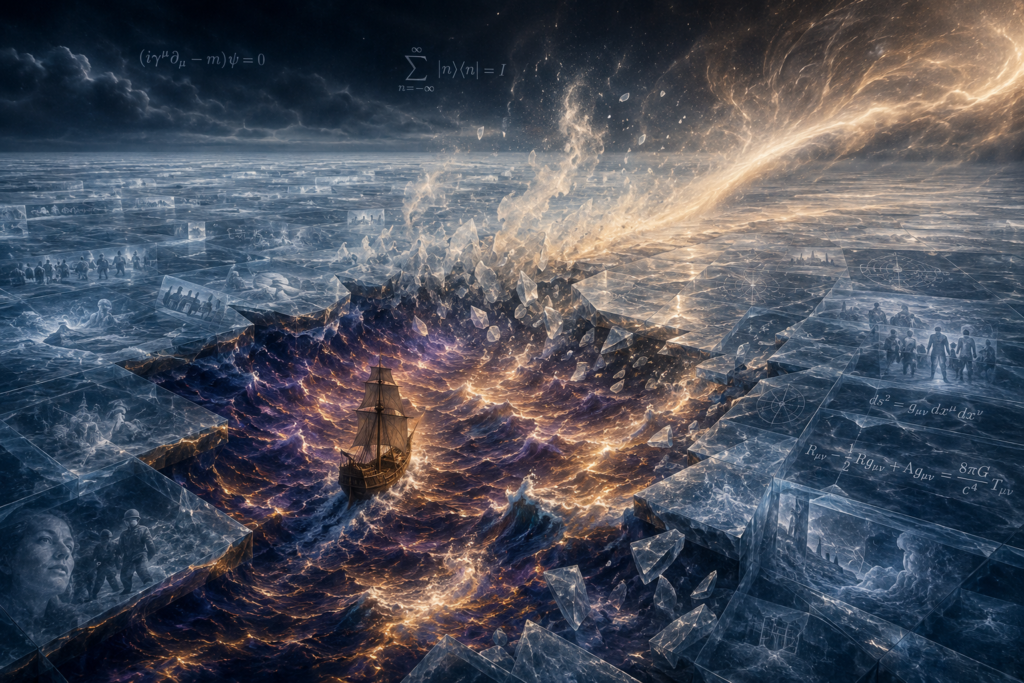
Imagine for a moment that our Dirac Sea is not alive. There are no waves, no wind, no tides. Everything that ever has happened, is happening, or will happen – is already there, arranged like an infinite sculpture of ice. Every event, every thought, and every feeling is already carved somewhere, and our consciousness is merely a powerless traveller sliding along that frozen landscape.
This is the picture of the block universe. It is elegant, coherent, and arises from the very geometry of spacetime. But today we shall not sing hymns to this frozen vision. Today we shall, like true mariners, confront the ice sculpture with the living sea. Today we shall critique the block universe from the standpoint of everything we have learned: from quantum mechanics, from Penrose’s objective reduction, and, of course, from Dirac’s vision.
🧊 The Ice Block and Its Allure
Before we strike the ice, let us recall where it comes from. Already in our voyage through the Andromeda paradox we saw that two people walking in opposite directions have two different “nows” in a distant galaxy. Simultaneity is not absolute, but depends on the observer. If all “now” moments are equally valid, is it not logical that the whole of spacetime already exists as a whole, and that the flow of time is merely a human illusion?
Penrose used this paradox to show how parochial our notion of time is. But the block universe did not stop there. It slips into many interpretations of modern physics, and its allure lies in the promise of eliminating the mystery of time. But, like the sirens who lure sailors onto the rocks, that allure conceals a danger – the danger of eliminating the very heart of the quantum reality we explore.
🎲 The Quantum Die Is Not Cast in Advance
The first and hardest blow to the ice block comes from the heart of quantum mechanics. Recall Heisenberg’s uncertainty principle and the Schrödinger equation: quantum mechanics describes the world as fundamentally probabilistic and indeterminate. The future is not fixed in advance, but consists of a superposition of possibilities that are only realized in the present through the collapse of the wave function.
In the block universe, the outcome of every measurement – whether Schrödinger’s cat will wake or not, whether the electron will pass through the left or right slit – is already forever inscribed in the four-dimensional sculpture. That implies that the result of a quantum experiment was determined before we carried it out, which is in direct contradiction with the standard formalism of quantum mechanics. The block universe negates genuine quantum randomness. It turns the open sea of possibilities into a frozen map.
Recall also quantum non-locality – a phenomenon we have explored in detail. When we measure the spin of one of two entangled particles, the other instantly “knows” what outcome it should have, regardless of distance. In the block universe, this mysterious correlation becomes just another fixed line in the ice. But in the living Dirac Sea, the outcome does not exist before the measurement itself. The sea foams, fluctuates, and decides only in the interaction. Non-locality is not a static picture; it is a dynamic process.
🌌 Many Worlds in One Block – A Solution or an Escape?
There is, of course, an interpretation that attempts to reconcile the block universe and quantum mechanics: Everett’s Many-Worlds Interpretation (MWI). According to it, there is no collapse; the universe simply branches. Every time a quantum event occurs, reality forks, and all outcomes are realized in parallel branches.
If we attempted to construct a block universe compatible with quantum mechanics, it would have to be a block multiverse – a static whole containing all branches of all possible histories. This sounds appealing, but it creates an enormous problem: why do we, as conscious observers, experience only one history? Why does our ship sail only one course across a sea of infinitely many parallel directions?
This becomes even more dramatic when we take into account the Wheeler-DeWitt equation – the wave function of the entire universe that contains no time. Its solution is a superposition of states, each of which would represent one possible universe. If we take this literally, we obtain the idea that the universe branched from the very beginning into countless copies, and that inflation (Guth’s theory) merely froze those branches into irreversibly separated worlds.
But here we encounter an essential unease: if everything is already settled, why is there indeterminacy at all? Dirac would certainly not have been satisfied with this answer. His sea is not a collection of parallel films; it is one, infinite, and ceaselessly fluctuating.
🧠 Penrose’s Hammer: Breaking the Ice
Here Penrose enters the stage with his most powerful argument. For him, the block universe is elegant, but fundamentally wrong because it fails to explain the most basic fact of our existence: the flow of time.
Recall our metaphor of the gravitational wind. Penrose’s objective reduction (OR) is the wind that continually smooths the waves of the Dirac Sea. In the block universe, the wind does not blow. The sea is frozen. But we know the wind blows – every conscious moment is testimony to that.
In Penrose’s picture, every objective reduction is an act that breaks the symmetry of the block. It is an event that selects one branch from all possible ones, thereby creating an objective “now” and an authentic flow of time. Without OR, we are merely prisoners of a pre-recorded film; with OR, we are active participants who create reality, wave by wave.
This is a direct attack on the idea that the past, present, and future are equally real. In the Dirac Sea, only the present is real. The past is a wave that has already broken, and the future is a wave that is only just forming. The block universe is merely an empty mathematical abstraction that does not see the gravitational wind.
🔗 Spacetime as an Emergent Fabric
Finally, there is the newest, and perhaps the most devastating argument against the block universe: it comes from quantum gravity theory. When we combine relativity and quantum mechanics (whether through string theory or loop quantum gravity), space and time are no longer smooth and continuous. They become granular, discrete, emergent.
Recall our voyages through discrete spacetime and Susskind’s lectures on gravity not being fundamental, but a statistical phenomenon emerging from quantum complexity. If that is correct, then the idea of a fixed, static block is even less tenable. Not only is the sea alive – it is not even made of water. Its waves are information, its depth is complexity, and its surface is emergent spacetime.
In such a world, the block universe is an illusion that arises when we look from too far away. Like watching an ocean from a high mountain: it looks calm and motionless, but when you dive in, you see infinite movement. The block universe is the view from the mountain. We are the divers in the sea.
⛵ Epilogue: Dirac’s Smile
What would Paul Dirac, our quiet captain at the stern, have said to all this? I think, if we could ask him, we would see that characteristic, restrained smile of his.
Dirac never liked dogmas. His equation did not describe a frozen destiny, but predicted the existence of antimatter – holes in the sea, changes, fluctuations. His sea was never a static background; it was a dynamic entity, filled with virtual excitations that are born and die in every moment.
The block universe is a picture of a world in which everything is already decided. The Dirac Sea is a picture of a world in which everything is open, and we – we are those who, with every measurement, with every choice, participate in the creation of reality.
Therefore, as we sail on, let us not forget this lesson: the sea never freezes. It is always in motion. And we are that motion.
The sea is always clear. The horizon is always open. And the wind – the wind is what breaks the ice. 🌊⛵💨
This post continues the series begun with “⚛️ Quantum Archaeology: Reading the Past from the Dirac Sea”, continued through the map of the quantum odyssey and all our previous voyages.
Leave a Reply