
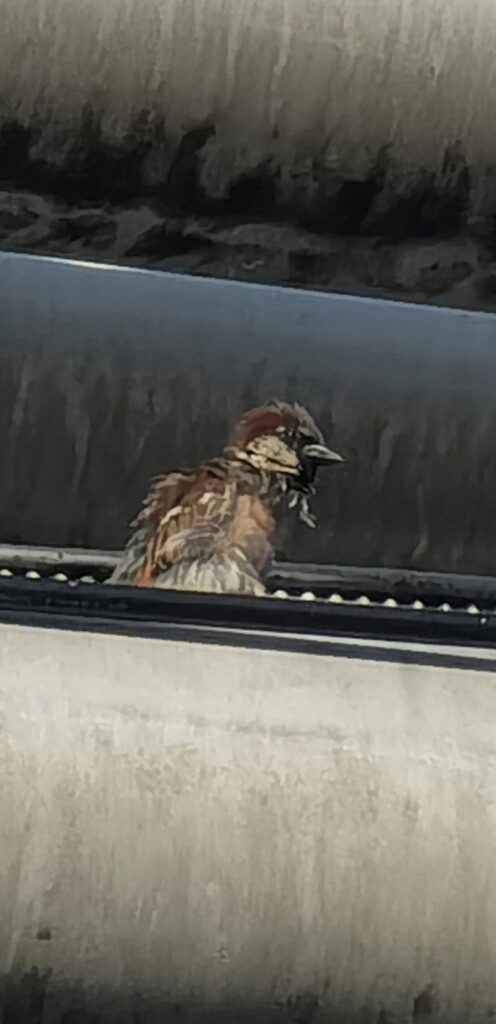
A few days ago, on a heating pipe in the factory yard, I spotted a sparrow. It looked like it had been through a serious fight – ruffled feathers, slightly swollen, a gaze that constantly “scans” the terrain. It seemed like it was in charge. And it probably is.
I’ve been seeing it for about ten days now. It constantly monitors the situation, chirps with other sparrows, issues “commands.” It reminds me of myself when I show up to work on Monday morning uncombed – except that, unlike me, it clearly knows what it’s doing.
This little, scruffy boss is the perfect introduction to the story of what has made sparrows one of the most successful creatures on the planet – social hierarchy.
🏛️ The Pecking Order: Who’s Who in the Sparrow World
Sparrows are highly social birds that live in communities of up to 40 members. They do everything together – chirp, bathe, fly – but that doesn’t mean they’re always friendly. As in any human organisation, there is a clear hierarchy among sparrows. Scientists call it the “pecking order”.
In that hierarchy, every male sparrow has its place, and it is determined – incredibly, but true – by the size of the black patch on its chest and throat. The larger the patch, the higher the sparrow is on the hierarchical ladder. This is its “uniform,” its officer’s insignia that tells everyone who is who – from officers to common soldiers.
One of the main theories is that the size of this black patch is linked to testosterone levels. Males with larger patches have higher testosterone, making them more dominant, more aggressive, and more successful in defending territory and attracting females.
What is particularly interesting is that these markings help sparrows avoid unnecessary conflicts. It is as if they wear a sign saying “don’t touch me” or “you may pass freely.” When a young, cocky sparrow with a small patch confronts an older, more experienced boss with a large one – it usually quickly learns its place.
In addition to the black chest patch, there is another important signal – the size of the white wing patch. The larger this white patch, the more attractive the male is to females. This trait is not just aesthetic – it is linked to greater resistance to lice (parasitic insects that damage feathers). Females choose males with larger white patches because it indicates better health and genetic quality.
👑 The Boss’s Privileges: Why It’s Good to Be on Top
Being at the top of the hierarchy brings serious privileges – just as in the human world:
- First at food: Dominant males have priority when feeding.
- Better territories: Larger and higher-quality nesting areas.
- More partners: Males with larger patches attract more females and pair up earlier.
- Safer feeding spots: They eat at more secure locations.
And just as a real boss needs to be vigilant, the dominant male is also responsible for scanning the terrain. He must be the first to detect danger – cats, falcons, and even uncombed electrical maintenance bosses. Constantly “scanning” the situation is not paranoia – it’s responsibility.
📜 How to Recognise an Old Veteran
Sparrows in the wild live on average 1.5 to 2.3 years – and if you count the young that don’t survive their first winter, the average drops to just 9 months. That is why any sparrow that survives several seasons is a true veteran.
My scruffy friend on the heating pipe, with its swollen feathers and calm, supervisory gaze, is likely over two years old – which in the sparrow world makes him a true veteran. And not only that – his ruffled feathers and “battle-hardened” appearance are probably signs that he has endured numerous skirmishes and maintained his position at the top of the hierarchy. Like any good boss, he has battle scars that speak louder than words.
🏙️ Sparrows and Us: The Story of Commensalism
Sparrows are among the few birds that have managed to follow humans through history. They are pioneers of commensalism – a relationship in which one species benefits from the presence of another, without harming it. Sparrows have followed humans from the first agricultural settlements, adapting to our architecture, our food, our rhythm.
And today, as this scruffy boss oversees his flock from the heating pipe, he continues the same game – adaptation, dominance, survival. His flock is a small version of what sparrows have been doing for thousands of years: living alongside us, using what we offer, and building their own hierarchies in the shadow of our buildings. Perhaps even modelled on our hierarchy.
💡 Conclusion: Little Kings of the Asphalt
The next time you see a sparrow – especially a scruffy one with attitude – stop for a moment. You are not looking at an ordinary bird. You are looking at a being that is part of a complex social network, a soldier with officer’s insignia on its chest, a boss of an organisation that functions by rules stricter than many human companies.
And if you wonder what that little, scruffy boss is actually doing – the answer is simple: he is managing. Supervising, protecting, maintaining order. And he does it with a style that many human bosses could envy.
Leave a Reply