Dear explorers,
On our previous voyages we have already dared to sail into unknown waters. We have questioned the nature of time, peered behind the looking glass, and critiqued the block universe. Yet there is one region on the map of the Dirac Sea that many have avoided in a wide arc. It is a place where compasses go mad, where firm axioms turn into quicksand, and “impossible” solutions of equations whisper like sirens from the reefs.
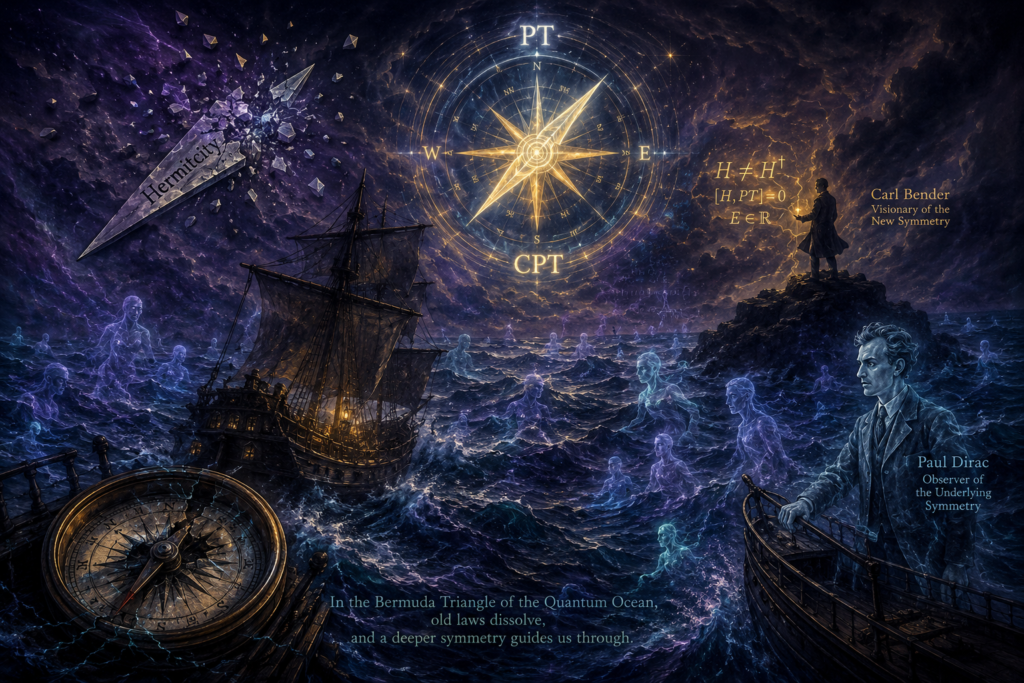
Welcome to the Bermuda Triangle of the Dirac Sea. Here we shall question one of the most sacred cows of quantum mechanics – the requirement that all operators be Hermitian – and dive into a radical alternative that promises to finally tame gravity. This is the story of how Paul Dirac, our great captain, laid the foundations, but also of how his choice may not have been the only possible path.
🧭 Hermiticity – Dirac’s Compass
At the dawn of quantum mechanics, John von Neumann and Paul Dirac formalised the theory with the aim of making it mathematically robust and physically intuitive. At the heart of this formalism lies the requirement that all operators representing measurable physical quantities – energy, momentum, position – be Hermitian. An operator is Hermitian if it equals its own adjoint, .
This seemingly technical requirement guarantees three things at once:
- Real eigenvalues. All measurable quantities must be real numbers.
- Orthonormality of eigenstates. Different states are mutually orthogonal, enabling a clean probabilistic interpretation.
- Conservation of probability. Unitary evolution with Hermitian guarantees that the total probability does not change over time.
At the time, this appeared to be the only way to obtain a consistent physical theory. Any solution that violated this structure – states with negative norm or negative energy – was automatically discarded as an unphysical “ghost”.
However, our great captain Dirac himself knew that the Hermitian structure came at a price. His famous Dirac equation yielded solutions with negative energy. Instead of discarding Hermiticity and accepting these “impossible” solutions as real, Dirac constructed his famous Dirac Sea – an infinite ocean of filled negative-energy states. Holes in that sea became positrons, antiparticles. It was a brilliant move that saved the formalism, but also a choice that has followed us for an entire century. Dirac chose to hold the Hermitian course firmly, even at the cost of creating an entirely new ocean.
🌪️ The Bermuda Triangle: Where Hermiticity Sinks
What if I told you that this choice was not the only one? What if Hermiticity, just like a compass in the Bermuda Triangle, is merely a navigational tool that can fail under extreme conditions?
The problem arises when we try to apply quantum mechanics to gravity. As we saw with Turok and Mannheim, any attempt to describe the gravitational field using higher derivatives (so-called quadratic or conformal gravity) within a Hermitian framework inevitably generates ghosts – degrees of freedom with negative kinetic energy. These ghosts, according to Ostrogradsky, lead to vacuum instability. The universe would, in such a theory, instantly disintegrate.
Physicists spent decades trying to “exorcise” these ghosts, but they kept stubbornly returning. This is the heart of the Bermuda Triangle: our deepest theories of gravity compel us to produce “impossible” solutions, yet our sacred axiom of Hermiticity forbids us from accepting them. The result has been a decades-long impasse in quantum gravity.
💡 PT Symmetry – A New Compass for Unknown Waters
The crucial turning point came in 1998, when Carl Bender and his collaborators demonstrated something revolutionary. Hermiticity is not necessary for real eigenvalues and unitary evolution. It is sufficient for the Hamiltonian to be PT-symmetric – invariant under the combined transformation of parity (P) and time reversal (T).
In this new paradigm:
- PT symmetry is defined by the condition . The P operator changes the sign of spatial coordinates and momenta (), while the T operator changes the sign of momenta and complex-conjugates numbers ().
- If PT symmetry is unbroken (i.e., the eigenstates of the Hamiltonian are simultaneously eigenstates of the PT operator), then all energy eigenvalues are real, even though the Hamiltonian is not Hermitian. The main reason for insisting on Hermiticity disappears!
- Unitary evolution can be defined via a modified scalar product – the so-called CPT inner product. This product requires a dynamically defined operator C, which is not the same as the standard charge conjugation, but serves a similar purpose: it guarantees a positive value of the norm and the conservation of probability.
In light of this, what we used to call “ghosts” suddenly becomes less frightening. In PT-symmetric quantum mechanics, negative norms vanish when one switches to the CPT inner product. What appeared in the Hermitian formalism as negative probability becomes, in the PT formalism, positive-definite. The so-called “ghosts” (such as Lee-Wick particles) become PT-symmetric excitations with real masses and short lifetimes, which naturally disappear from asymptotic states. They are not bogeymen; they are exotic but legitimate inhabitants of the Dirac Sea.
🌊 The Bigger Picture: The Dirac Sea, Mirror Matter, and Penrose
How does this paradigm shift fit into the archipelago of our voyage so far? Remarkably deeply.
- The Dirac Sea as a PT-symmetric vacuum. Recall our voyages through negative frequencies. The Dirac Sea is Dirac’s way of interpreting negative energies within the Hermitian framework. But if we abandon Hermiticity, the Dirac Sea becomes even richer and more dynamic. What we called “holes” (positrons) become manifestations of the PT-symmetric structure of the field, where negative frequencies are not an enemy, but an integral part of a CPT-invariant description. The sea is not a static background; it is a dynamic PT-symmetric web of relations.
- Mirror matter and CPT. The mirror sector we spoke about (Kobzarev, Okun, Pomeranchuk) can be viewed as a natural consequence of CPT symmetry. If the total Hamiltonian is not Hermitian, but PT-symmetric, then ordinary and mirror matter appear as two sectors connected by a CPT transformation. Their mixing (kinetic photon mixing, neutron oscillations) is precisely the weak breaking of that symmetry, which creates measurable effects such as the neutron anomaly.
- Penrose’s objective reduction and PT breaking. In PT-symmetric quantum mechanics, the breaking of PT symmetry leads to the appearance of complex energies – that is, states with finite lifetimes. This is precisely what Penrose wants: the spontaneous collapse of the wave function is not an ad hoc addition, but a natural consequence of the transition from a PT-symmetric phase (a timeless block universe) to a PT-broken phase (time with a direction, irreversibility, consciousness). Mannheim’s conformal gravity, with its higher-order terms, could provide precisely such a dynamical stage on which gravity becomes tameable and time acquires its arrow.
⛵ Epilogue: Sailing into the Unknown
Dear explorers, our great captain Paul Dirac set the Hermitian compass a century ago and led us on a safe voyage along the coast of the known. That compass was incredibly reliable for the shallow waters of quantum electrodynamics. But now that we have ventured onto the open sea, seeking a theory of everything, it is beginning to break. The Bermuda Triangle is not a place where ships necessarily get lost – it is a place where old maps prove insufficient and old instruments unreliable.
PT symmetry is a new compass, tailored for these restless waters. It enables us to sail where ghosts are only exotic currents, and gravity ceases to be an impossible problem and becomes just another wave in the infinite Dirac Sea.
It is human to overcome the fear of the unknown and press on. The sea in this triangle is indeed restless, and the horizon is blurred. But that is what distinguishes this voyage from a calm cruise. We are not here to be safe; we are here to discover.
The sea is always clear. The horizon is always open. And the true compass – the true compass is the one that leads us through the storm. 🚢🌪️🧭
This post continues the series begun with “⚛️ Quantum Archaeology: Reading the Past from the Dirac Sea”, continued through the map of the quantum odyssey and all our previous voyages.
Leave a Reply