This is the first article in a three-part mini-series on Soviet cybernetics, computing, and projects that were, in many respects, far ahead of their time. The idea is not simply to return to the history of technology, but to use these pioneering projects as a way to better understand our present moment of rapidly accelerating information technology, artificial intelligence, and the possibility that some once-futuristic visions may finally become technically achievable.
The history of computing, after all, has never followed a straight line.
Some ideas prevailed because they were better. Others because they were cheaper, easier to manufacture, or happened to emerge at the right moment within a stronger industrial ecosystem.
And some may simply have arrived too early.
One of them was called Setun.
⚙️ Cybernetics Behind the Iron Curtain
While cybernetics was already taking its first major steps in the West, the early 1950s were a very unfavorable period for the field in the Soviet Union.
During the late Stalinist period, cybernetics was described in official philosophical and popular publications as a “bourgeois pseudoscience” and part of Western ideological propaganda. At the same time, an important distinction should be made: this did not mean that the Soviet state stopped developing computers. Computing technology had enormous military and scientific importance, and early Soviet computers continued to be developed even while cybernetics itself remained ideologically suspect.
After Stalin’s death and during Khrushchev’s “Thaw,” attitudes toward cybernetics began to change rapidly. What had been dismissed as pseudoscience only a few years earlier became, by the late 1950s and early 1960s, one of the fields expected to modernize Soviet science, industry, and management.
The Cold War played an important role in this transformation.
Computers were no longer merely unusual mathematical machines. They were becoming strategic infrastructure for nuclear calculations, ballistics, the space program, industrial automation, and the processing of ever-growing quantities of information.
If the Soviet Union wanted to maintain technological parity with the West, it had to develop its own school of computing.
It was in precisely this atmosphere that a very unusual idea emerged.
🔢 Why Three?
Today, we are so accustomed to binary logic that it seems almost natural for a computer to recognize only two states:
0 and 1.
From a mathematical point of view, however, there is no fundamental law of nature requiring a digital computer to be binary.
Other numerical bases are possible.
One of the most mathematically interesting is base 3.
There is a classical argument based on so-called radix economy: when we consider the relationship between the number of digits required and the number of states each digit can represent, the continuous optimum appears at the base (e), approximately 2.718.
Since a practical computer must use an integer number of discrete states, the number 3 lies closest to this mathematical optimum.
This does not mean that a ternary computer is universally “better” than a binary one. Real efficiency depends on physical implementation, architecture, memory, logic elements, manufacturing technology, and algorithms.
But ternary systems do possess some remarkably elegant properties, especially when using balanced ternary. Instead of the digits 0, 1, and 2, three symmetric values are used:
-1, 0, and +1
which can be interpreted as negative, neutral, and positive states.
This symmetry provides a very natural way of representing both positive and negative numbers. There is no need for a separate sign bit or an additional representation such as two’s complement, which became standard in binary computers. The sign of the number emerges directly from the structure of its representation.
The mathematics becomes surprisingly elegant.
🧮 Sobolev, Brusentsov, and the Setun Computer
In 1956, the prominent Soviet mathematician Sergei Lvovich Sobolev, then working at Moscow State University, initiated the development of a small, reliable, and relatively inexpensive computer that could be used at universities, laboratories, design bureaus, and in industry.
A small group of young engineers and mathematicians was formed, with Nikolai Petrovich Brusentsov assuming the central technical role.
Rather than build yet another binary computer, they decided to take a different path.
The result was Setun, named after the small Setun River flowing near Moscow State University. The first functional machine was completed at the end of 1958.
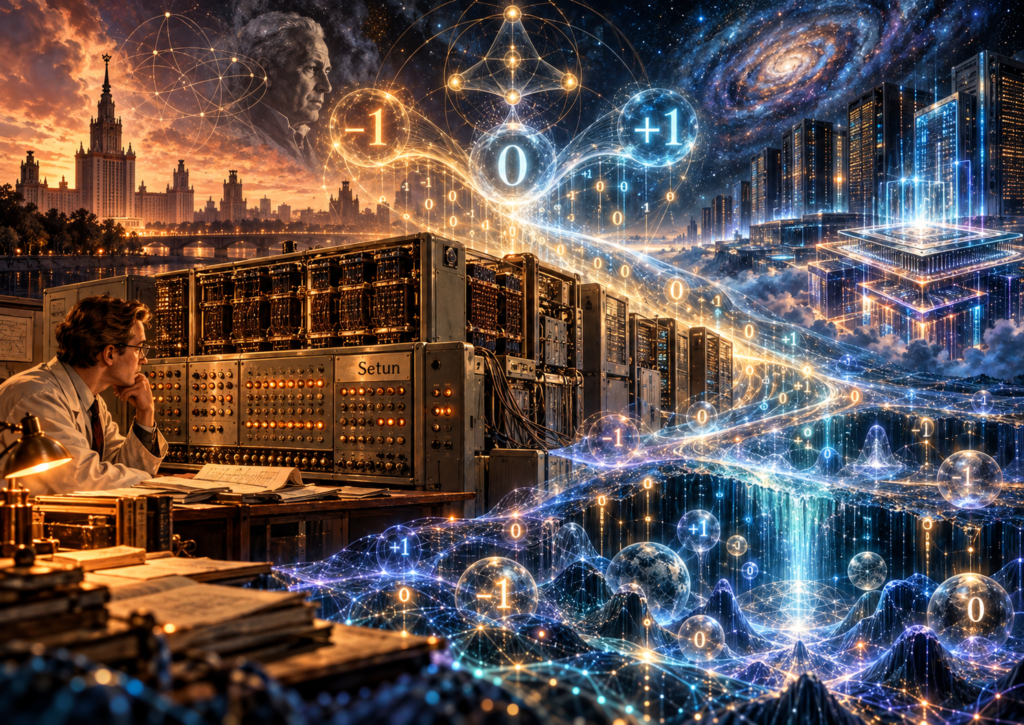
It became one of the rare practically implemented ternary computer architectures in history. Setun operated using balanced ternary and the values ((-1,0,+1)).
This was not merely an academic experiment.
The architecture offered concrete advantages: simpler signed arithmetic, elegant rounding, fewer conditional instructions in certain cases, and more natural execution of some arithmetic operations. The designers later argued that ternary implementation required less hardware and lower power consumption than comparable binary elements of the period.
🧲 A Computer Without the Transistors It Needed
The hardware implementation of Setun was particularly interesting.
Soviet engineers at the time did not have access to the stable, mass-produced transistor technology that was developing rapidly in the West. Vacuum tubes were bulky and relatively unreliable, while transistors were not sufficiently available for the kind of machine the team wanted to build.
Brusentsov’s group therefore developed logic elements based on miniature ferrite cores and semiconductor diodes.
The ferrite cores acted as controlled magnetic elements and made it possible to implement so-called threshold logic, including its ternary variant.
In other words, the lack of standard components did more than merely constrain the designers. It forced them to think differently.
That is one of the more interesting lessons in the history of technology: a limitation is not always merely an obstacle to innovation. Sometimes it is the reason innovation happens.
Setun also proved surprisingly reliable. Official tests in 1960 demonstrated stable operation across a wide range of supply voltages and temperatures, and the machine was judged relatively simple to manufacture, maintain, and operate.
🏭 Why Did Setun Never Become the Standard?
If the system worked, was reliable, and offered certain mathematical and hardware advantages, an obvious question arises:
Why do we not use ternary computers today?
The answer is not purely technical.
Setun was produced only in a limited series — roughly ten to fifteen machines per year, with around fifty units manufactured in total — even though additional orders existed. Production was discontinued in the mid-1960s.
According to accounts from the designers, part of the problem lay in administrative hostility toward a project that had emerged outside the dominant industrial plans and standards.
But there was also a much broader problem.
The global computer industry had already chosen binary logic.
Transistors, memory, logic circuits, programming languages, standards, and later integrated circuits were all developing around two stable physical states.
Once an industrial ecosystem becomes large enough, its advantages can outweigh the benefits of any individual alternative architecture. We know this pattern from many other areas of technology.
The best standard does not always win.
Often, the standard that first builds a sufficiently large ecosystem does.
The Soviet computer industry would later move heavily toward compatibility with Western binary architectures, including the ES EVM family, based on IBM System/360 and System/370 concepts.
Setun remained an interesting dead end.
Or at least that is how it seemed.
🤖 And Then AI Arrived
More than sixty years later, the computer industry is facing a problem that the pioneers of Setun could not have anticipated in its modern form.
Artificial intelligence requires enormous amounts of computation.
Large language models contain billions, and sometimes hundreds of billions, of parameters. Training and running them requires enormous memory bandwidth, computing power, and electrical energy.
This is why the industry is returning to a question that long seemed settled:
Do we really need so much numerical precision?
One of the more interesting answers has emerged through the BitNet b1.58 architecture.
Its neural-network weights are restricted to only three values:
{-1,0,+1}.
The name 1.58 comes from the approximate value of the base-two logarithm of 3, representing the amount of information needed to encode three possible states.
Published results indicate that ternary weights can retain competitive performance compared with conventional higher-precision models while offering significantly better characteristics in terms of memory use, latency, throughput, and energy consumption. The authors explicitly point toward the possibility of developing dedicated hardware optimized for this class of models.
And at this point, history begins to take a curious turn.
AI software is rediscovering the set:
{-1,0,+1}.
The very same set Brusentsov used in 1958.
🇨🇳 Huawei and the New Ternary Logic
The story becomes even more interesting when we leave software and return to hardware.
In recent years, Huawei has filed patents describing ternary logic circuits, computing structures, and chips based on three-valued logic.
The patent documentation points to the possibility of reducing transistor count, lowering power consumption, and improving computational efficiency.
Chinese industrial and technology sources have also published far more optimistic estimates, including claims of reductions of tens of percent in component count, substantially lower energy consumption, and increased computing speed.
Such figures should be treated as projected goals and development estimates, not as independently verified performance figures for finished mass-produced processors.
Still, the mere fact that ternary logic is once again being seriously considered is significant.
Especially because it is now appearing in a completely different technological environment.
⚛️ CNTFET: A Different Transistor for Three States?
One of the historical problems of ternary logic was physically very simple.
It is much easier to build a transistor that reliably distinguishes between:
on / off
than an element that must reliably distinguish among three voltage or current levels.
The closer those levels are, the smaller the tolerance for noise, temperature variations, and manufacturing-process deviations. This gives binary logic an enormous physical advantage.
New semiconductor technologies, however, are reopening the possibility of a different approach.
One candidate is the CNTFET — Carbon Nanotube Field-Effect Transistor. Its properties can be modified through the geometry and structure of the carbon nanotube, making it possible to design different switching thresholds.
In principle, such devices could provide a more natural physical basis for multivalued logic than conventional silicon CMOS.
Huawei’s patent documentation considers precisely such ternary logic circuits implemented using these types of devices.
This is still far from proof that ternary AI processors will appear within the next few years.
But it does show that the idea is no longer merely an obscure historical footnote.
🌐 A New Technological Cold War
There is another parallel that is difficult to ignore.
Setun was created during the first Cold War. Its modern reincarnation is appearing during a new technological competition between the United States and China.
Restrictions on access to the most advanced lithography and semiconductor technologies are encouraging Chinese companies and research institutions to explore alternative paths toward greater computational efficiency.
This does not mean that ternary logic emerged as a direct consequence of sanctions, nor that it alone represents an answer to present technological constraints.
But the context matters.
When it is no longer possible simply to continue along the same path, alternative paths suddenly become much more interesting.
And once again, we return to Setun.
⏳ An Idea That Arrived Too Early?
Perhaps ternary computers will never replace binary ones.
The industrial infrastructure built around CMOS technology, binary memory, and decades of optimized software represents an enormous advantage that will not be easy to overcome.
It is also possible that ternary architectures will remain limited to highly specialized applications — for example, certain AI accelerators in which weights naturally take the values ((-1,0,+1)).
But even that would be enough to change how we look at Setun.
We would no longer be looking only at an unusual Soviet computer from 1958.
We would be looking at an architectural idea that waited for more than half a century for a problem to appear for which it might once again become useful.
The history of technology is often presented as a sequence of winners and losers.
The transistor defeated the vacuum tube. The integrated circuit defeated discrete components. Binary logic defeated ternary logic.
But a technological idea does not have to be wrong in order to lose. Sometimes it simply appears at the wrong moment, with the wrong manufacturing process, and without an ecosystem capable of supporting it.
Setun may have been exactly such a case.
A computer that was not late for the future. A computer that arrived in the future too early.
In the next part of this mini-series, we will move one step further: from a single computer to an attempt to view an entire economy as a cybernetic system.
There we will meet Viktor Glushkov and his far more ambitious project:
OGAS.
Leave a Reply