
In the first part of our mini-series on Soviet cybernetics, we explored Setun — the unusual ternary computer that, in the late 1950s, attempted to offer a different answer to the question of what a digital machine should look like.
This time, we will take a much larger step. We will no longer look at a single computer. We will look at an entire economy as a cybernetic system.
That was the ambition of Viktor Mikhailovich Glushkov, one of the most important Soviet mathematicians and cyberneticists, who in the early 1960s began developing the idea of a nationwide computer network designed to collect, process, and use economic data.
The project became known as OGAS — the National Automated System for the Collection and Processing of Information for Accounting, Planning, and Management of the National Economy.
Today, it is often described as the “Soviet Internet.” That comparison is not entirely wrong, but it misses the essence of the idea.
Glushkov was not primarily trying to create a network through which people could exchange messages and documents or access remote computers. His goal was far more ambitious: to build a digital nervous system for the planned economy.
🧠 The Problem Glushkov Was Trying to Solve
It is easy to imagine a planned economy as a system in which the state simply “decides what will be produced.”
In reality, the problem is incomparably more complex.
Millions of products, raw materials, and intermediate goods move between thousands of enterprises. Each of them has its own production capacity, inventory levels, workforce, energy consumption, transportation requirements, and deadlines.
A change in one part of the system can produce consequences somewhere entirely different.
If a steel plant reduces production, the effects may appear in mechanical engineering. If the railway lacks sufficient capacity, the goods may exist but never reach the factory. If one supplier is late, production at another enterprise may come to a halt.
In other words, a national economy is an enormous network of interconnected processes.
Glushkov understood that the fundamental problem of planned management was not merely political or administrative.
It was also an information problem.
Data arrived late. It was often incomplete, outdated, or adjusted to the interests of the institution reporting it. By the time information passed through several layers of the bureaucratic apparatus, conditions on the ground had already changed.
From the perspective of control theory, such a system faces a serious problem.
If a controller receives outdated information about the state of the system, the control action it sends may be wrong even if the decision-making algorithm itself is perfect.
Glushkov therefore wanted to shorten the information feedback loop.
⚙️ The Economy as an Object of Control
Here we reach a part of the story that is particularly interesting to anyone who has worked with automation and control systems.
When we control a technical process, we first need to know its current state. We measure temperature, pressure, speed, flow, level, or some other variable. We then process the data. Based on a model of the system and the desired objectives, we determine a control action. We observe the new response and repeat the cycle.
In its simplest form:
measurement → data processing → model → decision → control action → new measurement.
That is a feedback loop.
Glushkov attempted to apply a similar logic to the economy. Of course, a factory, an industrial sector, or a national economy cannot be reduced to a single PID controller. The number of variables is enormous, the relationships are nonlinear, and human behavior introduces additional uncertainty.
But the fundamental cybernetic idea remains the same:
to control a complex system effectively, you must know its state quickly enough.
OGAS was intended to provide precisely that information infrastructure.
🌐 What Was OGAS Supposed to Look Like?
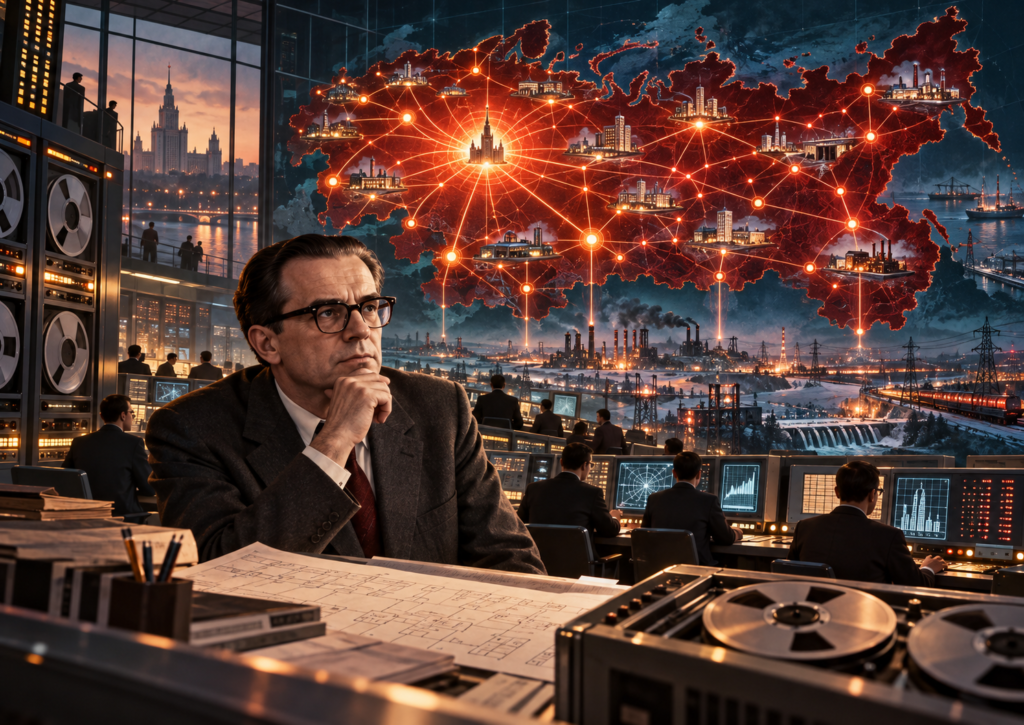
The technical foundation of the system was intended to be a Unified State Network of Computing Centers.
In Glushkov’s early proposals, around 100 major computing centers were to be distributed across major industrial cities and economic regions. Later versions considered expanding this number to approximately 200 nodes. These centers would be interconnected by high-bandwidth communication channels.
Connected to them would be around 20,000 lower-level computing centers located in major enterprises, ministries, and clusters serving smaller organizations. Glushkov also envisioned a distributed data bank and the ability to access information from different parts of the network following automatic verification of user authorization.
This is an important detail.
OGAS was hierarchically organized, but it was not conceived as a system in which data could travel only vertically toward Moscow and back. The architecture itself was intended to enable data exchange between computing centers and access to information stored in different parts of the system.
Hierarchy therefore did not mean complete communication isolation of the lower levels. It primarily reflected the organization of the economy and its management structure.
📡 Telephone Lines, Modems, and Communication Channels
Today, we take it for granted that computers can be connected through gigabit Ethernet, fiber-optic cables, or wireless networks.
At the beginning of the 1960s, the situation was entirely different. The most widespread telecommunications infrastructure was the telephone network.
For that reason, part of the OGAS concept relied on existing communication channels, supplemented by modems and specialized data-transmission lines. For the most important computing centers, Glushkov also envisioned direct broadband connections, fast enough to transfer large quantities of data between distant centers without constantly relying on conventional telephone switching.
In one of his later recollections, he gave a striking example: he wanted it to be possible to transfer the contents of a magnetic tape in Vladivostok to a tape in Moscow without reducing the effective transfer speed.
For the 1960s, that was an extraordinarily ambitious idea.
📦 Message Switching Is Not the Same as the Internet
Here we come to an important technical distinction that is often lost when OGAS is simply called a “forerunner of the Internet.”
OGAS planning documents refer to message switching.
In such a system, a message is treated as a complete unit.
A node receives the entire message, temporarily stores it, and then forwards it to the next node when the appropriate communication channel becomes available. This principle is commonly described as store-and-forward.
The Internet operates differently.
With packet switching, data is divided into smaller packets that may travel through the network along different routes and are then reassembled at the destination. This has major consequences for scalability, utilization of communication links, and network resilience.
OGAS therefore was not the Internet in a technical sense. But even this comparison should not be oversimplified.
For the main computing centers, Glushkov considered very fast direct connections and attempted to reduce dependence on the conventional switching mechanisms available at the time. His network was not simply a telephone pyramid with Moscow as the sole communication intermediary.
It represented a different architectural philosophy, designed for a different problem.
ARPANET was developed as a network connecting remote computing resources and research institutions.
OGAS was conceived as an infrastructure for the collection, processing, and distribution of economic data.
That distinction is more important than the ideological label of “decentralized versus centralized.”
📊 A Distributed Database Before It Became Normal
Another part of Glushkov’s vision sounds remarkably modern today.
Data was not merely supposed to pass through the network. It was to be stored in a distributed data bank accessible by authorized users from different locations.
Glushkov even envisioned automatic verification of user access rights.
In other words, the problem was not merely:
“How do we connect computers?”
It was:
“How do we organize the data of an entire economy so that different levels of management can actually use it?”
This is very close to the problems we now solve using distributed databases, ERP systems, data warehouses, and business analytics.
Of course, the hardware, memory capacity, and communications available at the time were incomparably more limited.
But the conceptual problem is very familiar.
🏭 From OGAS to ERP and MES
This is where OGAS stops being merely a historical curiosity.
A modern industrial company already contains many elements of what Glushkov was thinking about.
At the production level, we have sensors, PLC systems, and SCADA supervision. Above them, we often find MES, collecting data about work orders, production quantities, downtime, quality, material consumption, and equipment status.
At a higher level, ERP connects production with inventory, procurement, sales, finance, and planning.
In greatly simplified form, the structure looks like this:
physical process → sensors and operators → PLC/SCADA → MES → ERP → business planning and decisions.
And then decisions return through the system. Production plans generate work orders.
Procurement responds to inventory levels. Maintenance responds to equipment condition.
Management follows KPIs and adjusts business plans.
That is a cybernetic feedback loop.
Glushkov was attempting to raise a similar logic from the level of an individual enterprise to the level of an entire national economy.
Seen from this perspective, his vision no longer seems quite so exotic.
It seems familiar.
Only the scale was enormous.
🧮 Mathematical Planning Instead of Administrative Addition
The computer network itself was only the technical infrastructure. The true goal of OGAS was much broader.
Glushkov envisioned developing a system of mathematical models for economic management, using data from the network to plan and correct economic decisions.
This distinction is important.
OGAS was not intended merely to accelerate the transmission of reports from a factory to a ministry. It was intended to change the way planning itself was performed.
Instead of a long administrative process in which enormous quantities of data passed through countless offices, computers would take over part of the analysis.
Intersectoral balances, resource allocation, production capacities, and different economic scenarios could be calculated far more quickly.
In other words, the computer was not supposed to become merely the bureaucracy’s typewriter.
It was supposed to become part of the decision-making process itself.
🏛️ When Information Becomes Institutional Power
Here OGAS encountered a problem that could not be solved with a better algorithm.
Information is not merely a technical resource.
Information is also power.
Different Soviet ministries, statistical institutions, and other organizations possessed their own systems of data collection and their own administrative jurisdictions.
A unified network with common data standards could increase the efficiency of the system, but it would also change the balance between institutions.
It raised uncomfortable questions:
Who controls the database?
Who determines which information is valid?
Who can access which data?
Who defines the algorithms?
Who has the authority to change the plan?
These are no longer merely technical questions.
Benjamin Peters has identified institutional rivalry as one of the major reasons Soviet computer-network projects failed to develop into a unified national infrastructure.
The paradox is obvious.
A system intended to make a centralized economy more efficient encountered resistance from different centers of power within the centralized state itself.
💰 A Project of Enormous Scale
There was also a much more mundane problem.
Cost.
Full implementation of OGAS would have required enormous quantities of computing equipment, communications infrastructure, and skilled personnel.
Estimates associated with the project spoke of costs exceeding 20 billion rubles over a long construction period, together with the recruitment or reassignment of hundreds of thousands of workers.
Some estimates mentioned around 300,000 employees involved in the development and operation of the system.
For the Soviet Union of the 1960s, this was not a small technology project.
It was an infrastructure program on a national scale.
At the same time, the Soviet computer industry was already struggling with mutually incompatible machines, insufficient production of reliable components, and rapid technological progress in the West.
The vision was growing faster than the infrastructure capable of realizing it.
💻 IBM System/360 and a Change of Direction
By the late 1960s, Soviet computing was entering a new phase.
In 1967, a decision was made within the Soviet Union and the COMECON countries to develop a family of mutually compatible computers known as ES EVM, based on the IBM System/360 architecture.
That decision remains controversial.
Some interpret it as an abandonment of the original Soviet school of computing.
Others point to a very real problem: the Soviet Union had a large number of mutually incompatible architectures, while IBM had already demonstrated the enormous value of a standardized computer family capable of sharing a common software ecosystem.
From the perspective of industrial policy, choosing a compatible standard had its logic.
But it also had a price.
Soviet computing increasingly began to follow an architectural path that had already been defined in the West. Innovation gradually shifted from creating entirely new computing concepts toward catching up with existing standards.
Setun had been one symbol of the earlier period.
OGAS was another.
❌ Why Was OGAS Never Built?
There is no single simple answer.
Several explanations can be identified:
The technology was not mature enough.
The project was extremely expensive.
The Soviet computer industry was fragmented.
Ministries and institutions had conflicting interests.
Standardizing data and procedures required changes that reached deeply into the way the system itself functioned.
And political support was never stable enough to sustain a project of such scale over several decades.
Glushkov continued developing the idea of OGAS throughout the 1970s, but he was never given the opportunity to build the system in the form he had envisioned.
He died in 1982.
OGAS remained a vision.
🔄 Was OGAS Ever Realized Somewhere After All?
Not in the form in which it was conceived, as a national Soviet system.
But elements of its logic are now all around us.
Modern factories already generate enormous quantities of data.
ERP connects business processes.
MES monitors production almost in real time.
IoT sensors track physical objects.
Cloud systems consolidate data from different locations.
Digital twins attempt to model physical processes.
Algorithms optimize inventories, production, transportation, and energy consumption.
And artificial intelligence is increasingly entering the processes of analysis and decision-making.
Technically speaking, many of the components Glushkov lacked now exist.
They are simply no longer part of a single state project.
They exist across thousands of companies, platforms, and information systems around the world.
🤖 Glushkov’s Problem and Ours
Glushkov was attempting to solve the problem of a lack of timely and reliable data.
Sixty years later, we face almost the opposite problem.
We have so much data that a human being can no longer process it directly. Algorithms therefore filter information. Algorithms predict. Algorithms recommend.
Increasingly, they also decide.
And this is where the OGAS story reaches its boundary.
For a cyberneticist, it is natural to want to optimize a system.
But every optimization requires an objective function.
What are we optimizing?
Productivity?
Profit?
Energy efficiency?
Equality?
Growth?
Stability?
Quality of life?
Environmental sustainability?
And what happens when these goals conflict with one another?
A computer can be extraordinarily efficient at finding an optimal solution to the problem we have defined.
It is much harder to answer the question of who has the right to define what “optimal” actually means.
Glushkov believed that better data and mathematical models could help society make more rational decisions.
Today, we possess an infrastructure he could only have dreamed of.
We have global computer networks, cloud platforms, billions of sensors, enormous databases, and artificial intelligence capable of discovering patterns within them that human beings may struggle to see.
That is why OGAS can no longer be viewed merely as a failed Soviet technology project.
It becomes a mirror reflecting a question that may be even more important today than it was in the 1960s:
What happens when society genuinely acquires the technical ability to model, predict, and optimize itself?
Here the second part of our triptych comes to an end.
In the third, we will leave Glushkov’s laboratory and enter the far more uncomfortable territory between technological utopia and dystopia.
There we will encounter artificial intelligence, Industry 4.0, giant technology platforms, the idea of techno-feudalism — and a novel that, long before digital networks existed, attempted to imagine a society transformed into a perfectly rational system.
Yevgeny Zamyatin and his We.
Leave a Reply