
In the first two parts of our triptych, we began with the external world. First, we saw that the brain is not a simple decoder of sensory signals, but a system that continuously makes predictions, compares them with what it receives from the senses, and corrects its own model of reality when a prediction error appears. Then we opened the question of attention and awareness: why, among the enormous number of signals passing through the nervous system, do some receive greater neural gain, emerge under the mental spotlight, and become part of conscious experience, while others remain in the background?
Now we come to perhaps the most challenging part of the story. What happens when the external signal weakens, becomes impoverished, or almost disappears? The brain does not stop working. It continues to generate content.
Perhaps this is one of its most important properties: the nervous system is not merely a machine for processing what comes from the outside, but also a generator of inner worlds.
The Brain Does Not Like Emptiness
Our nervous system evolved in a world of constant change, signals, and the need to react. Silence, darkness, and a complete lack of external stimulation are not natural conditions for a system that is almost constantly engaged in prediction, comparison, and correction.
That is why it is especially interesting to observe what happens when the external structure of input suddenly weakens. In sensory-deprivation experiments, people who spend longer periods in dark, silent, or perceptually impoverished environments may begin to experience visual or auditory phenomena that have no immediate external source. Sometimes these are simple lights, patterns, or sounds; sometimes they are more complex scenes and experiences.
This does not mean that every person placed in silence necessarily begins to hallucinate, nor that the mechanism is the same in everyone. But the phenomenon demonstrates something very important: when the external world stops providing sufficiently structured input, the brain does not become empty. On the contrary, its internal dynamics become relatively more important.
In the language of predictive processing, we might say that the external signal then provides less corrective information, while internal models, expectations, and spontaneous neural activity exert greater influence on what the system “sees” or “hears.”
The brain does not stop generating when the external signal grows quiet. It simply loses the interlocutor that constantly corrects it.
Filling in the Gaps Is a Normal Function
This need to complete missing information is nothing unusual. We use it every moment.
In vision, we have a physiological blind spot where the optic nerve exits the retina. Yet in our conscious experience there is no black hole in the visual field. The brain uses surrounding information and its own assumptions to fill in what is missing.
Something similar happens in speech. If several phonemes disappear because of noise, we can often still understand the entire sentence. A familiar melody may remain recognizable even when individual notes are missing.
The brain, then, does not passively wait for a complete signal. It actively finishes the unfinished story.
Under normal conditions, this is an enormous advantage. It allows us to react quickly, function in a world of incomplete information, and avoid stopping every time sensory input is imperfect. But the same mechanism opens another question: if the system is built to fill in gaps, what happens when the gap becomes very large?
Imagination: A Controlled Internal Simulation
When we close our eyes and imagine the face of someone we know, there is no corresponding current visual signal on the retina. Yet we can still form a fairly clear internal image. We can imagine a room, a landscape, a voice, a melody, a movement, or an event we have never actually experienced.
This means that the brain has a generative capacity that is not tied only to the processing of current sensory input.
Imagination is perhaps one of the clearest examples of this. It uses experiences, memories, learned patterns, and emotional values, but reorganizes them into a new structure. We can combine parts of different experiences and create mental content that has never existed before.
Here we are already entering the very foundation of creativity. When an engineer imagines a new machine, a composer a melody, a writer a character, or a physicist a new theoretical model, the brain does not retrieve a ready-made picture from some archive. It constructs new content from previously learned elements.
Creativity, therefore, is not necessarily “creation from nothing.” It might be better described as the generation of new structure from existing representations.
Generative AI as a Technical Analogy
This is where contemporary generative AI provides an interesting technical reference.
Large language models generate text based on statistical relationships learned from enormous amounts of data. Image-generation models use high-dimensional representations and iterative processes to construct content that need not directly correspond to any single example in the training set.
Of course, the brain and generative AI are not the same. The brain does not work like an LLM, and human creativity cannot be reduced to next-token prediction. The nervous system has a body, autobiographical memory, emotions, goals, motivation, interoception, social experience, and subjective meaning.
But there is one useful parallel: both systems can produce new content from previously learned patterns.
In AI, we achieve this through enormous processing power, vast quantities of data, and mathematical models. The brain achieves something similar with a biological system that consumes roughly as much energy as an ordinary light bulb.
That alone shows how far we still are from fully understanding biological architecture.
When AI “Hallucinates”
Here we need to make an important terminological distinction.
When we say that an LLM “hallucinates,” we are using a metaphor. The model may generate plausible, grammatically correct, contextually coherent content that is factually wrong or unsupported by available data.
That is a problem of information generation.
In humans, hallucination is something else.
In the neuropsychiatric sense, a hallucination is a perceptual experience without a corresponding external sensory source, while the content may possess the qualities of real perception.
That is why the following formulation is useful:
An AI “hallucination” is an error in information generation. A human hallucination is a problem in the status of experience.
In humans, it is not enough for content to be generated internally. That also happens in imagination, memory, and dreams. The key difference lies in how the brain labels the source of that content.
How Do We Know That a Thought Is Ours?
At first glance, this question seems trivial. When we imagine something, we usually know we are imagining. When we remember, we know it is a memory. When we engage in inner speech, we know that the voice belongs to us.
But that ability is not automatically guaranteed.
The brain must somehow distinguish what arises as a consequence of an external sensory signal from what is produced within its own networks. In cognitive neuropsychology, this is often described as source monitoring — the assessment of the origin of mental content.
Did I actually see this? Did I merely think it? Did someone tell me, or did I read it? Did the voice come from the outside or from within?
Most of us make these distinctions almost effortlessly. But when source-monitoring mechanisms begin to fail, internally generated content may acquire the status of external reality.
This opens one possible pathway toward hallucinatory experience.
Dreams: An Inner World Without an External Director
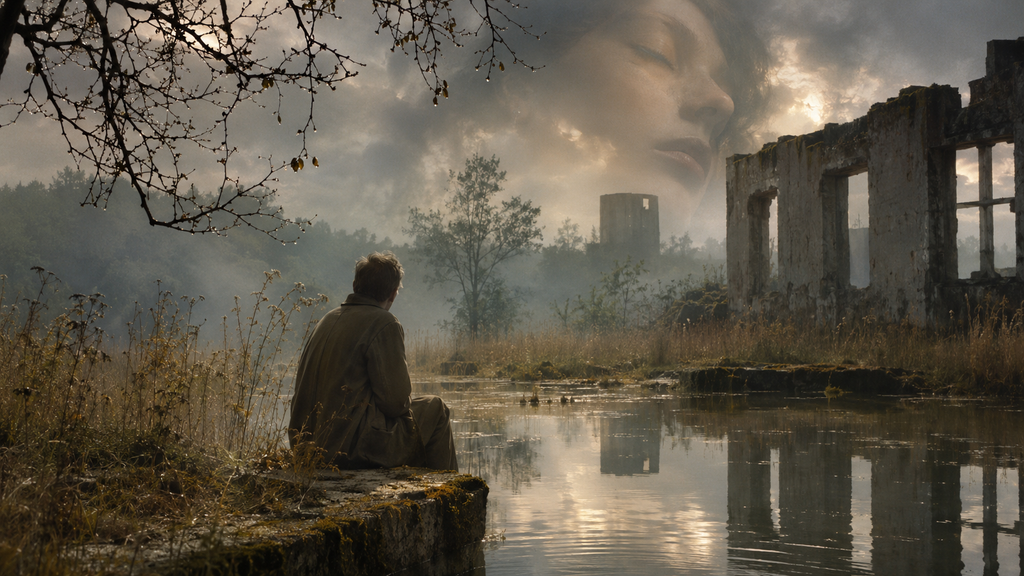
Dreams are perhaps the most impressive demonstration of how capable the brain is of generating experience without the immediate external world. During sleep, we can see spaces, hear voices, talk to people, experience movement, emotion, fear, joy, and entirely new events, while the body remains still in bed.
The REM phase of sleep is particularly interesting. During it, there is intense activity in brain systems associated with visual and emotional processing, while contact with the external world is significantly reduced. Rapid eye movements, after which REM sleep is named, have long raised the question of whether the eyes somehow “scan” the internal scene of the dream.
The most accurate answer is that this idea has not been fully proven in such a simple form. There are findings showing a relationship between eye movements and dream content, but the relationship is not simple enough for us to say that the eyes literally follow a dreamed scene in the same way they follow a real one.
Still, the basic idea remains fascinating: during REM sleep, the visual system can be activated top-down, from internal brain processes, without corresponding external visual input. In other words, the brain can activate part of the sensory system using its own internally generated content.
The scenes we see in dreams are not images from the retina. They are images from within.
Why Do We Believe the Impossible in Dreams?
One of the most fascinating features of dreams is how easily we accept absurdity. We may talk to someone who died long ago, fly, find ourselves in a city that makes no sense, or watch space change without any physical logic, and while the dream lasts, none of this may seem strange.
Part of the answer probably lies in the altered relationship between different brain systems. During REM sleep, emotional and visual systems may be highly active, while certain prefrontal regions associated with critical monitoring, logical checking, and reality assessment are less engaged than in the waking state.
The internal generator then operates very intensely, while reality checking is weaker. As a result, content that would immediately be rejected as illogical while awake can pass completely unquestioned in a dream.
In that sense, dreaming may be one of the clearest examples of a situation in which the internal model takes the stage with almost no external corrector.
Creativity and Dreaming Are Not So Far Apart
This brings us back to creativity.
In the creative process, we often need to temporarily weaken the strict control of familiar patterns. If we test every new idea immediately against the rules of what we already know, it becomes difficult to arrive at something genuinely new. That is why creative thinking often involves freer associations, unexpected connections, and the temporary tolerance of ideas that at first appear nonsensical.
Only later does the second phase arrive — evaluation, selection, and correction.
We might say that the creative process requires two different abilities: generation without excessive control, and control without suffocating generation. This is very similar to the tension we have followed throughout the entire triptych: the system must be free enough to predict and create, yet constrained enough by data not to lose contact with reality.
Where Imagination Becomes Hallucination
This brings us to a boundary that is difficult to draw with a single line.
Vivid imagination is not hallucination, inner speech is not hallucination, a powerful memory is not hallucination, and dreaming is not psychopathology. A clinical problem arises when internal content is experienced as external, when the ability to correct it against reality is lost, or when such experiences become intrusive, distressing, and functionally disabling.
Even then, there is no single mechanism. Hallucinations can occur in different psychiatric and neurological conditions, under the influence of certain psychoactive substances, during severe sensory deprivation, in high fever, in some sleep disorders, and in other states.
That is why it is not enough to say that “the brain imagines too much.” That would trivialize a complex phenomenon.
But the predictive model offers a useful framework: if internal expectations are given too much weight, while the sensory signal or the mechanisms for identifying the source of content become less reliable, an internal representation may acquire the qualities of perception.
Hallucination as a Misweighted Signal
Here we return to the second part of our triptych and to neural gain.
If an internal signal receives too much amplification, it can become functionally dominant over external input. If the system simultaneously misjudges its source, content generated within the brain may be experienced as an external event.
This is only one possible model of hallucination, but it is very useful because it connects all three parts of our story:
prediction → weighting → content generation
In the first part, the brain predicts the world. In the second, it decides which signals will receive priority. In the third, we see that it can generate content even when there is almost no external signal.
The problem arises when the mechanisms that normally maintain the balance between these three processes lose stability.
The Brain as a Generator, but Not a Free Generator
The most important thing is not to make the opposite mistake and conclude that the brain arbitrarily invents reality.
In the normal waking state, our internal model is constantly under pressure from the external world. If we think a door is open and then walk into a closed one, the prediction error is extremely convincing. If we expect someone to be in the room but there is no visual, auditory, or other corresponding signal, the model is normally corrected.
The external world does not determine every detail of our experience, but it sets boundaries. Creativity emerges when the brain temporarily relaxes those boundaries, dreaming when it quiets them further, and hallucination when, under certain conditions, the system’s ability to distinguish internally generated content from external input becomes disrupted.
Between Reality and the Inner World
Perhaps the greatest mistake is to imagine perception, imagination, dreaming, and hallucination as four completely separate functions.
They probably use a significant part of the same neural infrastructure. They differ in where the dominant content comes from, how strong the external input is, how much the internal model is checked against reality, and how the brain evaluates the source of its own experience.
In waking perception, the external world continuously corrects the model. In imagination, the model gains greater freedom, but we know that we are imagining. In dreams, external input weakens and the internal generator takes almost the entire stage. In hallucination, internally generated content may acquire the status of external perception.
These are not identical phenomena, but neither are they completely unrelated.
Generation Is a Feature, Not a Fault
This may be the most important message of the final part of the triptych.
The brain’s ability to generate content is not a pathological excess. It is a fundamental property of a system that must predict, plan, imagine the future, reconstruct the past, and model situations that do not yet exist. Without it, there would be no creativity, no art, no scientific hypotheses, no engineering design, and no ability to imagine the consequences of a decision before making it.
The problem does not arise because the brain generates.
The problem arises when the system loses a reliable boundary between generated content and external reality.
The End of the Triptych
In the first part, we saw that the brain does not decode the world, but continuously negotiates with it. In the second, we saw that consciousness does not listen to all participants in those negotiations equally loudly — some signals receive greater neural gain, greater priority, and access to conscious experience. In the third, we reached an even deeper level: the brain does not merely have to receive the world, but can also simulate it, modify it, imagine it, and dream it, while under certain conditions it can assign internally generated content the status of external reality.
Perhaps that is why the boundary between perception and imagination is not a wall, but a shifting balance between external input and the internal model. In the waking state, the external world strongly constrains that balance; in creativity, we temporarily loosen it; in dreams, external control weakens further; and in hallucinatory experiences, the assessment of where content comes from may become disturbed.
We began this triptych with the question: “How does our brain assemble the complex mosaic that represents our subjective experience of reality?” By the end, we have arrived at an open question whose answer each of us discovers piece by piece: “How much of our experience of reality is created from within, and how much is determined by the world around us?”
As human beings, we are capable of changing and adapting the world around us. And the first step, it seems, is changing and creating the world within us.
Leave a Reply