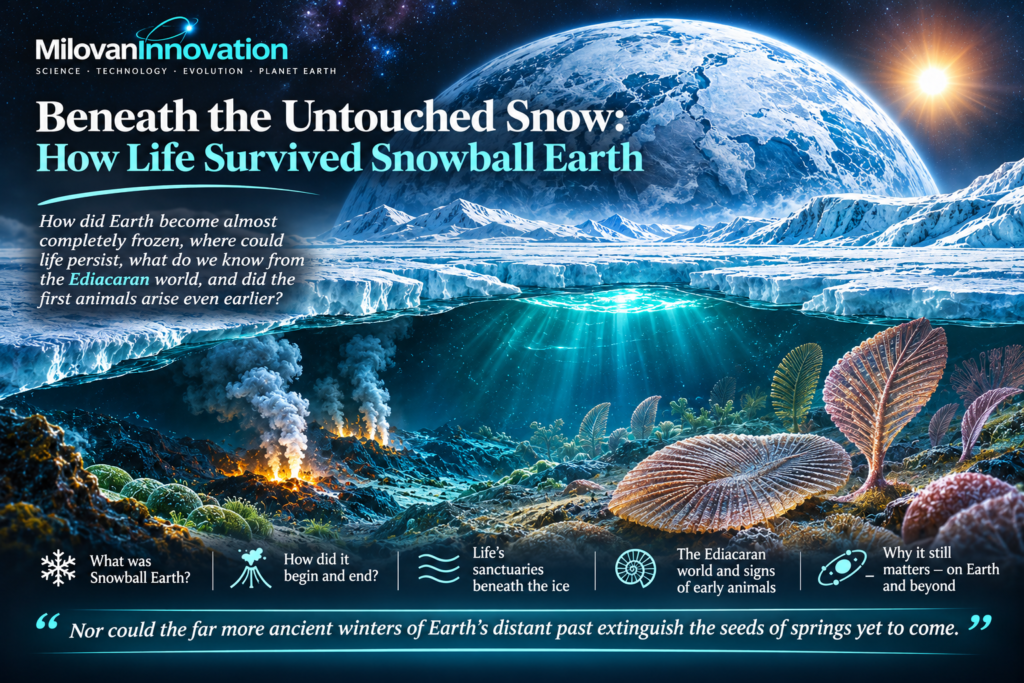
Before the first forests, before the dinosaurs, and perhaps even before the earliest animals we can confidently recognize, Earth experienced a winter that lasted millions of years. Yet beneath its frozen surface, life continued a story whose later chapters would eventually lead to us.
A World Beneath the Untouched Snow
Imagine observing Earth from space some 700 million years ago. Instead of the familiar blue planet, with white clouds drifting above its oceans and continents, we might encounter an almost entirely white sphere. Ice stretches across immense distances, glaciers descend toward tropical seas, and the rhythmic sound of ocean waves has largely fallen silent beneath a frozen surface. There are no forests, no birds, no animals leaving their tracks across snowy plains. The world appears silent, deserted, perhaps even lifeless.
There is something strangely beautiful about this imagined scene. An untouched blanket of snow extending to the horizon, concealing an entire planet beneath its cold perfection. But the apparent serenity is deceptive. This was not a peaceful winter after which spring would inevitably arrive according to the familiar sequence of seasons. It was a planetary climate crisis of extraordinary duration, perhaps lasting tens of millions of years.
And yet, beneath that immense covering of ice, an entirely different world existed.
Deep in the oceans, geothermal heat continued to rise from Earth’s interior. Along volcanic ridges and around hydrothermal vents, chemical energy remained available to microorganisms capable of surviving without sunlight. Elsewhere, perhaps beneath thinner ice, in temporary meltwater lakes, or through openings in the frozen surface, photosynthetic organisms may have continued to capture the energy of the Sun.
We should resist the temptation to populate this ancient world with familiar marine animals. There were no fish, crabs, or cheerful sea creatures celebrating life beneath the waves, as Sebastian would do hundreds of millions of years later in The Little Mermaid. But this slightly playful association raises a serious scientific question: what kinds of organisms actually inhabited those dark waters, and how much of the animal kingdom’s evolutionary history may have unfolded before the ice finally disappeared?
The answer takes us into one of the most fascinating, but also most controversial, chapters in the history of life.
How Earth Became a Giant Snowball — and How It Escaped the Ice
The geological interval known as the Cryogenian Period lasted approximately from 720 to 635 million years ago. During that time, Earth experienced two extraordinary glaciations: the Sturtian, approximately 717–659 million years ago, and the Marinoan, which ended around 635 million years ago.
Evidence for these events has been preserved in glacial sediments on different continents, including rocks whose paleomagnetic signatures indicate formation at surprisingly low ancient latitudes. In other words, ice reached regions close to the equator. These observations gave rise to the hypothesis of an almost globally frozen ocean, now known as Snowball Earth.
But what could have pushed an entire planet into such a state?
The answer lies in the delicate balance between solar radiation, atmospheric greenhouse gases, plate tectonics, and the chemical weathering of rocks. During the breakup of the supercontinent Rodinia, vast areas of freshly exposed rock appeared in warm and humid tropical regions. Rainwater reacted with silicate minerals, gradually removing carbon dioxide from the atmosphere and transferring carbon through geological processes toward the oceans and carbonate sediments.
One particularly intriguing candidate for triggering this climatic transformation is the enormous Franklin Large Igneous Province, formed approximately 719 million years ago. Volcanic eruptions are commonly associated with planetary warming because they release carbon dioxide. They can, however, also cause short-term cooling through the emission of sulfur aerosols. The long-term role of this particular volcanic episode may have been even more paradoxical.
The immense quantities of fresh basalt produced by these eruptions were highly susceptible to chemical weathering. Under tropical conditions, their reactions with water could have consumed atmospheric CO₂ so efficiently that long-term cooling eventually exceeded the initial warming caused by volcanic emissions. Research investigating the relationship between the Franklin magmatic province, intensive basalt weathering, and the onset of the Sturtian glaciation has explored precisely this possibility.
If greenhouse gas concentrations fell below a critical threshold, expanding snow and ice would begin reflecting increasing amounts of sunlight back into space. This is the familiar positive feedback between ice and albedo: cooling produces more ice, more ice reflects more solar radiation, and the resulting reduction in absorbed energy causes further cooling. Once a certain threshold is crossed, the climate system can enter an almost unstoppable process of glaciation.
With much of the ocean covered by ice, the ordinary mechanisms regulating Earth’s climate could no longer operate as they had before.
But Earth possessed another source of energy, hidden deep beneath its frozen surface: its own geological interior.
Volcanic activity did not cease because the planet was covered in ice. Carbon dioxide continued entering the atmosphere through geological outgassing, while the widespread ice cover substantially reduced many of the processes that normally remove it through the chemical weathering of continental rocks. According to the classical Snowball Earth explanation, CO₂ gradually accumulated until the greenhouse effect became powerful enough to overcome the exceptionally high reflectivity of the frozen planet.
After millions of years, the ice began to retreat.
This explanation remains one of the leading hypotheses, but modern research indicates that the ancient carbon cycle was more complicated than previously assumed. Weathering may have continued beneath glaciers and along the seafloor, while changes in seawater chemistry could have influenced the rate at which carbon dioxide was removed. A 2026 study examined the possibility that differences in submarine chemical weathering help explain why the Sturtian glaciation lasted considerably longer than the Marinoan.
And what about life itself? Could living organisms have contributed to thawing the frozen planet?
Microorganisms were undoubtedly already important participants in Earth’s ancient carbon cycle. Methanogenic archaea could produce methane, a powerful greenhouse gas, while other microorganisms consumed methane, fixed carbon, or transformed atmospheric and oceanic chemistry. Biological activity could therefore influence climatic conditions, including changes in methane and carbon dioxide concentrations.
Nevertheless, we must distinguish a physically plausible mechanism from a demonstrated historical cause. We do not possess firm evidence that massive biological methane emissions were the decisive factor ending the Cryogenian glaciations. The accumulation of geologically released CO₂ remains the principal explanation in the classical model, while the role of biological feedbacks is still under investigation.
Nature, it seems, needed millions of years to restore a balance it had once lost.
The Hidden Sanctuaries of Life
If the oceans were covered by ice, where could life have survived?
The first answer that comes to mind is the deep ocean. Even during global glaciation, heat from Earth’s interior would have continued warming the seafloor. Hydrothermal vents could have supported communities of microorganisms that obtained energy not through photosynthesis, but through chemical reactions.
However, an explanation based exclusively on the deep sea introduces another problem. We know that photosynthetic eukaryotes survived the Cryogenian glaciations. Their descendants existed after the ice melted, and their evolutionary continuity required environments in which light and liquid water remained available.
This directs our attention toward possible sanctuaries of life, known in scientific literature as refugia.
Some may have existed where sea ice was thinner or fragmented, near cracks, coastlines, or occasional patches of open water. Others may have been seasonal meltwater lakes formed on glaciers or in areas of land that periodically remained exposed. The precise distribution of such habitats remains uncertain, and different climate models offer different possibilities.
Modern research has considerably enriched this picture. Studies of present-day Antarctic meltwater lakes show that diverse communities of microorganisms and eukaryotes can survive in small, isolated bodies of water surrounded by ice. Research published in Nature Communications in 2025 examined precisely such environments as possible analogues for Snowball Earth ecosystems, although their existence today does not prove that identical habitats existed during the Cryogenian.
An especially intriguing climate study from 2026 explored a seemingly contradictory possibility: even on a planet with extremely low average temperatures, relatively dark land surfaces could absorb enough solar radiation to reach temperatures above freezing during certain seasons. Under suitable geographical and hydrological conditions, small areas of liquid water might therefore have persisted intermittently near the surface.
Imagine the contrast. Across most of the planet, enormous ice sheets conceal the oceans, while somewhere in a narrow coastal depression or a temporary meltwater lake, a microscopic community quietly continues its existence.
Perhaps some of these organisms produced oxygen through photosynthesis. Others fed on dissolved organic material or depended on microorganisms that converted chemical energy into biologically useful forms. Entire microscopic food webs may have persisted in places that would have appeared utterly insignificant on a planetary map.
Of course, the existence of possible sanctuaries does not prove that animals inhabited them.
To examine that possibility, we must leave the climatic history of Snowball Earth and confront a much older mystery: when did the first animals actually appear?
Before the Cambrian Explosion: The Lost History of Animals
For generations, the Cambrian explosion has dominated the popular understanding of animal evolution.
Beginning approximately 539 million years ago, the Cambrian Period witnessed an extraordinary diversification of animal forms, ecological relationships, and anatomical structures. The fossil record increasingly reveals organisms with complex sensory organs, mineralized skeletons, articulated appendages, and evidence of active predation.
It is hardly surprising that this event captured the imagination of scientists and the wider public alike. Readers can easily gain the impression that the animal kingdom suddenly emerged from an almost empty world.
Yet the history of life was already much richer long before the Cambrian began.
During the preceding Ediacaran Period, approximately 635–539 million years ago, unusual communities of large, predominantly soft-bodied organisms inhabited ancient seafloors. Some possessed leaf-like or branching structures, while others displayed radial or bilateral organization. Their relationships to modern organisms remain the subject of continuing scientific investigation.
One particularly important example is Dickinsonia, a flattened organism with a series of repeating body units that lived more than 550 million years ago. In 2018, Jochen Brocks and colleagues published research in Science examining molecular fossils associated with Dickinsonia. The presence of cholesterol-derived compounds provided strong evidence supporting its classification among animals.
The Ediacaran world, therefore, was not an empty stage awaiting the Cambrian explosion. Complex organisms and evolutionary experiments already existed, and we are still attempting to reconstruct their significance.
But an even more difficult question remains: did animals exist before the Ediacaran?
The Argument from Molecular Clocks
Evolution leaves traces not only in rocks, but also in the genomes of living organisms.
By comparing genetic differences between evolutionary lineages, scientists can estimate how much time has passed since their common ancestors existed. This approach, known as the molecular clock, relies on assumptions about evolutionary rates and fossil evidence used to calibrate those rates.
In October 2026, a study by Orin Lole Durbin and colleagues, published in Science Advances, reopened the possibility that the animal kingdom originated approximately 800 to 700 million years ago — potentially even before the beginning of the Sturtian glaciation.
The researchers questioned an important assumption employed in earlier analyses.
An exceptionally preserved microscopic fossil assemblage from the Weng’an region of China, approximately 590 million years old, contains no universally accepted animal fossils. This apparent absence had been used to argue that animals were unlikely to have originated much earlier.
But the absence of fossils from a particular deposit is not necessarily evidence that the organisms themselves were absent from the living world.
The research team examined the Kheseen Biota of Mongolia, a considerably younger assemblage with similarly exceptional conditions for microscopic fossil preservation. Animals certainly existed elsewhere when those deposits formed, yet no unequivocal animal fossils were found there either.
The implication is significant: even exceptionally preserved fossil assemblages do not necessarily contain representatives of every group of organisms living at the time.
When the researchers reconsidered the maximum-age constraints used to calibrate molecular clocks, their estimates of animal origins shifted considerably further into the past.
This does not prove that animals were swimming beneath the Sturtian ice 717 million years ago. It does, however, weaken one of the arguments that had previously restricted their possible origins to a much younger period.
Chemical Fossils: Traces Without Bodies
A second line of evidence comes from biomarkers — molecules preserved in sedimentary rocks that can reveal the biochemical activity of ancient organisms.
Certain sterane compounds found in rocks older than the Ediacaran have been interpreted as possible evidence of ancient sponges. More recent analyses of combinations of different steranes have strengthened the argument that some sponge lineages may have existed as early as approximately 650 million years ago.
This would place animals near the end of the Cryogenian, well before the earliest widely accepted fossils of their macroscopic bodies.
However, these interpretations are not without controversy.
Some compounds previously believed to be characteristic of sponges can also be produced by other organisms or through chemical transformations during the prolonged burial of organic matter in sediments. A study published in Nature Ecology & Evolution in 2020 demonstrated that an important group of biomarkers previously attributed to sponges could have originated from algae.
Newer and more complex biomarker evidence may be more persuasive, but it has not eliminated every uncertainty concerning molecular preservation, biological specificity, and the age of the organisms that produced these compounds.
Scientific caution does not diminish the appeal of this story. On the contrary, it is an essential part of it.
Arguments Against a Very Early Origin of Animals
We must take seriously the fact that most of the pre-Ediacaran fossil record still contains no universally accepted fossils of animal bodies.
Small organisms without hard skeletal structures are difficult to preserve, but explaining a gap lasting tens of millions of years requires more than simply invoking that difficulty. We need convincing models of ancient habitats, sufficiently sensitive methods for detecting biological traces, and evolutionary models consistent with what we know about early ecosystems.
Molecular clocks are not direct observations of ancient organisms. Their results depend on the choice of calibration points, models of molecular evolution, and the quality of genetic data.
Biomarkers, meanwhile, can survive far longer than the organisms that produced them, but some are not unique to a particular evolutionary lineage.
The evidence is therefore suggestive, but not yet conclusive.
Nevertheless, an important distinction must be preserved. The absence of unequivocal early animal fossils does not prove that animals appeared suddenly during the Cambrian. Equally, the possibility of an older origin does not diminish the genuine evolutionary importance of Cambrian diversification.
These are two different questions: when did the earliest animal evolutionary lineages arise, and when did animals become ecologically dominant, anatomically diverse, and sufficiently abundant to leave a rich fossil record?
Those events need not have occurred at the same time.
Perhaps the ancestors of later animal groups spent millions of years as small, inconspicuous organisms inhabiting microbial ecosystems, long before their descendants developed the complex body plans we recognize today.
And perhaps part of that hidden evolutionary history unfolded beneath the ice of Snowball Earth.
We do not yet know. But science provides increasingly good reasons to ask.
Why This Changes Our Understanding of Life
The significance of Snowball Earth extends far beyond an extraordinary episode in planetary climate history.
For a long time, the evolution of complex organisms was commonly imagined as a progression toward increasingly favorable environmental conditions. More oxygen, more available energy, more stable ecosystems — and, consequently, greater biological complexity.
The real history appears considerably less straightforward.
Earth experienced enormous environmental disruptions long before the appearance of familiar animal ecosystems. The Cryogenian glaciations transformed nutrient circulation, ocean chemistry, the distribution of habitable environments, and probably the ecological opportunities available to organisms that managed to survive.
When the ice disappeared, melting glaciers and intensified chemical weathering could have delivered enormous quantities of nutrients to the oceans. Biological productivity, oxygen availability, and seawater chemistry changed in complex ways, potentially influencing the subsequent evolution of eukaryotic organisms.
But it would be premature to claim that Snowball Earth directly caused the emergence of animals or the Cambrian explosion. A considerable interval separated these events, and the processes shaping evolution were diverse.
What these glaciations reveal more clearly is that biological evolution does not unfold independently of planetary history.
Life transforms its environment through metabolism and chemical processes, while geological and climatic changes continually reshape the opportunities available to life. These two systems are connected by feedback mechanisms operating over timescales ranging from individual generations to hundreds of millions of years.
There is also an intriguing implication for the search for life beyond Earth.
A world covered in ice need not be biologically dead. Beneath the frozen exterior of an ocean planet or an icy moon, liquid water can persist wherever internal heat, suitable chemistry, and accessible energy sources make it possible.
Europa and Enceladus immediately come to mind. Their environments differ considerably from Cryogenian Earth, and no extraterrestrial life has yet been confirmed there. Nevertheless, the ancient glaciations of our planet help illustrate an important principle: the outward appearance of a world may tell us surprisingly little about its true biological potential.
A frozen planet could conceal an active biosphere.
And on Earth, that hidden biosphere may already have contained organisms whose descendants would one day inherit the thawed world.
The Wolf That Swallowed the Sun
In the ancient Norse vision of Ragnarök, the end of the world is preceded by Fimbulwinter — a terrible succession of winters without intervening summers. The world descends into darkness and cold, while cosmic wolves finally overtake the celestial bodies they have pursued across the heavens.
In one familiar version of the myth, the wolf Sköll catches and devours the Sun.
The image is terrifying: the source of light disappears, and the world enters its final winter.
But even this story does not end in darkness alone. Norse mythology also preserves the promise of renewal, of a world emerging after catastrophe and a new Sun following the path of the old.
There is an unexpected resemblance between this ancient vision and the history written in Earth’s rocks.
During the Cryogenian glaciations, no cosmic wolf was needed to swallow the Sun. Our star continued to illuminate the planet. Yet the balance of atmospheric gases, geological processes, and reflected solar radiation was apparently enough to transform Earth into an almost entirely frozen world.
For millions of years, sunlight fell upon immense expanses of ice, while the oceans beneath remained isolated from much of its energy.
And still, life endured.
Whether the first animals had already appeared, or whether their evolutionary ancestors were only beginning to lay the foundations of the future animal kingdom, remains one of the great unanswered questions.
What we do know is that the great freeze did not mark the end of biological history.
The ice finally retreated. The oceans changed. New ecosystems emerged. Millions of years later, Ediacaran seafloors were inhabited by organisms with extraordinary body forms, while the Cambrian seas would become the stage for an astonishing diversification of animal life.
The snow that once seemed eternal disappeared, but it did not erase the future.
Perhaps that is the most important lesson hidden beneath the untouched snow: the continuation of life does not require an unchanging world. Sometimes life survives in places so small that we can barely notice them, carrying possibilities that will become visible only after the planet itself has changed.
The ancient Norse winter was not final.
Nor could the far more ancient winters of Earth’s distant past extinguish the seeds of springs yet to come.
Leave a Reply