
What science reveals about the consciousness, intelligence, and emotional bonds of small birds — and what it still cannot explain
There are encounters that change us almost imperceptibly. They do not happen through grand words, dramatic events, or decisions we have carefully prepared. Sometimes, two small feathered creatures, weighing only a few dozen grams, simply enter our lives and challenge beliefs we have long considered perfectly reasonable.
Before Mici and Cici came into our home, I listened with considerable skepticism to friends and acquaintances talking about their pets. They often attributed qualities, intentions, and feelings to them that I regarded as expressions of human personification. I was convinced that this was simply our need to recognize something of ourselves in other beings, even when we lacked sufficient grounds for doing so.
Then my brother, who was leaving for a seaside holiday with his wife, asked us to look after two little parrots for about ten days — blue-feathered Mici and yellow-green Cici.
Something happened that I had never planned.
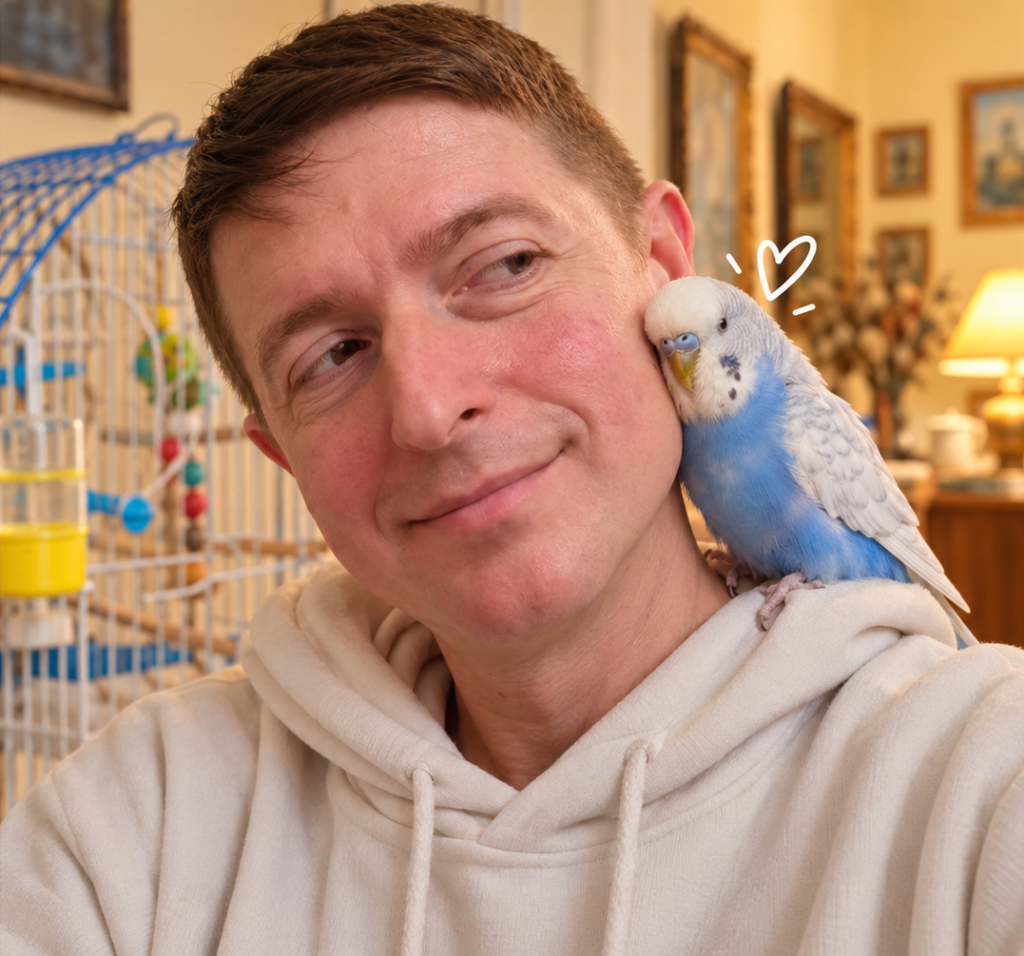
Their temporary stay became permanent, and my relationship with them began to change the way I looked at animals. Especially Mici, the little blue budgerigar who, as I later wrote, found a corner of my heart whose existence I had never even suspected.
Mici was not particularly demanding. He was calm, gentle, somewhat cautious, and had his own schedule for companionship, rest, and affection. He liked to keep his blue-and-white feathers immaculate, had moments when he withdrew into himself, and others when he sought attention of his own accord. He could be remarkably tolerant of mischievous Cici, but also quite firm when he decided he had endured enough of her teasing.
He loved music. He had his own melodies, variations, and little musical rituals. And when I came home burdened with worries I did not wish to speak about, he would sometimes approach me on his own. I did not know how much he understood, but I knew how much his presence meant to me.
Gradually, I stopped thinking of him merely as a representative of the species Melopsittacus undulatus. I began to see him as an individual.
That was my personal experience, not a scientific experiment. Nevertheless, it gave rise to questions for which science can offer far more fascinating answers than I had once imagined.
How complex is the inner world of a small bird? What does it perceive, remember, and learn? How does it recognize other individuals, form bonds with them, and respond when they disappear? And where does justified scientific caution end, and our underestimation of other forms of life begin?
🧠 Small Brains, Great Surprises: How Birds Challenged Our Understanding of Intelligence
For a long time, the prevailing assumption in science was that complex intelligence was inseparably linked to a large brain, particularly to the highly developed neocortex characteristic of mammals.
Birds do not possess a neocortex organized into six layers, as mammals do. Their forebrain has a different evolutionary and anatomical organization. For this reason, their cognitive abilities were once considered necessarily limited.
However, research over recent decades has profoundly changed that picture.
A study published in 2016 in the Proceedings of the National Academy of Sciences showed that the brains of many parrots and songbirds contain exceptionally densely packed neurons. In the species examined, the number of neurons per unit of brain mass was, on average, approximately twice that found in primates.
Particularly interesting is the fact that, in parrots and corvids, a substantial proportion of these neurons are located in the pallium, a region of the forebrain involved in complex information processing.
In other words, evolution did not need to produce a human-like brain to develop advanced cognitive functions.
Although avian and mammalian brains are organized differently, their nervous systems share certain functional and developmental similarities. Studies have shown that complex sensory processing and behavior can emerge through different neural architectural solutions.
This may be one of the most important lessons of modern comparative neurobiology.
Intelligence does not have to take a single anatomical form.
Of course, the fact that parrots have high neuronal densities does not imply that they possess all the abilities of primates, or that every parrot is equally intelligent. Cognitive abilities depend on the species, the organization of neural networks, experience, and the particular task involved.
Nevertheless, these findings have seriously challenged our old intuition that a small brain necessarily implies a simple mental life.
When I looked at Mici, a creature weighing around thirty grams, I was not looking at a miniature human being. I was looking at the representative of an entirely different evolutionary path that had produced surprisingly sophisticated abilities.
Perhaps our greatest mistake was that, for too long, we tried to assess that complexity exclusively through our own model of intelligence.
🌈 A World We Cannot Quite See
If we wish to understand the inner world of a budgerigar, we must first accept that its external world is not the same as ours.
Even when a human and a bird look at the same object, they do not necessarily receive the same information.
Under ordinary conditions, human color vision relies on three types of cone photoreceptors sensitive to different regions of the visible spectrum. Budgerigars have four principal types of cones involved in color discrimination, including receptors sensitive to ultraviolet light.
Their world is therefore richer, in an important sense, in information about the spectral composition of light.
Research has shown that ultraviolet reflectance from feathers can play a role in social communication and mate choice. Parts of the plumage that appear almost identical to us may carry different visual signals for other budgerigars.
This does not mean that we can simply imagine what their additional “color” looks like. Our nervous system has no direct subjective experience of such four-component color vision.
We can mathematically model receptor sensitivities, measure spectra, and study birds’ responses, but we cannot directly experience their visual world through our own eyes.
There is also an interesting detail that takes on a very personal meaning here.
Mici was particularly meticulous about maintaining his blue-and-white feathers. To me, it seemed like a kind of avian elegance, almost the behavior of a little dandy. Science shows that feather maintenance in budgerigars is not merely a matter of physical cleanliness: it can also influence the optical properties of plumage, including ultraviolet reflectance, which is important in communication between individuals.
Of course, we cannot claim that Mici was aware of his own beauty in a human sense. But we can say that his plumage was part of a visual communication system far more complex than it might appear at first glance.
Something similar applies to hearing.
Budgerigars are highly sensitive to the acoustic characteristics of their own vocalizations. They can distinguish subtle changes in frequency, duration, and the structure of vocal signals, while their nervous system is particularly adapted to processing sounds important for social communication.
For that reason, the question of what one budgerigar hears when another chirps is considerably more complex than the question of how that sound appears to us.
Perhaps what sounds like simple chirping to our ears represents, in the bird’s world, a rich collection of information about identity, proximity, willingness to interact, and relationships within the group.
We cannot yet reliably translate all this information into human language. But we can be certain that we should not dismiss it as insignificant.
🎶 Music, Memory, and the Voice That Becomes Part of a Relationship
One of the characteristics that makes parrots particularly interesting to scientists is their capacity for vocal learning.
Most animals possess a repertoire of calls that is innate to a considerable degree. Budgerigars, however, can modify and learn vocal patterns throughout their lives, relying on auditory experience and interactions with other individuals.
Their vocalizations include various short calls, but also longer, complex sequences of sounds often described in the scientific literature as warble song.
Research has shown that budgerigars can imitate one another’s contact calls. During the formation of social bonds, their calls may become more similar, while studies of bonded pairs have examined the role of such vocal convergence in establishing and maintaining relationships.
This is an extraordinarily interesting phenomenon.
We use speech not only to convey information but also to maintain relationships. The way we speak to people close to us often differs from the way we address strangers. We change our rhythm, intonation, choice of words, and emotional tone.
In budgerigars, we do not find human language in miniature, but we do find something that represents an important functional similarity: a voice that is not merely a response to an external stimulus, but also a means of social bonding.
For me, Mici revealed one of his most recognizable qualities precisely through his voice.
He loved music, especially our traditional folk music. One particular song held a special place in his repertoire. He often chirped along with its melody, creating variations that were uniquely his.
When listening to classical music, he would sometimes stand quietly and move his little tail, almost like a tiny conductor.
From a scientific perspective, such reactions may involve auditory learning, emotional arousal, recognition of familiar sound patterns, motor responses, or some combination of these processes.
Experiments have shown that budgerigars can be trained to perform certain tasks involving the temporal synchronization of movements with rhythmic signals. However, this does not mean that all budgerigars spontaneously perceive musical rhythm in the same way humans do. Research points precisely to the distinction between learned synchronization and spontaneous rhythm following.
What I observed in Mici remains a personal observation, not proof of any particular musical ability.
Yet that observation alone is enough to make us wonder: how rich is the acoustic world of a small parrot, and to what extent can music become part of its everyday experience?
Perhaps we cannot know what Mici experienced while listening to his favorite melody. But I do know that those moments became part of his unique relationship with us.
And every such relationship has its own history.
❤️ The Chemistry of Attachment: Do Birds Have Emotional Lives?
While the capacity for vocal learning in budgerigars is well documented, the question of emotions requires a somewhat more cautious approach.
In humans, we associate emotions with subjective experiences: joy, fear, pleasure, sadness, attachment, and love. However, when discussing other animals, we have no direct access to their experiences.
We can study behavior, physiological responses, nervous-system activity, hormonal changes, and reactions to social situations. From these data, we can draw conclusions about emotional processes, but we cannot simply assume that animals feel exactly as humans do.
Nevertheless, modern neuroscience provides growing reasons to take the emotional lives of birds seriously.
Systems regulating reward, stress, motivation, and social behavior did not emerge only with the appearance of humans. Their evolutionary roots extend deep into the history of vertebrates.
In birds, the neuropeptides mesotocin and arginine vasotocin play important roles. They are functionally related to the oxytocin and vasopressin systems found in mammals.
Studies of zebra finches, for example, have shown that these systems participate in regulating social bonding, maintaining pair relationships, and certain forms of social behavior.
This does not mean we have discovered a chemical formula for love. Complex emotional states cannot be reduced to a single substance, and findings obtained from one bird species cannot be directly applied to budgerigars without additional research.
But we can say that nature possesses evolutionarily ancient neurobiological mechanisms that enable the formation and maintenance of social relationships.
From an evolutionary perspective, this is understandable.
For social animals, proximity to other individuals can provide protection, easier access to food, greater reproductive success, and opportunities for learning. Mechanisms that maintain stable relationships can therefore have significant adaptive value.
However, a stable social bond is not merely a collection of useful interactions. It also involves changes in an individual’s behavior toward a particular partner.
And here we return to Mici.
He did not respond to everyone in the same way. He had his own patterns of approaching, withdrawing, socializing, and accepting affection. With Cici, he developed a relationship in which closeness, tolerance, and occasional disagreements alternated.
I cannot scientifically prove that what I experienced as his affection was identical to human love.
But neither do I see any justification for declaring every such interaction a soulless automatism in advance.
Perhaps the problem is precisely that we try to recognize love only when it speaks our own language.
🪶 One Small Individual: Where Does Instinct End and Personality Begin?
Behavioral biology has increasingly turned its attention to individual differences among animals.
Two individuals of the same species, even when raised in similar conditions, may show different tendencies toward exploration, caution, social contact, aggression, or responses to unfamiliar situations.
If such differences are sufficiently stable over time and across different circumstances, researchers may study them within the framework of animal personality, or individual temperament.
This, of course, is not identical to human personality in its full psychological and philosophical sense.
But it represents an important step away from viewing an animal as an interchangeable specimen of its species, toward understanding it as an individual with its own behavioral patterns and a unique history of experience.
Mici possessed precisely such a recognizable individuality.
Before arriving at our home, he had survived a traumatic encounter with a cat that killed his previous feathered companion. I cannot know how much that event shaped his later behavior. However, he was noticeably cautious while remaining capable of closeness and trust.
He was gentle, but by no means passive.
He knew how to show when something pleased him and when he had had enough. He sought attention, but on his own terms. He had moments of curiosity and moments when he wanted peace.
Once I came to know him, it ceased to matter to me whether every one of those qualities could be placed into a zoological category.
He became my friend.
Of course, we must distinguish two levels of reasoning here. Science can investigate temperament and individual differences in bird behavior. But the statement that a particular animal is our friend also belongs to the realm of human experience, ethics, and the philosophy of relationships.
The fact that these two perspectives differ does not mean that one must invalidate the other.
Knowing everything about the physiology of the species Homo sapiens does not mean knowing a particular human being. Likewise, knowing the biology of budgerigars cannot, by itself, describe everything that Mici was as a unique individual.
And it is precisely here that we encounter the question that changed me most.
When we lose an animal with whom we have built a deep bond, why can another individual of the same species not simply make up for that loss?
The answer I found was not particularly complicated.
Because we had not merely lost a parrot.
We had lost Mici.
💔 When Another Bird Falls Silent: What Do We Know About Loss and Grief?
Mici’s death did not change only our everyday lives.
It changed Cici’s life as well.
She had been his longtime companion, a partner in everyday activities, and a participant in their little disagreements, games, and communication.
After he was gone, we noticed significant changes in her behavior. Over the following months, she was less active and less interested in some of her usual activities. Gradually, she returned to her routines, her exploratory spirit, and her liveliness.
But one change remained particularly noticeable.
Cici began to chirp more quietly.
Her voice, once much stronger and more expressive, became noticeably softer. Even after most of her everyday activity had returned, that detail remained.
What does such an observation tell us?
First, we must be very careful.
A change in vocalization following the loss of a social partner does not, by itself, prove that a bird experiences grief in the same way a human does. Vocal behavior may be influenced by changes in social stimulation, the absence of another individual’s familiar acoustic responses, stress, aging, or health-related factors.
Research on vocal learning in budgerigars shows that their vocal behavior is strongly connected to their social environment. Their calls are not entirely fixed patterns; they can change throughout life according to experience and interactions.
It is therefore scientifically reasonable to hypothesize that the disappearance of a close partner may also alter vocalization patterns.
But we should not stop there.
A broader question arises: if a social animal forms a stable bond with a particular individual, what happens when that individual disappears permanently?
In various animal species, researchers have documented changes in activity, feeding, social behavior, and vocalizations following separation from, or the death of, a close companion. These phenomena are studied within comparative thanatology and the science of social bonding.
One possible interpretation is that responses to loss are connected to evolutionarily ancient mechanisms of attachment. Systems that maintain proximity to a partner may, after that partner’s disappearance, continue to produce searching behavior, distress, or withdrawal.
This is a biologically plausible hypothesis.
However, we must distinguish responses to separation, stress caused by changes in the social environment, and the subjective experience of sorrow. These phenomena may be connected, but they are not automatically identical.
For budgerigars, we still lack sufficient direct research to reliably describe their subjective experience of the death of a close companion.
For that reason, I cannot claim that Cici grieves in the same way that I grieved for Mici.
I can, however, say that his disappearance was followed by a lasting change in her behavior, and that modern biology gives us serious reasons not to dismiss such changes as insignificant.
And that is precisely one of the boundaries between scientific humility and the unjustified underestimation of animals.
🔬 Anthropomorphism and Anthropodenial: Two Traps in Our Understanding
When speaking about the inner worlds of animals, we face two opposing risks.
The first is anthropomorphism — the tendency to attribute human thoughts, intentions, and feelings to other beings without sufficient evidence.
The second is what primatologist Frans de Waal popularized under the term anthropodenial — the unjustified refusal to recognize characteristics and abilities that humans may share with other animals.
Both extremes can seriously limit our understanding.
If we interpret every behavior of a parrot as a human thought, we risk seeing our own projections in the animal. But if we declare every form of attachment, learning, or emotional response to be nothing more than a reflex, we ignore empirical evidence of the complexity of animal behavior.
The real scientific question is not whether birds are tiny humans with feathers.
Of course, we know they are not.
The question is which abilities humans and birds inherited from distant common ancestors, which they developed along independent evolutionary paths, and how much their internal representations of the world differ.
A particularly interesting development in this field is the New York Declaration on Animal Consciousness, published in 2024.
Its signatories pointed out that there is strong scientific support for attributing conscious experience to mammals and birds, while significant evidence is also emerging for the possibility of consciousness in many other animal groups.
The declaration is not experimental proof that every bird possesses a particular form of subjective experience. It is a scientific and philosophical statement based on a growing body of research and an assessment of its significance.
Nevertheless, it represents an important shift.
Instead of declaring consciousness an exclusively human privilege in advance, we are increasingly investigating its possible evolutionary forms.
And perhaps only when we stop looking for miniature versions of ourselves in animals will we begin to better understand just how diverse the world of subjective experience may be.
🌌 Thirty Grams of Life and the Question of Its Value
Here we arrive at the part of the story that science cannot resolve on its own.
How much is a life worth?
Biology can describe its complexity, physiology, evolutionary history, and ecological function. Neuroscience can investigate the capacity for perception, memory, and learning. Behavioral psychology can study individual differences and social relationships.
But none of these disciplines provides a simple formula for calculating the value of an individual life.
Mici was a small parrot. His body mass was measured in mere tens of grams, and the space he inhabited was incomparably smaller than the human world.
Yet his presence changed the lives of other beings.
That is a fact of my personal experience.
His existence shaped our everyday habits, emotions, attention, and relationships. His individuality was real in the way he behaved, in what we learned about him, and in the unique history we shared.
When he was gone, I found no comfort in the thought that we could simply get another parrot.
That thought did not diminish the value of other birds. On the contrary, it revealed something I had not sufficiently understood before.
Every being has its own place in the complex tapestry of life.
A new parrot can become a new friend. It can bring joy, closeness, and experiences we have never known before. But it cannot replace someone who existed before it.
For individuality is not merely belonging to a species, a collection of physical characteristics, or a particular behavioral pattern. It is also realized through an unrepeatable history of relationships with other beings.
Here we may be approaching one of the most interesting philosophical implications of modern research into animal consciousness.
If we accept that other beings may possess certain forms of subjective experience, then our ethical consideration of their lives cannot depend solely on how much they resemble us.
This does not mean that we must ignore the real differences between humans and other animals. It means, however, that we should not automatically turn those differences into an argument for denying the value of their individual lives.
For me, Mici was precisely such a discovery.
Not a something, but a someone.
Not an interchangeable specimen of a species, but a little individual.
💙 Conclusion: When the Voice Falls Silent, but the Bond Remains
Before Mici and Cici came into my life, I was convinced that people often exaggerated when speaking about the intelligence, feelings, and attachment of their animals.
Today, I no longer see things so simply.
Not because I have abandoned scientific caution, nor because I wish to uncritically attribute human characteristics to birds. On the contrary, it was precisely my personal experience that encouraged me to examine more seriously what neuroscience, evolutionary biology, and research into animal behavior actually tell us.
And they tell us much more than was once assumed.
Birds possess complex nervous systems, sophisticated perceptual abilities, capacities for learning and memory, developed forms of communication, and mechanisms of social bonding.
There are growing scientific reasons to regard the questions of their consciousness and emotional experience as legitimate fields of inquiry.
But there is still so much we do not know.
We do not know what the world subjectively looks like to a budgerigar. We do not know exactly what it experiences while recognizing its partner, listening to a familiar melody, or responding to that partner’s disappearance. We do not know whether its experience of loss resembles human sorrow or represents something for which we do not yet have an adequate language.
These questions remain open.
And perhaps that is precisely where the most important lesson lies.
Science does not lose its authority when it acknowledges the limits of its knowledge. On the contrary, that is when it demonstrates its greatest strength.
Mici came into our home for what was supposed to be ten days. He stayed much longer, and then left us one November day.
His final struggle was brief and difficult. He was losing strength, occasionally managing to rise again, and held on long enough for us to reach the veterinarian. But his little heart stopped beating.
What remained was his place in our home, our memories, his little habits, the melodies he sang, and Cici, whose chirping grew quieter after he was gone.
Later, Mićo came into our home, with his own distinctive nature and character. But his arrival did not erase what Mici had been. Nor was it ever supposed to.
For the true value of a relationship is not measured by our ability to repeat it, but precisely by its uniqueness.
I do not know whether there is some seventh heaven or an eleventh dimension in which what we have loved continues to exist. Science gives us no grounds to declare such a possibility a fact, but neither do philosophical and personal questions about the finality of existence disappear simply because we have no verifiable answers to them.
I only know that one little blue budgerigar changed my understanding of life.
And that he taught me something I had never expected to learn from a creature weighing around thirty grams.
That the greatness of a life is not determined by the size of the body that carries it.
And when I hear Cici’s quieter chirping today, I cannot know with certainty what is happening in her inner world. But I know that, in the world we shared, there once lived a little blue friend whose presence meant far more than I could ever have imagined.
Mici has forever remained a part of that world.
And perhaps that is the simplest answer to the question of why some small birds leave such an enormous mark.
For Mici. A soul, far greater and more eternal than his fragile body. 💙
📚 Scientific Sources and References
- Olkowicz, S., Kocourek, M., Lučan, R. K., et al. (2016). Birds have primate-like numbers of neurons in the forebrain. Proceedings of the National Academy of Sciences, 113(26), 7255–7260. https://doi.org/10.1073/pnas.1517131113
- Bennett, A. T. D., et al. (2001). Ultraviolet vision, fluorescence and mate choice in a parrot, the budgerigar Melopsittacus undulatus. Proceedings of the Royal Society B. https://pmc.ncbi.nlm.nih.gov/articles/PMC1088876/
- Color vision of the budgerigar (Melopsittacus undulatus): hue matches, tetrachromacy, and intensity discrimination. (2005). Journal of Comparative Physiology A. https://pubmed.ncbi.nlm.nih.gov/16086150/
- Farabaugh, S. M., Linzenbold, A. & Dooling, R. J. (1994). Vocal plasticity in budgerigars (Melopsittacus undulatus): Evidence for social factors in the learning of contact calls. Journal of Comparative Psychology. https://pubmed.ncbi.nlm.nih.gov/8174348/
- Male vocal imitation produces call convergence during pair bonding in budgerigars, Melopsittacus undulatus. (2000). Animal Behaviour. https://www.sciencedirect.com/science/article/pii/S0003347299914380
- Learned vocalizations in budgerigars (Melopsittacus undulatus): The relationship between contact calls and warble song. (2011). https://pmc.ncbi.nlm.nih.gov/articles/PMC3087398/
- Hasegawa, A., Okanoya, K., Hasegawa, T. & Seki, Y. (2011). Rhythmic synchronization tapping to an audio–visual metronome in budgerigars. Scientific Reports, 1, 120. https://pmc.ncbi.nlm.nih.gov/articles/PMC3216601/
- Oxytocin antagonist treatments alter the formation of pair relationships in zebra finches of both sexes. (2012). Hormones and Behavior. https://pubmed.ncbi.nlm.nih.gov/22633910/
- Hypothalamic oxytocin and vasopressin neurons exert sex-specific effects on pair bonding, gregariousness, and aggression in finches. (2014). Proceedings of the National Academy of Sciences. https://pmc.ncbi.nlm.nih.gov/articles/PMC4000841/
- De Waal, F. B. M. (1999). Anthropomorphism and anthropodenial: Consistency in our thinking about humans and other animals. Philosophical Topics, 27(1), 255–280.
- The New York Declaration on Animal Consciousness. (2024). New York University. https://sites.google.com/nyu.edu/nydeclaration/declaration
- Conscious birds. (2025). Philosophical Transactions of the Royal Society B. https://pmc.ncbi.nlm.nih.gov/articles/PMC12612704/
- On the nature of grief: Uncovering the evolutionary roots of loss across the animal realm. (2026). A scientific review of the evolutionary and neurobiological foundations of responses to loss. https://pmc.ncbi.nlm.nih.gov/articles/PMC13601878/
- Janicijevic, M. (2025). Priča o Miciju (The Story of Mici). Personal tribute published after his passing.
Leave a Reply