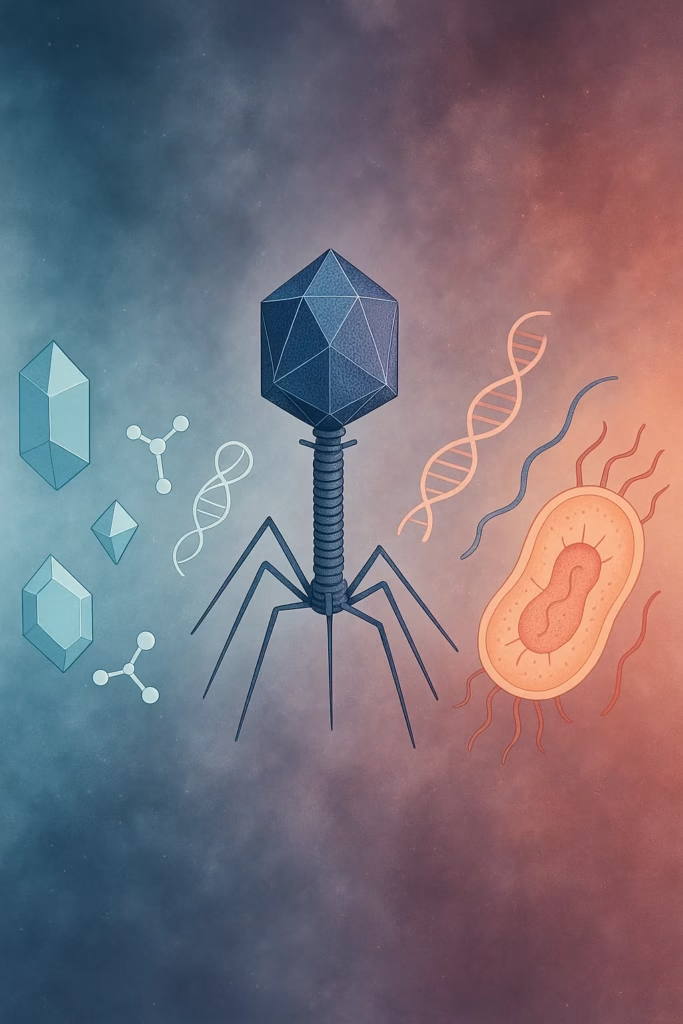
From viruses to virusoids: through the misty realm at the border of living and non-living.
Introduction: The Most Important Division That Eludes Us 🌫️
Living and non-living. It seems like the most basic division in nature – on one side a growing tree, on the other a stone. However, the closer we get to the very source of life and its most humble manifestations, the line of demarcation becomes blurred. We discover a whole spectrum of entities that challenge our definition of life, yet we have an impression, intuitive and subjective, that they lack something essential that would grant them belonging to the living world. This is not just narrow scientific magic; this is the deepest challenge to our understanding of our own existence.
Astonishment at First Glance: Viruses – Zombies with Genes 🦠
Viruses are classic causes of dilemma. They have genetic material (DNA or RNA), mutate, are subject to natural selection, and evolve faster than many living beings. But, by themselves, they are inert. They have no metabolism, do not respond to stimuli, do not grow. Like a computer virus on a USB stick, which ‘comes to life’ only when loaded into the computer’s working memory – equivalent to penetrating a living host cell. By analogy with the horror genre – they are zombies that turn healthy cells into infected “zombified” cells that cease their normal functioning and help viruses spread further in the host’s body.
Epidemics, and especially viral pandemics, are still more terrifying than any zombie movie, as they are capable of causing planetary-scale disruptions merely by their reproduction. Or more precisely, by the process of replication. So, is life an entity, a subject with intent, or can it also be the process itself?
Deeper into the Mist: The Subviral World 🔍
If viruses are at the border, what about things that are even less than viruses?
- Virusoids: Just RNA without a protein coat. They are small, circular RNA molecules that replicate only with the help of a host virus. They are parasites of parasites – information that parasitizes machinery that is already parasitizing.
- Satellite viruses: Similarly, they depend on another virus to multiply.
- Viroids: The smallest of all – just short, circular, proteinaceous RNA that can infect plants, not by replicating, but by binding to part of a plant’s functional gene, thereby impairing its ability to produce a protein essential to the plant. It has no genes for proteins. Pure information, questioning whether even the most basic “tools” are needed for life.
The Extreme Point: Prions – Life Without Genes? ☠️
Here we enter an even more bizarre domain. Prions are misfolded proteins. They do not replicate by copying genetic code, but directly change the shape of other, healthy proteins into their own form. They spread, not by their own replication, but by “transferring” their properties to healthy proteins. Like miniature influencers. But that is enough to cause some of the most terrible diseases known to us, such as mad cow disease. No DNA, no RNA. So, is life just information? And if so, must that information be encoded in nucleic acids, or is the three-dimensional structure of a molecule sufficient?
Scientific Criteria: Why Don’t We Have an Answer? 📜
Biologists have tried to define life through properties:
- Homeostasis: Maintaining internal balance.
- Organization: Composed of one or more cells.
- Metabolism: Converting nutrients into energy.
- Growth
- Adaptation and evolution.
- Response to stimuli.
- Reproduction.
The problem? For almost every one of these criteria, we can find an example as proof, but also a counterexample. Crystals grow, fire has metabolism, some hybrids (like mules) do not reproduce. Viruses satisfy only some. Life seems more like a “family resemblance” than a strict checklist.
Philosophical and Practical Nuggets: Why Does This Interest Us? 💭
This is not just a semantic game. Understanding this continuum has huge implications:
- The Origin of Life: If life arose from non-living matter, there must have been a continuum. Studying viruses and prions leads us toward understanding that transition.
- Astrobiology: What are we looking for on other planets? If we adhere to narrow definitions, we might miss completely different forms of “life.”
- Ethics: Is destroying a virus “killing”? Where do we draw the ethical line?
Conclusion: Life as a Process, Not a State 🌀
Perhaps we err in seeking a line. Perhaps life is more like a spectrum – a continuum of complexity and autonomy. From an inert protein, through parasitic RNA, to a virus, then to a bacterium, and finally to a conscious being.
Instead of asking “Is this alive?”, perhaps we should ask: “How alive is this?” or “In what way is this alive?”. Acknowledging this ambiguity is not a weakness of science; it is its greatest triumph – a sign that we have reached the point where our simple categories can no longer encompass the wondrous complexity of nature.
In the end, life may not be a thing, but a relationship – a dynamic process of maintaining order in chaos, replication with variation, existing in dialogue with the environment. And in that sense, perhaps all of us – from humans to viruses – are part of the same great, unfinished experiment we call existence.
Leave a Reply