
Were the planet’s first predators also the beginning of the story of “good” and “evil”? 🌊➡️⚔️
Paradise Lost: The Ediacaran World of Abundance 🏝️
Some 600 million years ago, the depths of the primeval ocean floor were covered by a soft, spongy, bacterial “mat” — an inexhaustible food source.
In this world, there were no teeth, claws, or armor. The first animals (Dickinsonia, Charnia, Kimberella) were neither prey nor predators.
They were slow-moving or fixed forms that “grazed” on the microbial substrate.
There was no need for aggression, struggle, or deceit — because abundance was absolute. It was, in fact, a biological paradise – an ecosystem where antagonism was unnecessary and unprofitable.
This was the only period in the history of life where antagonism was not an evolutionary prerequisite for survival. Life flourished in peace.
The Fall from Grace: The Emergence of the First Predator 🐙
Around 560 million years ago, Auroralumina attenboroughii appeared — the first known predator, a precursor to today’s jellyfish.
This animal didn’t just develop tentacles for catching prey; it brought a new evolutionary pressure.
This wasn’t just another new species — it was a game-changer for all living things. Biodiversity shifted dramatically: many peaceful Ediacaran forms disappeared, and the ecosystem began to reward speed, protection, deceit, and aggression.
The Cambrian period confirmed the new order: a clear divide between predators and prey.
From that point on, the entire history of the animal world — including our own — carries this first, fundamental division. War, in a biological sense, had begun.
The Biological Basis of “Good”: Altruism as an Evolutionary Paradox ❤️🤝
But the story isn’t just about conflict. In this new, more dangerous world, a deeply counterintuitive phenomenon also emerged: altruism.
This is not an abstract concept – these are concrete survival mechanisms visible in nature today:
- The guard bee that, when the hive is attacked by a predator, stings and leaves its entire stinger in the attacker. It kills or repels the threat, but dies itself – sacrificing its life for the survival of the hive, which shares its genetic material.
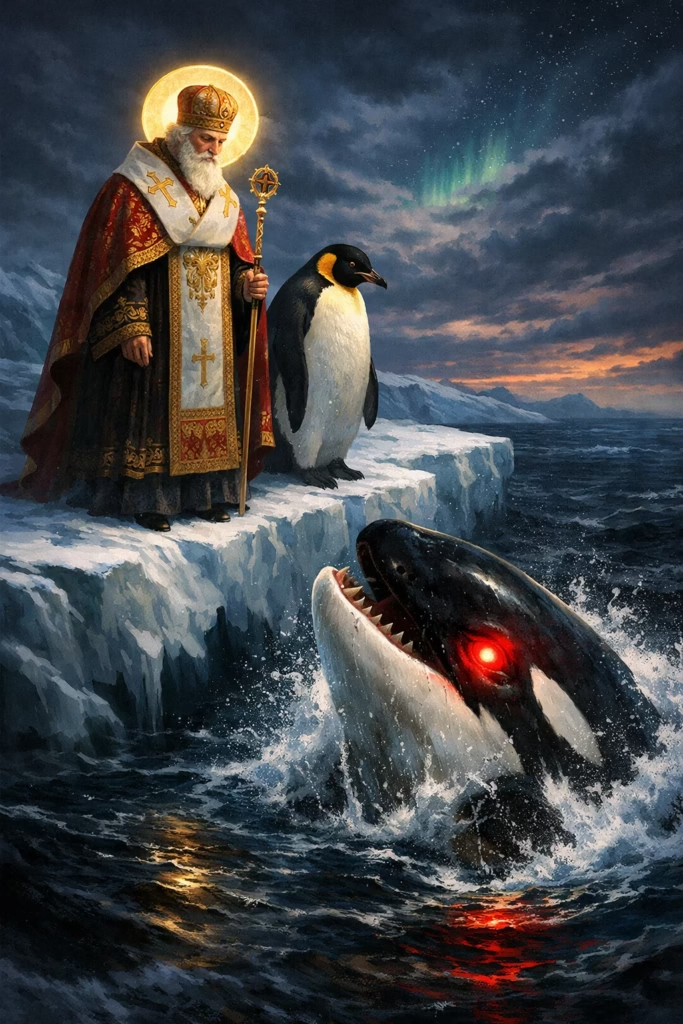
- The penguin “sacrificial lamb” that, when the hungry colony needs to enter the sea for food, is the first to jump from the ice shelf. It risks being eaten by a leopard seal that may be waiting below – thereby testing the safety for the entire group.
These are not coincidences, but sophisticated evolutionary patterns that promote group survival, even at the cost of the individual. This is, in a sense, the biological foundation of what we call “good.”
The Biological Basis of “Evil”: Sadism and Senseless Destruction 🐋💀
On the other hand, the same world gave rise to behaviors with no clear adaptive purpose, which transcend the framework of “struggle for resources”:
- Killer whales that, after killing their prey (e.g., a seal pup), do not stop there. They sometimes play with the carcass, toss it in the air, torment it without the intent to eat it.
- Chimpanzees that wage organized wars against neighboring groups, systematically killing males and taking females.
This is not simple “struggle for survival.” This is destruction for destruction’s sake, violence that transcends functional boundaries. It appears as a biological trace of what we humans call sadism or “evil.”
Neurobiology: The Two Sides of the Same Brain 🧠⚖️
All these possibilities – from self-sacrifice to sadism – are recorded in our deepest biology: in the structure of the brain.
- The “old brain” (amygdala, reptilian complex) is our evolutionary heritage from times of struggle. It governs fast reactions: fear, rage, aggression, the desire for dominance. When this part is activated, we act on the “fight or flight” principle, often “beyond” complex moral reasoning.
- The “new brain” (prefrontal cortex) is the center for empathy, planning, predicting consequences, moral judgment. It prevents us from blindly following the impulses of the old brain.
The problem – and the source of many tragedies – arises when the alarm system of the “old brain” is activated without a real, immediate threat. Then rage, fear, and aggression become aimless and destructive. Then, one might say, biological function transforms into what we experience as evil.
Why This Isn’t Just Biology: A Question That Remains Open 🤔➡️🌟
If it’s true that:
- Paradise (the Ediacaran) exists as a biological fact,
- The Fall (the emergence of predators) is an evolutionary turning point that introduced conflict,
- Duality (altruism/sadism) is woven into the very fabric of life and the architecture of our brain –
Then a difficult question arises: Is our morality then merely an extension of biology? Are our most sublime ideals of good and our deepest horrors of evil actually just a play of genes and neural pathways?
Or, perhaps, biology only provides the raw stage and tools – the skeleton of conflict and cooperation – while it is up to us, our consciousness and culture, to decide how we continue this story? Is the human soul, with its struggle between impulse and conscience, precisely the continuation of that drama, hundreds of millions of years old, which began in the depths of the primeval ocean?
Perhaps it is precisely in that space between biological determinism and human freedom of choice that our moral battle is still being fought today.
And perhaps it is symbolic that today, as we ponder these profound topics, MilovanInnovation extends greetings for the feast day dedicated to Saint Nicholas – the very figure who, through tradition, has become the religious embodiment of what we call good: self-sacrifice, protection, and selfless love for others.
Question for our community:
Was the first predator on the planet also the beginning of the story of evil?
Or is antagonism simply the inevitable price we pay for complexity, consciousness, and, ultimately, freedom of choice?
Share your thoughts in the comments. Are we slaves to biology or its enlightened interpreters?
Leave a Reply