How did a celestial phenomenon become a symbol of hope for the entire world – and what does modern astronomy say about it? 🌟✝️
Christmas has become a global cultural phenomenon. From dazzling decorations in Tokyo to paper lanterns in Manila, from Christmas markets in Berlin to Santa Claus parades in New York – December 25th is now a universal symbol of togetherness, generosity, and light in the darkest time of the year.
But behind the commercial glitter lies an ancient, profound story whose roots reach into astronomical observations, religious revelation, and the humanistic yearning for peace. The Star of Bethlehem, described in the Gospels, remains to this day a fascinating mystery at the boundary of faith and science.
What Did the “Three Kings” Actually See? Astronomical Hypotheses 🔭
For centuries, scientists have tried to identify this celestial sign. Four theories are most commonly discussed today:
- A Supernova – a stellar explosion so bright it could have been visible even during the day. Chinese and Korean astronomical records from around 4 BC mention the appearance of a “new star” in the constellation Capricorn.
- A Rare Planetary Conjunction – In 7 BC, a triple conjunction of Jupiter and Saturn occurred in the constellation Pisces. The two brightest planets (then considered “royal”) met three times in one year, creating the illusion of one large, luminous point.
- The Comet of 5 BC – The latest study by astronomer Mark Matney (published December 2025) offers a new perspective. By analyzing Chinese chronicles from 5 BC that mention a comet, Matney calculated that this celestial body could have had “temporary geosynchronous motion” in early June of 5 BC. This would mean the comet moved so slowly relative to Earth that it would have appeared to “stand still” in the sky – perfectly matching the biblical description of the star that “stopped over the place where the child was”. This would explain both the visual effect and its astrological interpretation.
- A Combination of Events – Some scholars believe the Magi, as experts in the astrology of that era, interpreted a series of celestial signs (conjunctions, a comet) as one grand, fateful event.
Interestingly, all hypotheses simultaneously provide a scientific explanation and support chronological indications that Jesus was likely born between 7 and 4 BC – not in the year 1 as later calculated by our calendar.
Why Do We Celebrate on December 25th Then? 📅
No biblical sources mention the exact date. Today’s Christmas date was established only in the 4th century. It is believed that the Christian Church chose this date to adopt and reshape the popular pagan festivals of the winter solstice – the Roman “Dies Natalis Solis Invicti” (Day of the Birth of the Unconquered Sun) and the Germanic Yule celebrations.
The goal was to give new, Christian meaning to existing popular gatherings and customs.
Astronomy as the Language of the Divine 🌌
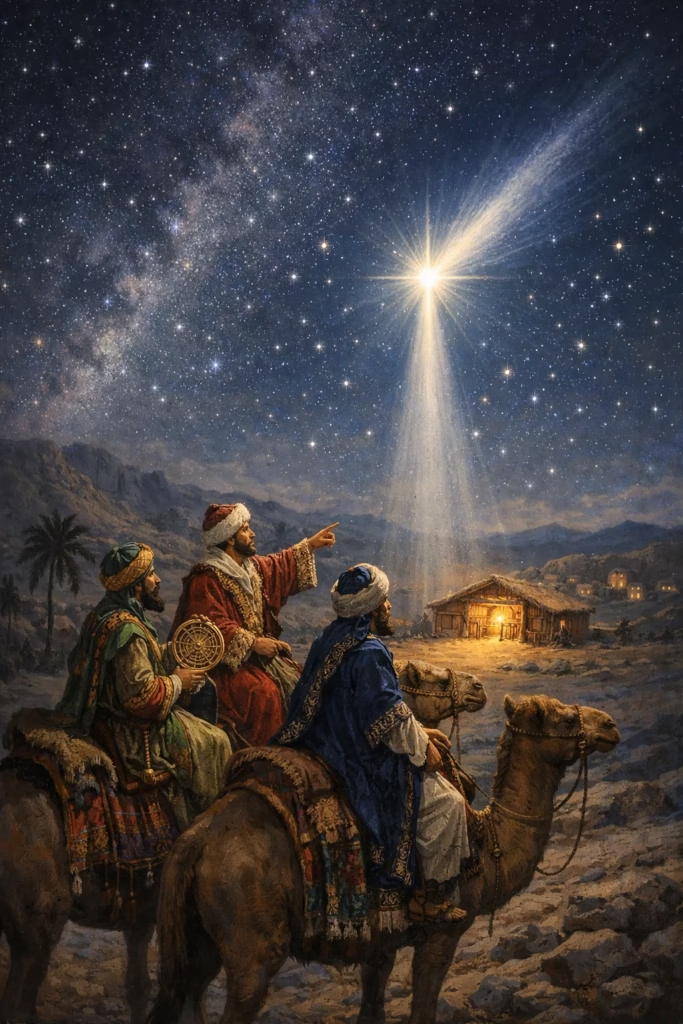
The “Wise Men from the East” were most likely scholars known as Magi, religious astronomers/astrologers from Persia or Babylon. For them, celestial movements were not random but a language through which the divine addressed humanity. The appearance of an unusual celestial body – whether a rare conjunction of planetary “kings” (Jupiter and Saturn) or a comet with unusual motion – was interpreted as a sign that a new, greater king was being born on earth.
The Essence Beyond the Date and Astronomy ✨
Regardless of the precise astrological event or chronological accuracy, the essence of Christmas remains unchanged. It is the story of hope arriving in the darkest time, of light being born in the midst of night, and of a universal message of peace, love, and kindness towards all.
The Star of Bethlehem, be it a comet, a planetary meeting, or a deep religious symbol, still reminds us today: there is something greater than us, which calls us to look up, to seek our path, and to gather in a spirit of community and reconciliation.
To all who celebrate – we warmly wish you a Merry Christmas!
And to all of us – may the message of peace from Bethlehem be our shared guide in the new year. 🕊️
Leave a Reply