🌌 Shattering Intuition: The Explosion That Wasn’t
Imagine the Big Bang. You probably see a cosmic explosion in a vast void. That’s a natural image—but it is, essentially, wrong. The Big Bang was not an explosion in space. It was the moment when space itself, along with time, began to exist. Matter didn’t fly apart into a pre-existing emptiness; the emptiness itself came into being—and is still being created.
🧶 The Dynamic Fabric: What Is Actually Expanding?
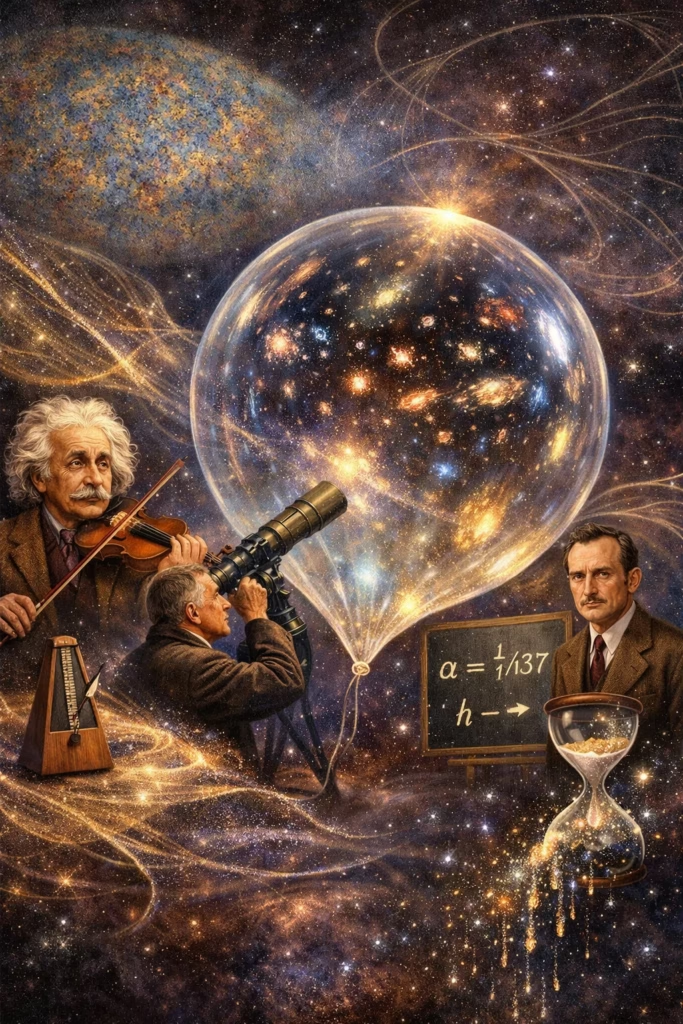
Albert Einstein gave us the key: space and time are not rigid frames, but a dynamic fabric—a continuum that can bend, stretch, and expand. That is why the austere equation of his General Theory of Relativity describes gravity not as a force, but as the curvature of this fabric. Even Einstein initially imagined a static Universe, introducing a “cosmological constant” to prevent its collapse. History showed this was his “greatest blunder,” because the fabric does not rest—it grows.
🔭 Hubble’s Discovery: The Balloon That Inflates Itself
The evidence came from the depths of the cosmos. Edwin Hubble noticed that light from distant galaxies shifts toward red—proof they are moving away. And a crucial relationship emerged: the farther away a galaxy is, the faster it appears to recede from us. Why? Because the space between us and it is expanding. Imagine a balloon with dots on its surface. As it inflates, the distance between every pair of dots increases uniformly. There is no center of expansion on the balloon itself; every dot sees the others fleeing. So too with our Universe: galaxies are not moving through space, but are carried by the growing fabric of space itself.
📡 Evidence from the Cradle: Light Fossils and Inflation
The most compelling evidence comes from the very beginning. The Cosmic Microwave Background (CMB) is a snapshot of the Universe at 380,000 years old, when the first atoms formed. It is perfectly uniform, proving the entire early cosmos was connected. How is that possible? The theory of inflation provides the answer: in the first instant of existence, space itself expanded exponentially—at a speed greater than the speed of light. Nothing can overtake the speed of light in space, but space itself has no such limitation. This was the quantum fluctuation that gave birth to everything we know.
❓ Open Questions: Have the Rules Always Been the Same?
The expansion of space is now an accepted fact. But what about the laws of physics themselves? Have they always been the same? P. A. M. Dirac raised an intriguing possibility: could fundamental constants, like Planck’s constant or the fine-structure constant, have gradually acquired their present values as the Universe cooled? This means the physical laws we consider eternal may not be absolute, but conditional, “formatted” over cosmic history. Also, gravity remains the greatest mystery—the first force to separate from the unified forces at the Bang, and still outside the Standard Model of physics.
🌀 Beyond Our Horizon: The Multiverse and Higher Dimensions
Our story may be taking place on an even larger stage. According to theories like M-theory, our 3D space plus time may be just one “brane” in a higher-dimensional super-space. And a logical outcome of inflation is the idea of a multiverse: that there exists a vast, perhaps infinite, number of universes with completely different constants and laws. We live in one that is, by chance, suitable for life. This is not science fiction, but a serious theoretical frontier of our knowledge.
✨ A New Cosmological Awareness: The Growing Fabric
We do not live in a finished, static void. We live within a fabric growing on the loom of the Universe’s expansion. This image shatters our anthropocentric intuition: there is no center, no edge, no “outside.” Every point is equal. Only the endless creation of new “emptiness” between every point of existence.
This is no longer just cosmology. It is the deepest philosophical revolution—the realization that the very framework of our reality had a beginning, is dynamic, and is in constant growth. If space and time had a beginning, what exists beyond their frame? Perhaps that very question is the next frontier for MilovanInnovation.
💡 How do you perceive this image of the Universe? What is more intellectually challenging to you: that space expands, that physical laws may have formatted over time, or that there are infinitely many other realities? Share your cosmological dilemma in the comments! 👇
Leave a Reply