
🌌 Returning to Abandoned Genius: The Dirac Sea and Its New Life
In 1930, facing the problem of infinite negative energies in his equation, Paul Dirac proposed a revolutionary concept: the Dirac Sea – an invisible “sea” of completely filled negative energy states. An electron does not move through empty space, but through this sea, and a positron is merely a “hole” in its structure. The idea was long considered a mathematical curiosity. Until Roger Penrose arrived.
🔬 Penrose’s Twist: From an Energy Sea to the Geometry of Quantum Information
Penrose does not see the Dirac Sea as a mere mathematical construct. In his conformal cyclic cosmology, information from one universe passes into another through conformal mapping. The Dirac Sea becomes a potential bridge between cycles, a reservoir of quantum information that survives the “death” of time and space. But the real twist is deeper: what if the sea itself is fundamental, and spacetime is an emergent phenomenon?
⚛️ The Emergence of Reality: Quantum States Before Space
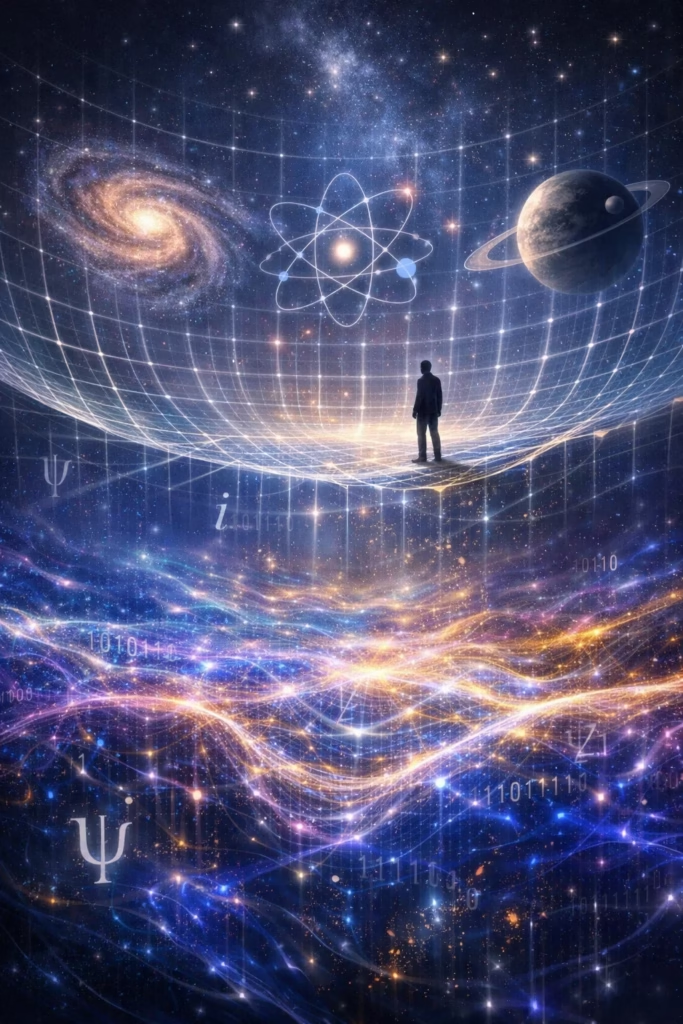
Modern physics faces a wall: general relativity describes a continuum, quantum mechanics describes discrete particles. The solution may lie in reversing the hierarchy. What if quantum states (information, relations, superpositions) are the basic “atoms” of reality? Space and time would not be fundamental frameworks, but collective effects – the way our consciousness or measurements “reconstruct” that quantum network from our perspective within it. The Dirac Sea would then be the fundamental quantum substrate, and everything we see – particles, forces, even the continuum itself – merely excitations of that sea.
🔄 A Quantum-Informational Basis: The Sea as a Processor of Reality
This perspective finds echoes in quantum information theory and approaches like the holographic principle. The Dirac Sea would not just be a sea of energy, but a sea of quantum correlations and computation. Spacetime would arise from the entanglement of these fundamental quantum states, similar to how temperature and pressure emerge from the chaotic motion of molecules. The “excitations” we see as particles would be local disturbances in this global, quantum-informational sea.
🌀 Philosophical Earthquake: What Remains When Spacetime Disappears?
This paradigm shift would not only solve the technical problems of unifying physics. It would overturn our ontology. Instead of living in space and time, we would be of the quantum information that produces the illusion of space and time. Just as water is the basis for waves, but waves are not fundamental – so the quantum sea would be the basis for our perceived reality.
✨ MilovanInnovation Speculation: What If We Already Live in That Sea?
Penrose’s revitalization of the Dirac Sea is not nostalgia. It is a bold step towards a theory of everything that does not start from spacetime, but from something deeper: from quantum information and its relations. Perhaps future physics will be less about “particles in space” and more about the architecture of quantum correlations from which the very idea of space and time was born.
💬 What do you think? Is spacetime the foundation of reality, or merely the most successful illusion that our brain, as part of that system, has constructed? Is the concept of emergent reality liberating… or utterly disorienting? Share your perspective!
Leave a Reply