Introduction: Two Titans, One Goal 🎯
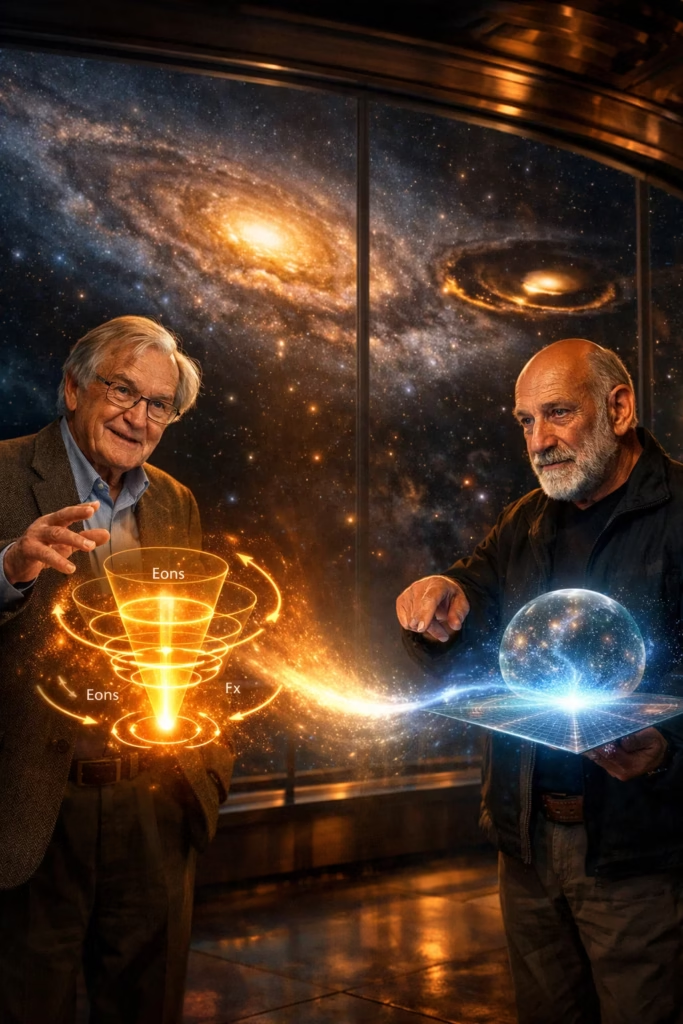
At first glance, little connects Sir Roger Penrose, mathematical physicist and Nobel laureate, with Leonard Susskind, father of string theory and advocate of the holographic principle. Penrose thinks in images, geometry, topology. Susskind thinks in strings, branes, quantum information.
But when you scratch beneath the surface, something surprising emerges: both geniuses are building a path toward the same truth. And that truth is this:
Information is not just a description of reality – information is the foundation of reality. 🧾🌍
Susskind and the Holographic Principle – The Universe as Projection 🌀
Let us briefly recall Susskind’s revolutionary idea.
When Bekenstein discovered that the entropy (amount of information) of a black hole is not proportional to its volume, but to the surface area of its horizon, Susskind drew a radical conclusion:
“If the densest object in the universe can only store as much information as fits on its surface – perhaps our entire three-dimensional reality is merely a projection of information inscribed on some distant, two-dimensional boundary.”
In other words: The depth we see around us is an illusion. What we experience as 3D space is actually a holographic image, encoded on a 2D surface like a cosmic screen. 📺✨
Penrose and CCC – Cosmic Cycles and the Dirac Sea ♻️
Penrose has spent years developing his conformal cyclic cosmology (CCC). The basic idea:
- The universe passes through infinite eons.
- At the end of each eon, all particles that have mass (electrons, protons…) disappear. Only photons and other massless particles remain.
- In this state, space and time lose their usual meaning – everything becomes “conformally flat.”
- And then, from this “empty” state, a new Big Bang is born – a new eon.
But what happens to the information from the previous eon? Penrose believes it somehow “survives” in the structure of space, perhaps in the form of massless fields that influence the distribution of matter in the new eon.
This brings us to a fascinating connection with the Dirac sea – an old idea that the vacuum is actually a sea of negative energy filled with virtual particles.
The Dirac Sea as an Information Field 🌊
In the 1930s, Dirac imagined that what we call “empty space” is actually an infinite sea of electrons with negative energy. When an electron is “pulled out” of this sea, a hole appears – a positron.
Although modern quantum field theory dismissed this picture as too naive, the idea is returning in a big way.
Because, imagine:
- The Dirac sea as a vast field of potential information.
- The particles we observe (electrons, protons…) as localized excitations, “ripples” on that field.
- Penrose’s end of eon (the disappearance of mass) as the calming of the field – excitations vanish, information returns to its ground, unexcited state.
- A new eon as a new rippling of the same field.
In this picture, the Dirac sea is not a physical entity in the classical sense – it is the informational substrate of reality. 🌊➡️🌌
Convergence – Two Languages, One Message 🤝
Now we come to the most exciting part. Let’s see how these two theories align:
Susskind tells us that reality is a projection of information from a 2D boundary. The black hole horizon encodes everything that happens inside. Three-dimensional space is emergent, derived. Information is fundamental.
Penrose tells us that the end of each cosmic eon “resets” information to a ground state. Particles are emergent, derived from fields. The Dirac sea serves as an informational substrate across eons. Information is fundamental.
The shared message: What we perceive as physical reality (space, time, matter) is not the fundamental layer of existence. Beneath it all lies information – pure, unexcited, potential.
Penrose’s end of eon is, in essence, an informational vacuum. And Susskind’s hologram is the way that information projects itself into what we experience as reality.
The Problem of Mechanism – What’s Missing? 🔍
Of course, this is not a finished theory. The biggest question remains:
How exactly does information become matter?
What is the mechanism of wave function collapse?
How do excitations of the quantum vacuum manifest as observed physical reality?
These are questions for the future of physics. But what’s exciting is that the signposts are aligned.
Both Susskind and Penrose, each from their own perspective, point in the same direction: information theory must become the foundation of physics. Perhaps the next great synthesis will come precisely from attempts to unite these two visions into a coherent picture.
Conclusion: Toward a New Understanding of Reality 🌠
Penrose and Susskind rarely sit in the same room. Their styles, methods, even mathematical languages, are so different that they seem to describe two different universes.
But beneath the surface, they are building the same cathedral.
Penrose gives us the cosmic framework – the story of eons, of resetting, of massless fields carrying information through time.
Susskind gives us the local mechanism – the story of how information is encoded on boundaries, how it projects into 3D space, how horizons preserve the record of everything that has happened.
Together, they whisper the same message:
“Reality is not what you think it is. But neither is it what you fear it might be. Reality is information. And your task is to learn its language.”
Leave a Reply