
Why ions levitate above electrodes, how lasers write and read them, and why this approach is one of the oldest – and still one of the most promising 🧲🔦💡
This is the fourth part of our series on quantum computers.
In the first part, we explored BB codes and how they reduce the hardware overhead of error correction. In the second, we delved into physical reality – dilution refrigerators, superconducting chips, and the cold of deep space. In the third, we met topological qubits and the mysterious Ettore Majorana.
Now we arrive at an approach that is one of the oldest and at the same time one of the most stable – trapped ions. While superconducting qubits are fast and topological ones promise robustness, trapped ions have held the record for coherence times and operation fidelities for decades. What does this world look like, where ions “levitate” above electrodes and lasers play their quantum melodies?
What Are Trapped Ions and Why Do They Levitate? 🧲🪄
Ions are atoms that have gained or lost an electron and therefore carry a net charge. This charge allows their motion to be controlled by electric and magnetic fields.
An ion trap is typically a Paul trap (radio‑frequency quadrupole) or a Penning trap (magnetic field + electrostatic field). In a Paul trap, an alternating electric field (RF) on the electrodes creates a potential well where ions can “levitate” – stably, without touching the walls.
In practice, ions (most often ytterbium Yb⁺, calcium Ca⁺, or beryllium Be⁺) are cooled to millikelvin temperatures (using lasers) and then held about 50–100 micrometers above the chip surface. At the microscopic level, they levitate – literally hang in vacuum, completely isolated from the environment.
The Potential Well: How the Trap Creates Energy Steps 📐⚛️
The potential generated by the electrodes is not uniform – it shapes a potential well. In a first approximation, this well is a harmonic oscillator: ions behave like tiny balls oscillating around an equilibrium position, and their energy is quantized – it can take only discrete values.
For quantum computation, the two lowest energy levels of this oscillator (or more often two internal electronic states of the ion, such as ground and metastable) are used. Those levels represent the |0⟩ and |1⟩ of the qubit.
Key advantage: Because ions are naturally isolated from the environment (they levitate in vacuum), coherence times can be exceptionally long – up to several minutes! That is orders of magnitude better than superconducting qubits.
Lasers as Tweezers, Pen, and Reader 🔦✍️📖
How is information written and read in a trapped ion? The answer is lasers.
- Writing (manipulation): A precisely tuned laser beam (or microwave field) can drive transitions between the two chosen levels. The laser frequency is chosen to resonate with the energy difference. When the laser “hits” the ion, it can cause Rabi oscillations – periodic flips between |0⟩ and |1⟩. The duration of the laser pulse determines which quantum logic gate we perform.
- Reading (readout): This uses fluorescence. If the ion is in one state (say |0⟩), the laser that drives an electronic transition will cause it to glow (fluoresce) . If it is in the other state (|1⟩), it does not fluoresce. The photons reaching the detector reveal the qubit state with very high fidelity (over 99.9%).
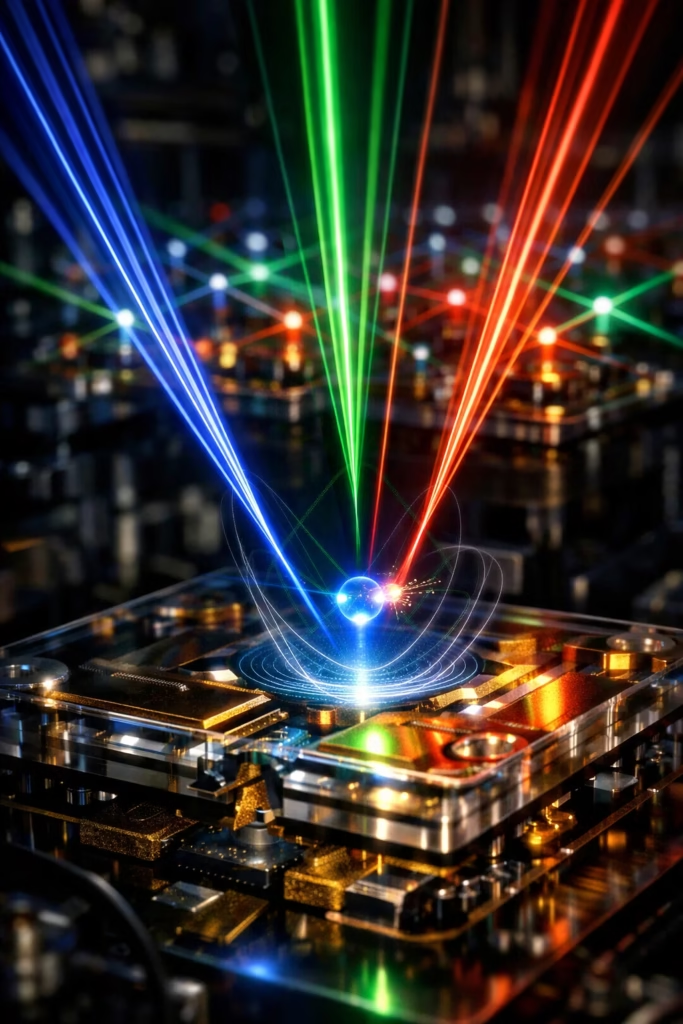
Thus, laser beams simultaneously hold, cool, control, and read the ions. It is no coincidence that such setups are often called “laser harps”.
Scalability: From One to Many Ions – The Challenge of Interconnection 🔗🧩
One of the biggest challenges with trapped ions is scaling. To have more than a few tens of qubits, one needs to connect multiple traps or create ion arrays on a single chip.
- Micro‑traps – modern chips contain hundreds of electrodes that can trap individual ions in potential wells arranged in a 2D grid.
- Shuttling – ions can be physically moved from one zone to another, where they are brought together with other ions to perform two‑qubit gates.
- Photonic links – instead of physical shuttling, ions can be entangled via emitted photons that travel through optical resonators.
The largest demonstrated systems today have a few tens of trapped ions (e.g., Quantinuum’s H‑series with 32 qubits). Companies like IonQ, Quantinuum, and Alpine Quantum Technologies are working to increase the qubit count while maintaining high fidelity.
Comparison with Other Technologies: Speed vs. Stability ⚖️
| Feature | Trapped Ions | Superconducting Qubits | Topological Qubits (Majorana) |
|---|---|---|---|
| Coherence time | very long (minutes) | short (tens of μs) | potentially very long (theory) |
| Gate speed | slow (μs–ms) | fast (ns–μs) | still experimental |
| Fidelity | very high (>99.9%) | high (>99%) | not yet demonstrated at scale |
| Scalability | challenging (shuttling) | promising (lithography) | unknown (early stage) |
| Cooling requirements | millikelvin (less strict) | millikelvin (strict) | millikelvin (but potentially higher T) |
Trapped ions are champions in qubit quality – best coherence and most accurate gates. Their downsides are slowness and scaling complexity. For large‑scale machines with millions of qubits, hybrid solutions or completely different approaches will likely be needed.
Connection to the Series: Where Do Ions Fit? 🔄
- Error correction (Part 1): Because of their high fidelity, trapped‑ion qubits require less overhead for error correction – though not as little as topological qubits (theoretically).
- Cooling (Part 2): Ions require millikelvin temperatures, but not as extreme as superconducting qubits. Dilution refrigerators are still needed, though with less stringent filtering requirements.
- Topology (Part 3): The potential wells create discrete energy levels – that is a “topology” in terms of structure, but it is not the topological qubits with Majorana modes. This is a different kind of stability: isolation from the environment rather than topological protection.
Where Are We Now? 📍
Trapped ions are the first quantum technology to reach commercial use (IonQ, Quantinuum). They are already used via the cloud for small‑scale quantum simulations and research. Although they do not promise millions of qubits on a single chip, they are reliable and accurate – ideal for early practical applications and for building quantum networks (via photon‑mediated connections).
The future may lie in hybrid systems: ions as long‑term memories, superconducting as fast processors, topological as robust elements.
Conclusion: The Harp Played by Light 🎶💡
Trapped ions are perhaps the most beautiful illustration of what quantum computing is: precise control of nature at the level of individual atoms. Lasers become fingers playing on electric strings, and the ions – illuminated, cooled, trapped – respond with quantum states waiting to be read.
This technology already works today. It is not a “promise” – it is reality. The only question is how far we can scale it.
Question for you: Do you believe that trapped ions, with their extraordinary precision, will remain the leading technology for quantum simulations and quantum networking – or will superconducting and topological approaches overtake them once they reach sufficient scalability?
Leave a Reply