
Why quantum computers don’t solve every problem, but those they do solve change the rules – Shor, Grover, VQE, and the future of quantum machine learning 🧠⚛️💻
This is the seventh part of our series on quantum computers.
In the previous six parts we traveled a long road: from error correction through physical implementations (superconductivity, ions, topological qubits) and logic gates to the fascinating possibility that the human brain itself is a quantum computer.
Now we ask the obvious question: Why build quantum computers at all? The answer lies in the concept of quantum supremacy – the moment when a quantum computer solves a problem that is practically unsolvable for a classical computer. But quantum supremacy is not magic. It rests on quantum algorithms – specially designed procedures that leverage superposition, entanglement, and interference to achieve exponential speedups over the best classical algorithms.
In this post, we’ll introduce the most important quantum algorithms, the areas where quantum computers truly shine – and those where (for now) they are completely unnecessary.
Feynman’s Insight: When Classical Computers Fail 🔭💡
The story begins in 1981 at a conference at MIT. Richard Feynman, one of the greatest physicists of the 20th century, put forward a provocative idea: Nature isn’t classical. If we want to simulate nature, we must use computers that behave like nature – quantum computers.
Feynman observed that when simulating quantum systems (like molecules or particles), classical computers face an exponential explosion of states. For a system of just 300 qubits, the number of possible states is greater than the number of atoms in the visible universe. Classical computers simply cannot handle that complexity.
His conclusion: If we want to understand the quantum world, we must simulate it with quantum devices. That was the idea that launched the entire field of quantum computing.
Not All Problems Are for Quantum Computers – Where Is the Boundary? 🧩⚖️
Before diving into algorithms, it’s important to stress: quantum computers are not “faster” than classical computers in every sense. They are specialized tools. For most everyday tasks – word processing, internet searches, database management – classical computers are not only sufficient, they are optimal.
Using a quantum computer for such problems would be like cracking a walnut with a steamroller – unnecessary, expensive, and inefficient.
Quantum supremacy manifests only on a narrow but extremely important set of problems – those that demand enormous computing resources and for which quantum algorithms offer exponential or quadratic speedups over the best known classical methods.
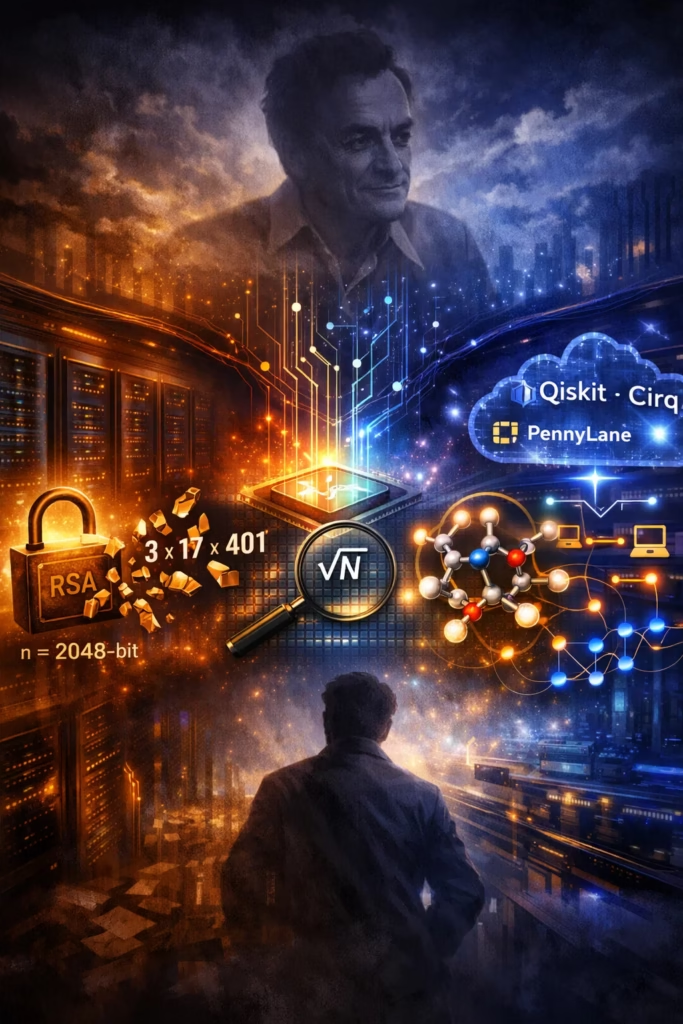
Shor’s Algorithm: The End of RSA Encryption? 🔐🔓
One of the most famous quantum algorithms is Shor’s algorithm for factoring large numbers (Peter Shor, 1994). Classical computers would take billions of years to factor a few‑hundred‑digit number. Shor’s algorithm can do it in hours (on a sufficiently large quantum computer).
Why does this matter?
Modern encryption (RSA, ECC) relies on the difficulty of factoring large numbers or computing discrete logarithms. When a quantum computer with enough qubits (a few thousand logical qubits) is built, today’s cryptographic systems become vulnerable. That is why post‑quantum cryptography – algorithms resistant to quantum attacks – is already being developed.
Grover’s Algorithm: Unstructured Search 🔍📚
Another cornerstone is Grover’s algorithm (Lov Grover, 1996). It solves the problem of searching an unstructured database: if we have N items and want to find the one that satisfies a condition, a classical computer must check N/2 items on average. Grover’s algorithm does it in √N steps – a quadratic speedup.
Example: for a database of 1,000,000 items, a classical computer needs about 500,000 checks; a quantum computer only about 1,000. This speedup is not exponential like Shor’s, but it is still revolutionary for many fields – from optimization to artificial intelligence.
Simulating Molecules: VQE and QPE – Medicine of the Future 💊🧪
The area where quantum computers may deliver practical results first is quantum chemistry. Classical simulation of molecules is extremely hard because electrons and atomic nuclei obey quantum laws.
Variational Quantum Eigensolver (VQE) and Quantum Phase Estimation (QPE) are two algorithms that enable quantum computers to efficiently find the energy states of molecules.
- VQE is a hybrid algorithm: the quantum part prepares the state, the classical part optimizes the parameters. Already today it is used to simulate small molecules (e.g., lithium hydride, hydrogen).
- QPE is more demanding but offers more accurate results. It is key for developing new drugs, catalysts, and materials.
Pharmaceutical companies (e.g., Pfizer, Roche) are already investing in quantum simulations to shorten drug development from decades to years.
Quantum Machine Learning: A New Paradigm for AI 🤖📈
The combination of quantum computing and machine learning opens entirely new possibilities. Quantum algorithms for classification and clustering can process data in high‑dimensional spaces that classical algorithms cannot handle.
Quantum neural networks (QNNs) and quantum boosting promise acceleration in training models and discovering patterns in data. Although the field is still in its infancy, demonstrations on small datasets already exist.
Software for Quantum Algorithms: Qiskit, Cirq, PennyLane 🛠️💻
The development of quantum algorithms would be impossible without sophisticated software frameworks. Today, programmers have at their disposal:
- Qiskit (IBM) – the most popular open‑source framework, with rich libraries for Shor, Grover, VQE, and error correction.
- Cirq (Google) – optimized for their superconducting quantum processors, focusing on short, deep circuits.
- PennyLane (Xanadu) – specialized for quantum machine learning, integrating with TensorFlow and PyTorch.
These tools allow researchers to write, simulate, and execute quantum algorithms on real quantum hardware via the cloud, accelerating the path from theory to practical application.
Connection to the Series: Where Are We Now? 🔗
This seventh part ties all the previous ones together:
- Error correction (Part 1) and physical implementation (Parts 2–4) are prerequisites for algorithms to run on scalable hardware.
- Logic gates (Part 5) are the language in which these algorithms are written.
- Consciousness as a quantum process (Part 6) raises the deeper question: if quantum algorithms can simulate nature, can they also simulate consciousness?
Quantum algorithms are the bridge between abstract theory and practical application. Without them, quantum computers would be nothing more than collections of qubits doing nothing useful.
Conclusion: Quantum Supremacy Is Not a Goal, but a Beginning
Quantum supremacy is not the moment when a quantum computer “defeats” a classical one – it is the moment when a quantum computer opens the door to problems that were previously out of reach.
Today we have quantum computers with hundreds of qubits. Algorithms like Shor’s and Grover’s are waiting for hardware with millions of qubits and error correction to become practical. But VQE and quantum machine learning are already delivering first results – in chemistry, pharmaceuticals, optimization.
The future will not be about replacing classical computers with quantum ones. It will be a hybrid world: classical computers for everyday tasks, quantum computers as accelerators for the hardest problems, connected via the cloud – much like today’s GPUs.
Quantum algorithms are the key that unlocks that future. And we are only at the threshold.
Question for you: Which application of quantum computers excites you most – breaking encryption, developing new drugs, accelerating artificial intelligence, or something completely different? And do you believe quantum computers will achieve practical supremacy within the next decade?
Leave a Reply