📡 Introduction: A signal where there should have been nothing
Just as Tesla detected anomalies in Colorado Springs where Maxwell’s equations predicted nothing, contemporary biology has detected something similar: the first life did not arise as we thought.
Not as a lone hero. Not as a random chemical reaction that happened once and won. But – as a network.
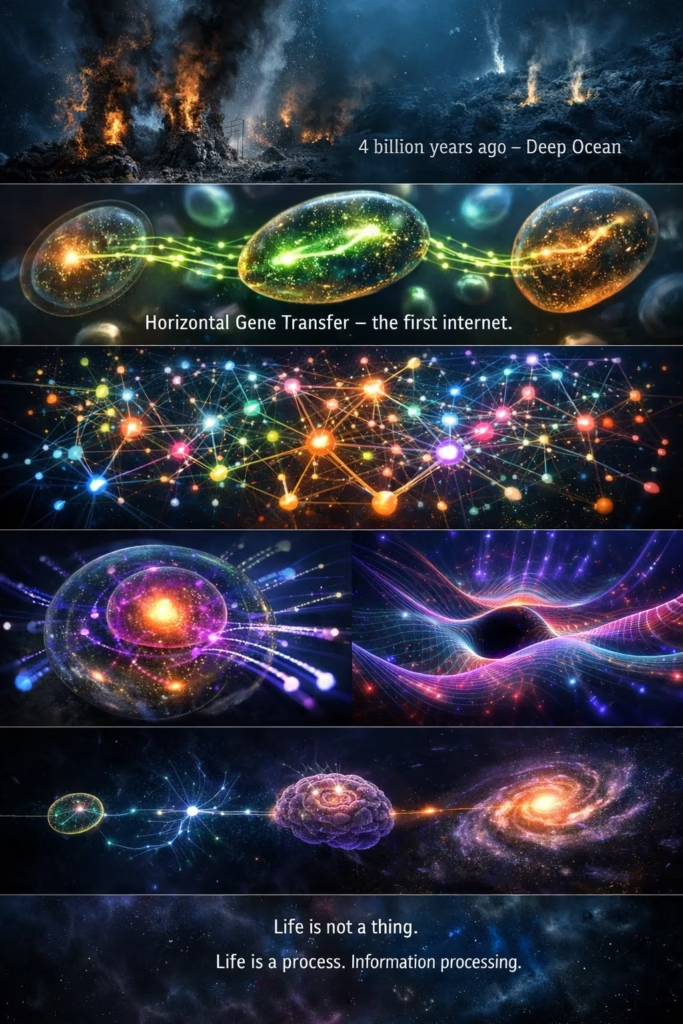
About 3.8 to 4 billion years ago, on the ocean floor, in geothermal vents where hot, mineral-rich water collided with the cold ocean, something happened that overturned our picture of the origin of life.
🔬 LUCA: What is the minimum needed to call something alive?
Before we go further, we must define what we are looking for. Scientists have identified the minimal requirements to call something a living cell:
- A membrane – a boundary separating inside from outside
- Genes – carriers of hereditary information
- Enzymes – catalysts that enable chemical reactions
- Ribosomes – protein factories that translate genetic code into functional molecules
All of this must work together. And all of it – had to emerge from a chemical “soup” four billion years ago.
That common origin of all living beings on Earth is today called LUCA (Last Universal Common Ancestor). And what we have discovered about it in recent years – fundamentally changes the picture.
🌋 The scene of the crime: Geothermal vents on the ocean floor
Recent research shows that LUCA lived in serpentinizing hydrothermal vents – underwater geysers where water reacts with rock to produce hydrogen, methane and other organic molecules.
Why there?
Because those vents provide everything needed for life: CO₂ as a carbon source, H₂ as a reducing agent, transition metals as catalysts, and ionic and temperature gradients that drive chemical reactions.
But the key discovery is this: LUCA did not have a complete metabolism. Its enzyme system was incomplete – it only finished after the bacterial and archaeal lineages split. What kept those early protocells alive were metal catalysts – iron, cobalt, nickel – that substituted for missing enzymes and coenzymes.
🤝 The key to survival: They were not individualists, but a network
Here comes the biggest twist.
The first protocells were not solitary opportunists competing for resources. If they had been – they probably would not have survived. Instead, they cooperated.
Their genetic material was not transferred only vertically (from parent to offspring). The dominant mechanism of exchange was horizontal gene transfer – the sharing of genetic information between related, and even completely different, protocells.
Imagine it: a world where every cell can “borrow” a gene from its neighbor. Where an innovation – once discovered – instantly colonizes the entire community. Where there is no “private property” over the genetic code.
Computer simulations have confirmed that this kind of communal evolution – based on horizontal exchange of genetic code fragments – can explain the regularity, optimality, and near-universality of the genetic code. Simulations have shown that LUCA could have formed through absorption, fusion, and takeover of different vesicles and protocells, driven by cyclic wet-dry conditions.
These protocells were not loners. They were part of an ecosystem before they became individuals.
🧬 From network to specialization: How horizontal transfer accelerated evolution
Horizontal gene transfer was not just a way to survive. It was the engine of innovation.
Instead of waiting for a random mutation to produce a beneficial trait in a single lineage, protocells could exchange ready-made solutions. This enabled:
- Specialization – different protocells could develop different skills, then share them
- Adaptation – the community could respond quickly to environmental changes
- Accumulation of complexity – instead of each cell carrying the full genetic burden, functions were distributed
This is a fundamentally different model of evolution from the one that dominates higher organisms. In us, vertical transfer (inheritance) is primary. In the first life forms – horizontal exchange dominated.
Some scientists believe that these early life forms – which Carl Woese called “progenotes” – were so permeable and open to exchange that they can hardly be called individual species in the modern sense.
⚛️ Quantum complexity: When life encounters the fundamental principle of information
Here we come to perhaps the most exciting intersection – between the origin of life and quantum information theory.
In quantum computing theory, the concept of quantum complexity describes the difficulty of constructing a quantum state from simple operations. It has turned out that this concept is not merely technical – it is more fundamental than classical complexity. It describes the very structure of space, time, and information.
Now – imagine a network of protocells exchanging information. Every gene exchange is an information processing operation. Every new combination is a computation. And out of that network, out of those endless iterations of exchange, something new emerges by itself – an emergent property.
Emergent properties are characteristics possessed by the system but not by its individual parts. Life is an emergent property of chemistry. Consciousness is an emergent property of life. And self-organization – which we observed in the first protocells – is one of the key mechanisms enabling this emergence.
What our protocells were doing – forming networks, exchanging information, specializing – is information processing at a level that surpasses individual components.
And information processing is, in its deepest sense, what quantum information theory is all about.
🖥️ Eukaryotic cells: The first quantum computers?
Then came the next great leap: the emergence of eukaryotic cells (those with a nucleus). This happened about 1.5 to 2 billion years ago, and since then all multicellular life – including us – has been built upon them.
But here is what has only recently been discovered: eukaryotic cells may not be merely chemical machines. They could be – quantum computers.
Research has shown that eukaryotic organisms use quantum signals for information processing. Their cytoskeletal filaments (microtubules, actin filaments) exhibit quantum properties that enable data processing up to a billion times faster than classical biochemical processes.
The discovery of UV-excited qubits in biological fibers suggests that nearly all life uses quantum mechanisms to optimize biological functions.
Some scientists go further: evolution discovered quantum mechanics billions of years before humans formalized it.
Think about it:
- Photosynthesis uses quantum coherence to transfer energy with nearly 100% efficiency
- Enzyme reactions use quantum tunneling to accelerate biochemical processes
- Magnetoreception in birds uses quantum entanglement
And eukaryotic cells – with their nucleus, mitochondria, cytoskeleton – could be evolved quantum computers, capable of parallel information processing in ways we are only beginning to understand.
🌊 Emergence, self-organization, and the path to reason
Let us now connect all the dots.
We began at geothermal vents 4 billion years ago. The first protocells – genetically limited, metabolically incomplete – did not survive alone. They survived together, forming networks of horizontal gene transfer. Out of those networks emerged emergent properties – specialization, adaptability, complexity.
Then eukaryotic cells appeared – perhaps themselves quantum computers, capable of processing information in a fundamentally different way.
And then – multicellular organisms. Nervous systems. Consciousness. Reason.
And all of it – from an original network that chose to cooperate rather than compete.
There is a deep irony: today we build artificial neural networks and quantum computers, trying to imitate what nature discovered billions of years ago. Our artificial networks are inspired by biological ones. And biological ones – as it increasingly appears – operate on quantum principles.
🧩 Conclusion: Life as an information network
What does all this tell us about ourselves?
That life is not a matter of the individual. That connectedness was key from the very beginning. That information – in the form of genes, and later in the form of neural signals – was processed in ways that still surpass our best supercomputers.
And that there is something deeper: information processing is not just a human invention. It is a fundamental property of matter at the boundary between the classical and quantum worlds.
Quantum complexity, horizontal gene transfer, emergent properties, self-organization – these are all different names for the same phenomenon: nature processes information.
And we, in the end, are just one of its implementations.
“The most beautiful thing we can experience is the mysterious. It is the source of all true art and science.” – Einstein
And the mysterious origin of life, it turns out, may not lie in some rare chemical reaction – but in the universal principle of information processing that permeates the cosmos.
We continue the search.
Leave a Reply