
How neutral atoms in optical tweezers replace ions, reduce hardware overhead, and pave the way to practical quantum computers with just 10,000 qubits 🧲🔦⚛️
This is a continuation of our large series on quantum computers.
In eight posts we covered error correction, superconducting qubits, topological qubits, trapped ions, logic gates, quantum consciousness, and algorithms. Now we return with a new, exciting story – a technology that promises to bring quantum supremacy closer by a full decade.
Instead of ions, the focus is now on neutral atoms.
What Are Neutral Atoms and Why Are They Now in the Spotlight? 🧲⚛️
In the fourth part of the series we met trapped ions – atoms that have lost one electron and carry a net charge. Their traps are electric, and the ions are cooled by lasers. The technology is stable, precise, but slow and difficult to scale.
Neutral atoms, as the name suggests, have no net charge – they retain all their electrons. Their main advantage: they do not feel electric fields, so they can be held in completely different traps – optical tweezers.
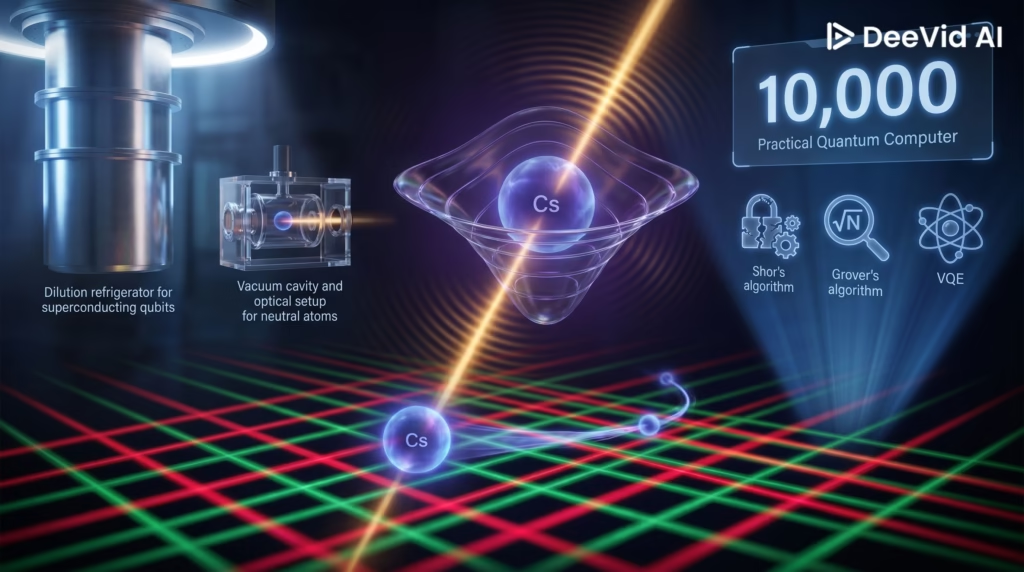
An optical tweezer is a highly focused laser beam that creates an attractive potential well in which a neutral atom can “levitate” – completely isolated from the environment, yet accessible for control. This technology enables dynamic atom shuttling over large distances within an array, which is key to new, ultra‑efficient error correction schemes.
Advantages of Neutral Atoms Compared to Ions ⚖️
When we compare neutral atoms with ions, several key differences stand out. Ions have a net charge and are held in electric traps (Paul or Penning); their coupling is achieved through shared vibrational modes (phonons). This makes scaling challenging, although coherence times and gate fidelities are very high (coherence minutes, fidelity above 99.9%). Gate speeds are slow (microseconds to milliseconds).
Neutral atoms, on the other hand, have no charge and are held in optical tweezers (laser traps). Their enormous advantage is dynamic shuttling – an atom can be physically transported to the other end of the array and directly entangled with any other atom. This enables entirely new error correction codes. Scalability is very promising: arrays of over 6,100 atoms have already been demonstrated. Coherence times are long (13 seconds in a 6,100‑atom array), and gate fidelity reaches 99.98% even in large systems. Gate speeds are still slow (microseconds), but constantly improving.
Key difference: With ions, two qubits are coupled via a shared vibrational mode – all ions in the trap feel each other. With neutral atoms, optical tweezers can physically move one atom to the other end of the array and directly entangle it with another atom. This dynamic connectivity enables a completely new class of error‑correcting codes.
Record‑Breaking Arrays: From 448 to 6,100 Qubits 📈🔢
Neutral atoms have set several records in the past year that have caught the attention of the entire industry.
448 qubits – The Harvard breakthrough
In November 2025, a team from Harvard (in collaboration with MIT and QuEra Computing) published a paper in Nature demonstrating a fault‑tolerant architecture with 448 neutral rubidium atoms. For the first time, they successfully integrated all key elements of error correction on a single neutral‑atom platform – physical entanglement, logical entanglement, logical magic gates, and entropy removal. The system performed below the error correction threshold. This was the first proof that neutral atoms can be the foundation for scalable, fault‑tolerant quantum computing.
6,100 qubits – The Caltech record
In September 2025, the team of Professor Manuel Endres at Caltech created the largest neutral‑atom array ever – 6,100 cesium atoms arranged in an optical lattice. Even more importantly, this size did not come at the cost of quality. The atoms maintained superposition for 13 seconds (almost 10 times longer than previous records), and individual manipulations achieved a fidelity of 99.98%. As one author put it: “Qubits are not useful without quality. Now we have both quantity and quality.”
5 Physical Qubits per Logical Qubit – A Revolution in Error Correction 🔄🔢
The biggest leap in this story came in March 2026. A team from Caltech and the startup Oratomic published a new error correction architecture that dramatically reduces the number of physical qubits needed per logical qubit.
Classical schemes (such as the surface code) require about 1,000 physical qubits to obtain one reliable logical qubit. The new architecture, which uses dynamic connectivity of neutral atoms, reduces that number to just 5 physical qubits per logical qubit.
How is this possible? In standard architectures (superconducting qubits, ions), each physical qubit can only interact with a fixed set of neighbors. That restricts the types of codes that can be implemented. With neutral atoms, optical tweezers can move one atom to the other end of the array and directly entangle it with any other atom. This dynamic connectivity allows multiple uses of the same physical qubit for several logical qubits, drastically reducing hardware overhead.
Final conclusion: With this architecture, a fault‑tolerant quantum computer could be built with just 10,000 to 20,000 physical qubits – instead of the previously estimated millions. That means practical quantum computers could become a reality by the end of this decade.
Enormous Consequences: Quantum Supremacy Is Closer Than We Think ⚠️🔐
These discoveries are not merely academic. They carry huge practical implications:
- Cryptography under pressure: A quantum computer with 10,000–20,000 qubits could run Shor’s algorithm and break today’s RSA encryption. That means the transition to post‑quantum cryptography is more urgent than ever.
- Quantum chemistry and pharmaceuticals: Molecular simulations (VQE, QPE) become practical on much smaller machines, accelerating the development of new drugs and materials.
- Quantum machine learning: Hybrid quantum‑classical algorithms gain an accessible hardware platform.
- Economic aspect: Instead of billions of dollars for millions of qubits, we are now talking about tens of thousands of qubits – which is within reach of today’s or near‑future technologies.
Industry Wakes Up: Google Invests in Neutral Atoms 🏢🌐
In early April 2026, Google Quantum AI officially announced that it is expanding its efforts to neutral atom systems. The company, which for decades focused on superconducting qubits, now sees neutral atoms as a complementary path to scalable quantum computers. The program is led by Adam Kaufman (JILA, CU Boulder), who will head a team in Boulder, Colorado – a region with deep expertise in atomic, molecular and optical physics.
Hartmut Neven, founder of Google Quantum AI, stated: “Investing in both approaches increases our ability to fulfill our mission, and faster. By advancing both, we cross‑pollinate research and engineering breakthroughs.”
Connection to the Series: Neutral Atoms as a New Point on the Map
This new chepter connects perfectly to our series:
- Error correction (Part 1): Neutral atoms enable ultra‑efficient codes – just 5 physical qubits per logical qubit, far better than both BB codes and the surface code.
- Physical implementation (Parts 2–4): Neutral atoms are cheaper and easier to scale than superconducting qubits and ions, although they still require vacuum and laser cooling.
- Logic gates (Part 5): Gates are performed with laser pulses, similar to ions, but with dynamic connectivity enabling new types of operations.
- Quantum consciousness (Part 6): If nature uses quantum effects in tryptophan and microtubules, neutral atoms are an artificial imitation of that natural solution – a controlled, scalable version of what evolution already does.
- Quantum algorithms (Part 7): With 10,000–20,000 qubits, algorithms like Shor’s, Grover’s, VQE, and QPE become practical – not in a decade, but in just a few years.
Conclusion: A New Era of Quantum Computing
Neutral atoms are not just another technology on a long list – they are a paradigm shift. Their ability for dynamic connectivity enables error correction with unprecedented efficiency, reducing the required number of physical qubits from millions to tens of thousands.
Caltech has shown that we can build arrays of 6,100 qubits with excellent coherence. Harvard and QuEra have demonstrated a fault‑tolerant architecture on 448 qubits. Google is investing billions. And theory suggests that practical quantum computers could be operational by the end of this decade.
Nature already solved the problem of quantum computing in the hot, wet environment of our cells (tryptophan, microtubules). Now, neutral atoms offer a path to implement that solution in silicon, lasers, and vacuum – and make it scalable.
The quantum future is not just a promise – it is being built, atom by atom, tweezer by tweezer.
Question for you: Do you think neutral atoms will truly surpass superconducting and ion technologies, or will all three coexist in hybrid systems? And what do you think about the estimate that practical quantum computers could be operational by the end of this decade?
Leave a Reply