
Just as the sword of a Roman soldier extinguished the light of ancient Greek science, so too did the swords of the Crusaders interrupt the golden age of Arabic learning. But unlike the spoils of gold, the greatest trophy the Crusaders brought to Europe was invisible: a treasure of knowledge. Hellenistic philosophical, scientific, and technical texts, preserved and enhanced by Arab scholars, became the spark that would ignite the European Renaissance and the Scientific Revolution.
However, this flame had to survive a dark age. The fires of the Inquisition, which consumed those who dared to oppose scientific thought to church dogma – like Giordano Bruno – could have smothered every spark of free thought. But they failed.
During this time, Galileo Galilei turned his newly invented telescope (1609) towards the heavens. His observations of the light from planets and the moons of the Solar System were the first steps towards the birth of modern physics. Along with the microscope, the telescope became the first true tool of science, opening the doors to both the macro and the micro world. And both relied on the laws of reflection and refraction of light. It was logical that the first great theories to explain it would appear.
❌ The Wave Theory: First Attempts
In the 17th century, the dominant view was that light was a wave. By analogy with sound and water waves, it was believed that white light from the Sun was “pure,” and that passing through matter (glass, crystal) “sullied” it, giving it color. This was the accepted dogma.
⚫️ Newton: The Man Who Saw Colors in White
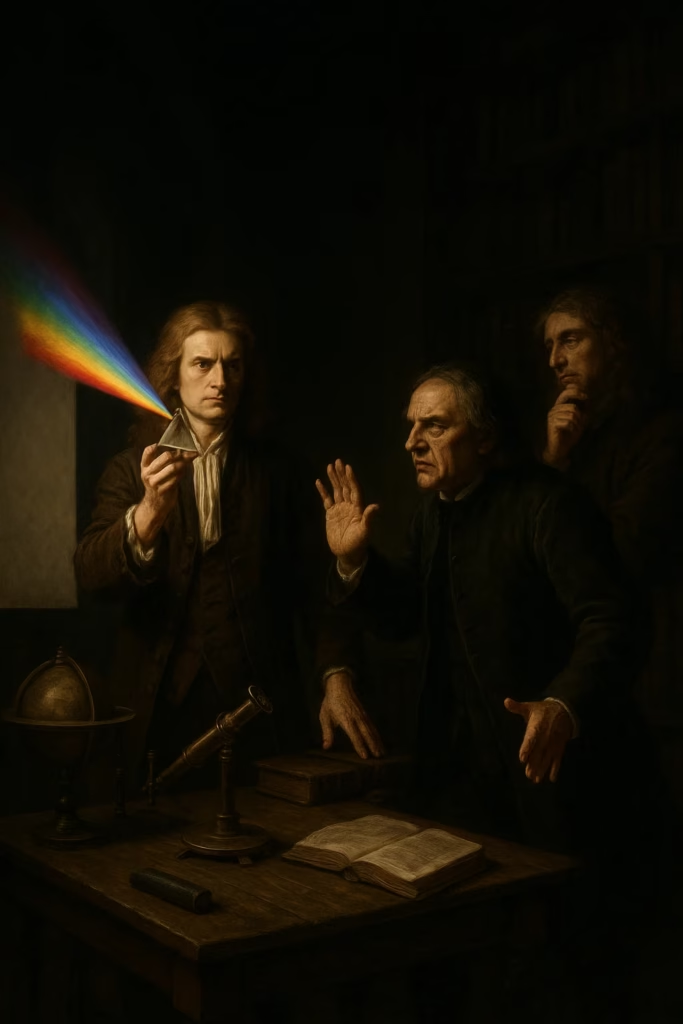
Isaac Newton, one of the first titans of science as we know it today, was not satisfied. He was not a theorist at a writing desk – he himself polished lenses and built telescopes. Experimenting with prisms, he created an artificial rainbow and proved something revolutionary: white light is not pure – it is a mixture of colors.
His brilliant experiment with two prisms was a blow to the old theory: the first one separated white light into a spectrum, and the second, carefully positioned, recombined that spectrum back into white light. How can “soiling” be reversed? He demonstrated this even more clearly with a rotating disk with segments in the colors of the rainbow – at high speed, the disk turned white.
Newton defined 7 primary colors (red, orange, yellow, green, blue, indigo, violet), partly due to his mystical belief in the magic of the number 7.
So why did he believe light was made of particles (corpuscles)?
- Reflection: Light reflects from a mirror at the same angle – it reminded him of the elastic rebound of small balls.
- Directionality: Light travels in straight lines, as rays. Water waves, on the contrary, spread out in all directions.
🌊 Hooke and Huygens: The Wave Response
Newton’s public stance met with fierce resistance from his colleague at the Royal Society, Robert Hooke, a fervent advocate of the wave theory. Their dispute was not just scientific – it was fraught with personal animosity and strong personalities.
A very different man, Christiaan Huygens, was quietly building his career on the other side of the English Channel. This modest Dutch genius worked on building telescopes and developed precise mathematical models to describe lenses, taking aberrations into account. With his telescope, he discovered Titan, Saturn’s largest moon.
Huygens deeply respected Newton, even though he disagreed with him. He was aware of phenomena that Newton’s theory could not explain:
- Diffraction: Light bends when it passes the edge of an obstacle.
- Double Refraction: When passing through a calcite crystal, light splits into two rays.
Huygens offered an elegant solution: light is a wave. He formulated what is now known as Huygens’ Principle: every point on a wavefront is itself the source of new wavelets. However, he believed these were longitudinal waves (like sound), a mistaken assumption that would later slow the acceptance of his theory.
👑 Newton’s Victory and a Century of Darkness… for the Wave Theory
When both Hooke and Huygens were dead, Newton finally published his “Opticks” in 1704. Without his most capable critics, and with the aura of the greatest scientist of his age, Newton’s corpuscular theory became the new, unchallenged dogma. For the next 100 years, the scientific world believed light was made of particles.
But, just as white light can be split by a prism, the truth must break through. The experiments of a young genius in the early 19th century – Thomas Young – would demand a revision of this dogma. We will talk about that in the next post.


Leave a Reply to glpro review Cancel reply